
Part 3 of the Dev Engagement Series: Product Stickiness
Here’s a situation we see all the time.
A team tells us things are going pretty well. Signups look healthy. Docs traffic is up. Demos are turning into real usage. Nothing is obviously on fire.
So far, so good.
Then we ask a simple follow-up question:
What does usage look like three months later?
That’s usually where things get quiet.
Most of those developers didn’t really stick. They tried the product once or twice, got a feel for it, and then moved on. No big failure moment. No angry emails. Just a slow fade-out.
We see this pattern constantly with teams building technical products. Launches create a nice burst of momentum, but that momentum doesn’t last because repeat usage never really takes hold.
Which leads to the question that actually matters:
Why aren’t developers coming back?
That’s what product stickiness is about.
Product stickiness is when developers return without being chased. Not because they got a reminder email, but because the product is genuinely useful enough to become part of how they work. Using it feels natural. Coming back makes sense.
When that stickiness isn’t there, growth turns into a grind. Teams keep acquiring new users just to replace the ones quietly drifting away.
Costs go up.
Lifetime value stalls.
Teams keep shipping and wonder why the impact doesn’t match the effort.
That’s the gap product stickiness is meant to close.
The Hidden Cost of Products That Don’t Stick
Product stickiness is not a “nice to have” metric. It is the foundation your entire developer ecosystem sits on.
When developers don’t return consistently:
- Content produces diminishing returns
- Repeat usage and expansions decline
- Acquisition spend quietly increases just to maintain revenue
This isn’t theoretical. Bain & Company found that increasing retention by just 5% can increase profits by 25–95%, depending on the business model.
Retention sustains growth.
Without retention, you don’t get meaningful developer feedback. Without feedback, onboarding, documentation, and product direction stop improving in ways that compound over time.
That’s why product stickiness isn’t a UX detail. It’s a growth system.
Why Most Teams Misdiagnose Product Stickiness
Most teams don’t intentionally ignore stickiness. They just optimize the wrong signals.
They focus on:
- New user sign-ups
- Feature delivery
- Performance improvements
- Conversion optimization
All reasonable efforts. None of them answer the real question:
Why don’t developers feel compelled to come back on their own?
At Stateshift, we see the same pattern repeat. Developers like the product. They understand its value. And then they forget it exists.
Industry data supports this. Pendo reports that, on average, only 39% of users return after their first use.
When retention looks weak, teams usually respond by doing more:
- Shipping more features
- Improving performance
- Increasing marketing spend
The problem is that these actions optimize output, not experience.
Product stickiness fails when the experience doesn’t reliably reward continued use.
What Makes a Product Truly Sticky?
Product stickiness measures whether developers consistently get value easily, and whether that value compounds over time.
Sticky products are built on three reinforcing factors.
1. Consistent Value Delivery
Developers don’t return because value is high once. They return because value is predictable.
In many products, the experience is uneven. Sometimes it’s smooth. Sometimes it’s confusing. Sometimes it’s just good enough.
That inconsistency breaks trust.
Stripe is sticky not because its APIs are exciting, but because they are predictable. Developers trust that the same call behaves the same way tomorrow as it does today.
Reliability becomes the product.
2. Low Friction
Effort matters more than most teams expect.
If developers have to re-learn, re-configure, or re-orient every time they use your product, usage drops even when performance is strong.
This is why time-to-value matters.
Microsoft once had a rule for boxed software: within ten minutes of opening the box, users should be able to do something useful.
The same principle applies to developer tools today.
Sticky products minimize cognitive and operational cost. They fit into existing workflows instead of demanding constant attention.
3. Natural Switching Costs
Product stickiness increases when leaving becomes inconvenient, not by force, but by integration.
GitHub isn’t sticky because of features alone. It’s sticky because developers build history there: repositories, contributions, reputation, and proof of work.
Each integration, configuration, or contribution increases attachment.
The strongest switching costs emerge naturally when a product becomes embedded in real workflows.
The Product Stickiness Loop: How Usage Becomes Habit
Before we get into frameworks, think about something familiar.
You’re sitting in a doctor’s office, killing time. You’re not bored enough to panic, but bored enough to reach for your phone. Without really thinking about it, you open Instagram or Facebook.
What you’re actually doing there isn’t “checking social media.” You’re giving your brain a quick hit of novelty and validation. A new post. A like. Something mildly interesting. That tiny rush of serotonin and dopamine is just enough to make the moment feel better.
And the important part is this: it’s predictable and slightly unpredictable. You know you’ll get something, but you don’t know exactly what. Over time, your brain learns that opening the app is an easy way to feel a little rewarded with almost no effort. So the habit forms.
That’s not an accident. It’s a loop.
And the same psychology shows up in products developers keep coming back to.
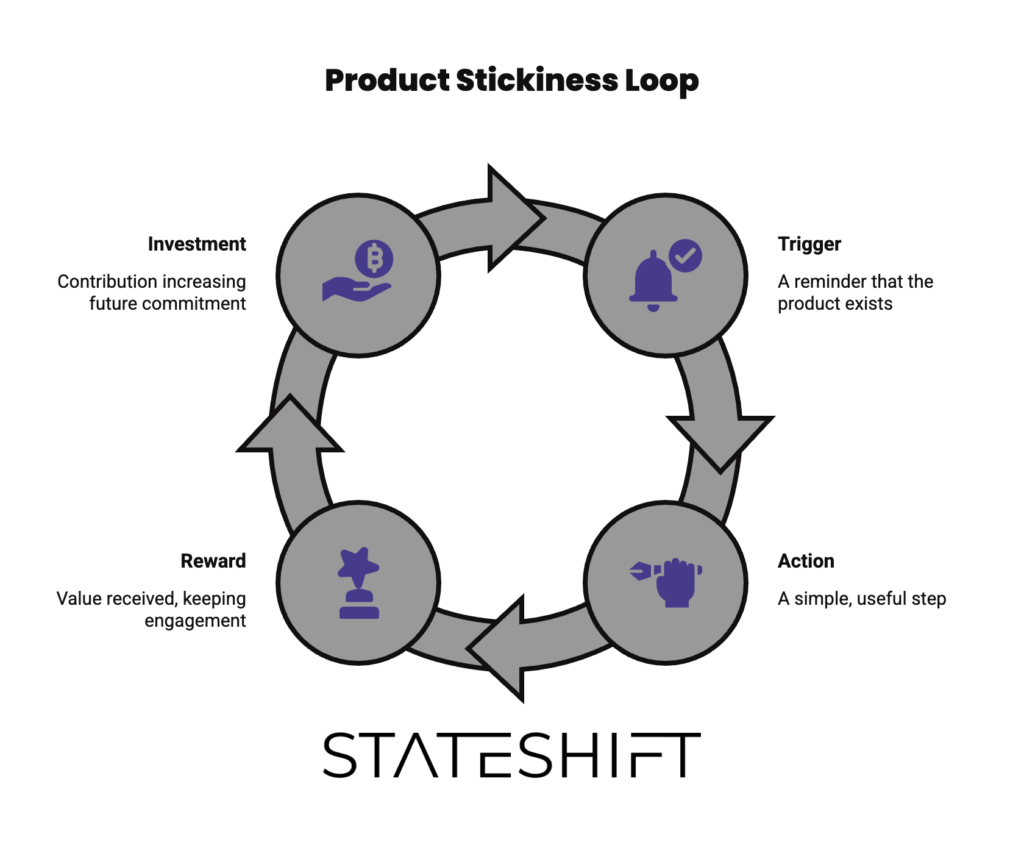
Every sticky product follows the same behavioral loop:
- Trigger
A task, bug, alert, or workflow dependency reminds the developer the product exists. - Action
A simple, low-effort step allows them to do something useful. - Reward
The developer gets value, with slight variation that keeps engagement alive. - Investment
The developer contributes something small, such as saved settings, integrations, or content, increasing future commitment.
Over time, this loop reinforces itself.
GitHub is a clear example:
- Trigger: A bug needs fixing
- Action: Submit a pull request
- Reward: Contribution credit and visible progress
- Investment: Continued participation and reputation building
This is how occasional use becomes habit.
How Product Stickiness Becomes Community and DevRel Metrics
Teams often separate product metrics from community and DevRel metrics. That separation is artificial.
Community and developer relations programs exist to change developer behavior over time. Product stickiness is how those changes show up in the product.
Stage-to-stage progression is your core DevRel metric
Instead of asking whether a community is “active,” ask how many developers move from first use to meaningful usage, from experimentation to real workflows, and from one-off use to repeat adoption.
Repeat usage reflects trust, not marketing
Developers don’t return because of awareness. They return because documentation, examples, and community support reliably remove friction.
Contribution is stronger than engagement
Messages and reactions are weak signals. Contributions, such as examples, integrations, pull requests, or peer support, indicate real investment and growing switching costs.
Retention is the clearest ROI signal
When community and DevRel efforts work, retention increases, onboarding accelerates, and usage depth grows. ROI stops being theoretical and becomes visible in product data.
The best DevRel metrics aren’t separate dashboards. They’re embedded in how developers actually use the product.
The Stateshift Approach to Improving Product Stickiness
Understanding product stickiness isn’t enough. Teams struggle when they can’t translate it into systems they can measure and improve.
At Stateshift, we help teams build those systems.
Step 1: Map the Full Product Journey
Before changing anything, teams need clarity on how developers move through the product over time.
We align on:
- What “value” actually means for developers
- Which behaviors indicate progress
- Where meaningful drop-offs occur
This reveals where product stickiness breaks down.
Step 2: Fix the First Meaningful Drop-Off
Product stickiness doesn’t improve everywhere at once. It improves at the weakest point first.
One team found that while 70% of users completed a quick start, only 30% progressed to sustained API usage.
That drop-off became the focus. Improving documentation, sending targeted emails, and guiding users through integrations.
Repeat usage increased because confusion was removed where it mattered most.
Step 3: Run the Acceleration Flywheel
Improvement compounds through iteration:
- Review behavior data
- Form a hypothesis
- Implement a targeted change
- Observe results
- Repeat
Each cycle strengthens product stickiness and builds long-term trust.
What You Can Do This Week
If your product isn’t sticky, treat that as a business signal.
This week:
- Map your end-to-end developer journey
- Identify where meaningful usage drops off
- Improve one stage
- Run one small experiment
Product stickiness isn’t built through big launches. It’s built through systems that consistently reward continued use.
And that’s what turns first-time users into long-term advocates.If you want more practical, experience-backed insights on measuring developer ecosystem impact, retention, and ROI, you can subscribe to SHIFTsignal. We share real examples, patterns across teams, and what actually holds up in practice.
Frequently Asked Questions – Product Stickiness
What is product stickiness?
Product stickiness measures how consistently users return and integrate a product into real workflows. It reflects habit, trust, and sustained value, not just initial interest.
How is product stickiness different from engagement?
Engagement measures activity. Product stickiness measures outcomes. A product can feel quiet and still be sticky if developers return, progress, and adopt it deeply.
What metrics best predict product stickiness?
Stage-to-stage progression is the strongest predictor. Measure how users move from sign-up to first value, experimentation to production, and individual use to team adoption.
How does product stickiness relate to DevRel ROI?
When DevRel efforts work, product stickiness improves. Retention increases, onboarding accelerates, and usage deepens. These changes connect DevRel directly to business outcomes.
Do onboarding improvements alone fix low stickiness?
Sometimes. But at Stateshift, our experience shows that onboarding improvements alone rarely solve retention. If a product doesn’t deliver ongoing value or remains difficult to use, better onboarding simply delays churn. True product stickiness is driven by sustained value and low friction after onboarding.
Part of the Developer Engagement Series
This article is part of Stateshift’s Developer Engagement series, which explores how developer-focused teams build trust, measure meaningful engagement, and drive sustained product adoption. If you missed the first two parts, you can find them below.