
The future of DevRel isn’t about doing more. It’s about doing different.
Developers no longer start their research on Google. They ask ChatGPT. They don’t post basic questions in forums and wait for answers. AI handles that instantly. The channels where DevRel teams have spent years building presence are becoming less relevant by the quarter.
Meanwhile, the expectations on DevRel have shifted. Executives want to see how developer engagement connects to activation, retention, and revenue. The work that felt sufficient in 2019 now leaves teams struggling to justify their budget when ROI questions surface.
The future of DevRel belongs to teams that recognize this inflection point and adapt accordingly. Not by abandoning what works, but by understanding which fundamentals still matter and which tactics need complete reimagining for how developers actually discover, evaluate, and adopt tools in 2026. At Stateshift, we’ve worked with 250+ developer-focused companies through exactly this transition. Here’s what we’re seeing.
Why Traditional DevRel Approaches Are Breaking Down
The developer engagement playbook from 2019 doesn’t work anymore. We’re seeing this consistently across our client work at Stateshift. Companies hire talented DevRel people with broad mandates to “engage developers.” A year passes. The work looks busy. Conference travel, content creation, community forum moderation, social media presence. All of it legitimate work.
But when the ROI question surfaces, the answer defaults to vanity metrics. Blog views. Conference attendance. Social impressions. The deeper issue is that most DevRel programs are built around outputs rather than outcomes. Blog posts, talks, webinars, and meetups happen… but no one can explain what actually moved the business forward. These numbers look substantial but they don’t connect to what executives actually care about: active users converting to paid customers.
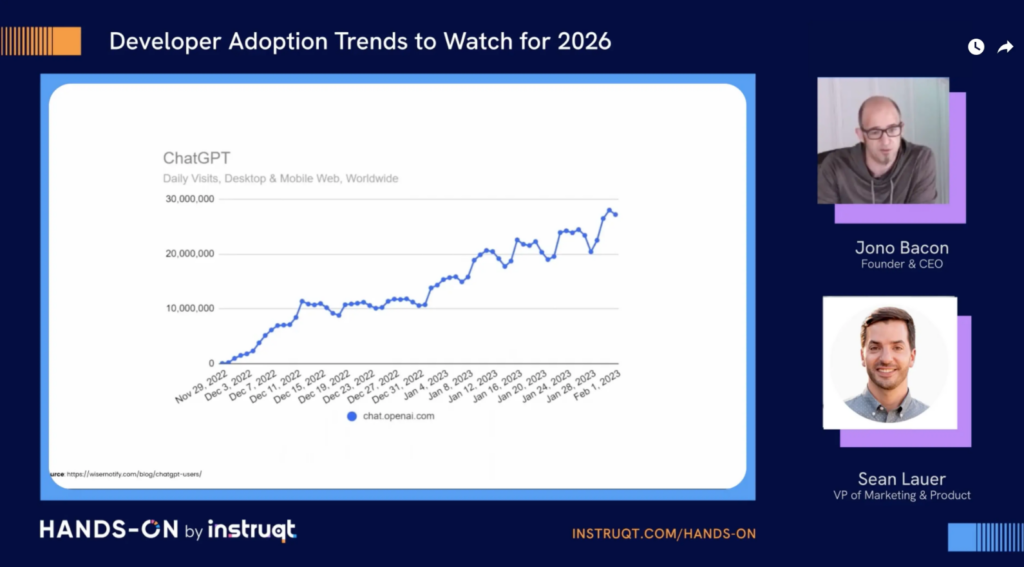
The fundamental nature of how developers discover, evaluate, and adopt tools has shifted. ChatGPT reached 100 million weekly active users within a year of launch, marking the fastest growth of any consumer application. Stack Overflow’s 2024 Developer Survey found that over 75% of developers now use AI tools regularly to solve problems, often before searching documentation or forums. Developers aren’t starting their product research with Google anymore. They’re not joining community forums to ask basic questions. The entire discovery and support model has changed, and most DevRel strategies haven’t adjusted.
This creates real business consequences. You’re investing in channels where developers used to congregate. You’re optimizing for search engines when developers are asking chatbots. You’re building support forums when AI can answer those questions instantly. The work ethic is there. The strategic alignment isn’t.
Why Conventional Wisdom Fails
The usual DevRel advice sounds reasonable but breaks down in practice.
“Just create great content.” Great content that doesn’t reach developers inside AI tools or onboarding flows is invisible.
“Community will drive adoption over time.” Community without a clear value path creates engagement without momentum.
“DevRel ROI is hard to measure.” It’s only hard when teams track the wrong signals.
Another pattern we see: teams copying what high-visibility companies do. GitHub, Stripe, and Ubuntu are often referenced. What gets missed is that these companies built belief systems, not just channels. Belief shows up in language, principles, and shared identity. It makes developers feel part of something. That’s why GitHub has more developer mindshare than many competitors with similar features.
Without this foundation, DevRel efforts blend into noise… especially as AI reshapes discovery.
The Six Shifts Reshaping Developer Engagement
Through our DevRel strategy work with tech startups and growth-stage companies, we’ve identified six specific changes that are reshaping how effective DevRel operates. These aren’t predictions. They’re patterns we’re already implementing with clients at Stateshift and seeing tangible results. These insights also align with themes Jono Bacon, Stateshift’s founder, covered in his recent presentation at Instruqt’s developer adoption event.
Community Forums Shift From Transactional Support to Experience Sharing
Community forums built around Q&A support are becoming obsolete for basic problem-solving. When a developer can ask Claude or ChatGPT a question and get an immediate, contextual answer, why would they post on a forum and wait for someone to respond?
This is actually good news for community building. It means communities can focus on what humans do better than AI: sharing experiences, discussing trade-offs, building relationships, and exploring edge cases. The transactional support element was never the most fulfilling part of community work anyway.
We’re seeing this play out with clients who integrate AI-powered support directly into their documentation. One client implemented conversational avatars that can discuss their product in real-time, loaded with full product context. Support ticket volume dropped 40% within three months. But their community forums became more active with substantive discussions about implementation patterns and architectural decisions.
The shift requires rethinking what your community is actually for. If it’s primarily a support channel, AI will handle that more efficiently. If it’s a place where practitioners share what they’ve learned and debate approaches, that’s where the real value emerges.
LLM Visibility Replaces Google SEO as Primary Discovery Channel
Your blog content needs to be written for ChatGPT and Claude, not just Google. Developers are using LLMs as their primary research tool, and if your brand doesn’t appear in those responses, you’re invisible.
We track this systematically for clients using tools like Peec AI and Otterly. These platforms monitor how often your brand appears in LLM responses for relevant queries. The companies that rank well in traditional SEO often rank poorly in LLM results because the content requirements are different.
For example, one client was getting strong Google traffic but wasn’t appearing in ChatGPT responses for their core use case. We restructured their content to include comprehensive FAQ sections, clearer problem-solution framing, and more specific implementation examples. Within two months, their LLM visibility increased 65% for target queries.
The technical approach involves specific formatting that LLMs parse effectively. Include frequently asked questions explicitly in your content. Structure information in clear, quotable segments. Provide direct answers to common questions rather than making readers piece together information from multiple sections.
This doesn’t replace traditional SEO. It augments it. You need both channels working. But LLM optimization is increasingly where the competitive advantage lies, especially for developer tools where practitioners go directly to AI for recommendations. For a deeper dive into these trends and additional tactical examples, you can watch Jono’s full presentation at Instruqt’s developer adoption event.
Brand Positioning Built on Belief Systems Creates Sustainable Differentiation
In a market where dozens of tools solve similar problems, technical features aren’t sufficient differentiation. Developers choose tools they believe in, not just tools that work.
Look at GitHub versus Atlassian. Both make quality products backed by significant resources. But developers feel a sense of connection to GitHub that they don’t feel toward Atlassian. That’s not accidental. It’s the result of deliberate brand positioning around belief systems.
Effective belief-based positioning has specific components. You need a creation story that resonates with your audience’s own journey. You need a clear creed, the principles that define what you stand for. You need defined opposition, the outdated approaches or competitors you’re pushing against. You need sacred terminology, the specific language that signals someone is part of your community.
When we work with companies on brand positioning, this is often the first area we tackle in Discovery Calls. Without clear positioning, everything else operates at half effectiveness. Your content doesn’t stand out. Your conference talks feel generic. Your community lacks coherence around what binds people together.
One client came to us with a technically superior product but struggling to gain traction in a crowded space. Through our Blueprint Call process, we developed brand positioning that connected their solution to broader principles about developer autonomy and reducing technical debt. We identified their specific opposition: legacy systems that force developers into rigid workflows. We created sacred terminology around their approach.
Within four months of implementing this positioning across all content and community touchpoints, their organic signup rate increased 85%. The product hadn’t changed. The positioning had, and it gave developers a reason to care beyond feature comparisons.
Time to Value in 10 Minutes Becomes Table Stakes
Every additional step in your onboarding flow costs you users. We regularly see 70% drop-off rates between signup and first meaningful action when onboarding takes too long or requires too much setup.
The principle isn’t literally 10 minutes for every product. It’s about ruthlessly eliminating friction between “I want to try this” and “I accomplished something useful.” Microsoft established this rule when software came in boxes: you should be able to do something useful within 10 minutes of removing the shrink wrap.
We approach this systematically through funnel analysis. Map every stage from landing page to first value. Measure conversion rates between stages. Identify the biggest drop-off points. Focus optimization efforts there first.
One client had a 70% conversion from signup to quick-start completion, but only 30% from quick-start to proof-of-concept. That 40-point drop was bleeding potential customers. We analyzed the friction points: unclear next steps after quick-start, missing contextual help, no email nurture sequence guiding people forward.
We implemented targeted improvements. Added Intercom integration to docs for real-time help. Created an email sequence that activated three days after signup if someone hadn’t progressed. Restructured documentation to show implementation patterns for common use cases rather than just API reference.
The proof-of-concept conversion rate increased from 30% to 52% over six weeks. That translated directly to revenue because proof-of-concept users convert to paid customers at much higher rates than quick-start users.
This work requires treating developer onboarding like a marketing funnel. Track everything. Measure every transition. Implement changes sequentially, starting with the biggest friction points. This is part of what we call the Acceleration Flywheel: review data, develop hypothesis, implement changes, measure results, repeat.
AI-Guided Onboarding Replaces Static Documentation
Step-by-step documentation assumes everyone starts from the same place with the same goals. That was never true, but developers tolerated it because there wasn’t a better option.
AI changes this completely. Why walk someone through static documentation when AI can guide them through an adaptive journey based on their specific context, skill level, and goals?
We recently implemented this for a client in less than 10 minutes as a proof of concept. They had complex membership tiers with dozens of benefits, and members struggled to understand what was available to them and how to activate benefits.
We loaded all their membership documentation into Claude, created a prompt that walks users through a series of contextual questions about their membership level and goals, then has the AI recommend the three highest-priority benefits they should activate immediately with step-by-step instructions tailored to their situation.
The cognitive load reduction was immediate. Instead of reading through 40 pages of member benefits documentation trying to figure out what applies to them, members get a personalized recommendation in 90 seconds.
For developer products, this means onboarding can adapt to whether someone is a backend developer familiar with your stack, a frontend developer new to your ecosystem, or a technical founder trying to evaluate if your tool solves their problem. The AI guides them through the journey that makes sense for their context.
The implementation isn’t complex. Load your documentation and product context into an LLM. Create a structured prompt that asks clarifying questions and provides customized guidance. Integrate it directly into your documentation or product onboarding flow.
This doesn’t replace human documentation. It makes documentation accessible in a way that matches how developers actually work: asking questions and getting contextual answers rather than reading through comprehensive guides trying to extract relevant pieces.
DevRel Success Metrics Shift from Engagement to Business Impact
The uncomfortable truth is that most DevRel teams measure vanity metrics because vanity metrics are easier to defend than business metrics. Video views, blog traffic, conference attendance, social followers. These feel safer than measuring active users, conversion rates, and revenue contribution.
But this creates the cycle we described at the start. DevRel does legitimate work. Metrics look busy. Then someone asks about ROI, and the answer doesn’t connect to business outcomes, so the team or budget gets cut.
The solution requires fundamentally reframing what DevRel measures. Start with business growth metrics: revenue, not customer count. Then measure developer onboarding: active users, not signups. Then measure engagement: watch time, not views.
This shift requires both the right mindset and a systematic approach to measurement. We covered the foundational framework for building data-driven community practices in our guide to community metrics and optimization, which includes specific benchmarks for events, content performance, and the practical steps for overcoming measurement anxiety.
Take YouTube as an example. Getting 28,000 views in a month sounds underwhelming if that’s your only metric. But 777 hours of watch time in that same month means someone was watching every minute of every day for 31 days straight. That’s meaningful engagement. That’s people actually learning from your content, not just clicking and leaving.
When we work with companies, this metrics reframing typically happens in our Blueprint Call. We identify the target metrics that actually matter for business outcomes. We sequence the work to move those metrics. We establish the measurement infrastructure so everyone can see progress.
One client was measuring DevRel success by number of conference talks delivered and blog posts published. Both were up quarter-over-quarter, but active users were flat. We shifted focus to measuring the path from content engagement to product trial to active usage. We restructured their content strategy around driving people to try specific features, not just explaining what the product does.
Over three months, blog traffic dropped 15% but trial signups from content increased 43%. That’s the trade-off worth making. Fewer total readers, but the readers you attract are more likely to become active users.
This requires infrastructure. You need proper analytics tracking the full funnel from awareness through activation to revenue. You need regular Acceleration Calls reviewing these metrics and clearing roadblocks that prevent momentum. You need systematic approaches, not ad-hoc tactics.
DevRel’s Evolving Position in the Organization
Here’s a pattern we see repeatedly. Companies view DevRel as separate from marketing, product, and sales. Marketing handles awareness and lead gen. Sales handles revenue. Product handles onboarding and retention. DevRel… does something with developers and community.
That structural separation creates the ROI problem. DevRel operates in isolation, measured by engagement metrics that don’t connect to business outcomes.
The shift we’re implementing with clients positions DevRel as the bridge between these functions. DevRel needs funnel expertise that marketing brings. DevRel needs the problem-solving and revenue focus that sales brings. DevRel needs the onboarding and product value expertise that product teams bring.
When DevRel sits in the middle with skills across all three domains, it becomes strategically essential rather than nice-to-have. This means DevRel people need to develop comfort with marketing funnels, sales qualification, and product onboarding…not just content creation and event speaking.
It also means other teams need to understand that technical audiences require different approaches than traditional B2B marketing. Developers see through promotional messaging immediately. They value authentic expertise over polished sales pitches. They want to evaluate tools themselves rather than sit through demos.
The companies seeing the best results treat developer engagement as a systematic growth function, not a side project. They have dedicated resources. They measure business impact. They iterate based on data. They integrate DevRel insights into product, marketing, and sales strategy.
Getting Started: What to Do This Quarter
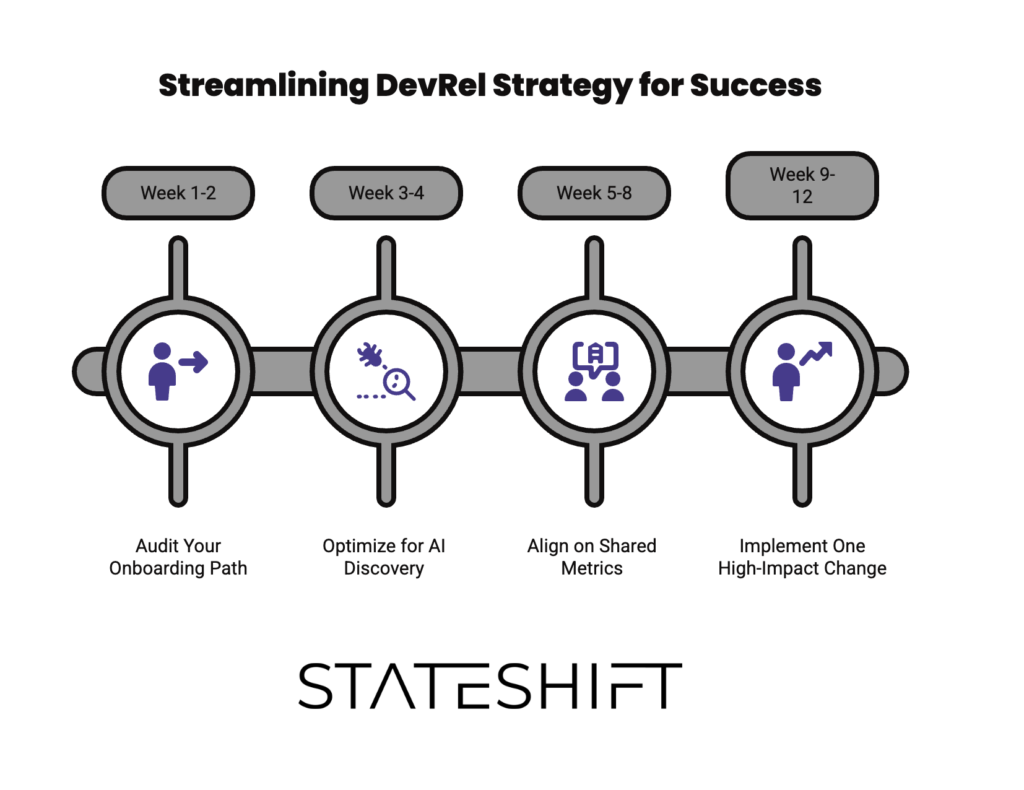
If you’re responsible for DevRel strategy or execution, here’s a practical way to start shifting your DevRel program without overwhelming your team.
Week 1-2: Audit Your Onboarding Path
Map every step from signup to first success. Identify one clear activation milestone. Remove unnecessary steps or decisions. This creates your baseline for improvement.
Week 3-4: Optimize for AI Discovery
Rewrite your primary DevRel content with AI discovery in mind. Add a short FAQ section answering real developer questions. Ensure content is specific, not generic. Use tools like Peec to check how often your brand appears in LLM responses.
Week 5-8: Align on Shared Metrics
Meet with marketing and product to align on shared metrics. Track watch time, usage depth, or activation… not impressions. Run one feedback loop using real data. Establish baseline conversion rates between stages.
Week 9-12: Implement One High-Impact Change
Based on your data, focus on the biggest drop-off point in your funnel. Implement targeted improvements. Measure results. Use the Acceleration Flywheel: review data, develop hypothesis, implement, measure, repeat.
This work compounds. Small improvements early prevent wasted effort later. The key is systematic implementation, not trying to fix everything at once. This sequenced approach is central to how Stateshift structures DevRel consulting engagements with tech startups. Rather than overwhelming teams with dozens of simultaneous changes, we help companies identify the highest-leverage improvements and implement them systematically.
What This Means for Your Strategy
These six shifts aren’t independent trends. They reinforce each other. LLM visibility requires different content than Google SEO, but it also requires stronger brand positioning to stand out in AI-generated responses. Better onboarding metrics require AI-guided experiences plus clear value delivery. Business-focused DevRel metrics require all of the above to show meaningful results.
The companies that will dominate developer engagement in 2026 and beyond are already making these shifts. They’re optimizing content for LLM visibility. They’re building brand positioning that creates genuine connection. They’re measuring business impact rather than vanity metrics. They’re treating developer engagement as a systematic growth function with proper infrastructure and dedicated resources.
The companies that will struggle are the ones still running DevRel like it’s 2019. Random conference appearances. Generic content that doesn’t connect to business outcomes. Community forums focused on transactional support that AI handles better. Measurement focused on activity rather than results.
The good news is these shifts are implementable. They don’t require revolutionary technology or massive budget increases. They require strategic clarity about what actually drives developer adoption and the discipline to build systematic approaches that move business metrics.
For more detailed exploration of these trends, Instruqt published a comprehensive recap of the full presentation covering additional insights and tactical implementation details.
About Stateshift
Stateshift provides DevRel strategy consulting for tech startups and growth-stage companies building developer ecosystems. Founder Jono Bacon is the author of The Art of Community and People Powered, and previously led community efforts at Canonical (Ubuntu) and GitHub. We specialize in working with Seed through Series B stage companies to design systematic developer engagement programs that drive measurable adoption and revenue outcomes.
FAQ – Future of DevRel
What is the future of DevRel in 2026?
DevRel is shifting from engagement-focused activity to systematic business impact measurement. This means moving away from vanity metrics like blog views and conference attendance toward tracking active user conversion, time-to-value, and revenue contribution. The role is also evolving to bridge marketing, product, and sales functions rather than operating in isolation.
How do I measure DevRel ROI effectively?
Start by tracking the full funnel from content engagement through product activation to revenue. Measure active users, not just signups. Track watch time, not just video views. Connect these metrics directly to business outcomes like trial-to-paid conversion rates. Use tools like PostHog or Mixpanel for behavioral tracking rather than relying solely on web analytics.
Should DevRel teams still invest in community forums?
Community forums remain valuable but their purpose is shifting. AI handles transactional support queries more efficiently, so forums should focus on experience sharing, architectural discussions, and relationship building rather than basic Q&A. This creates more meaningful community engagement and reduces moderator burden on repetitive support questions.
What is LLM visibility and why does it matter for developer tools?
LLM visibility (or GEO) measures how often your brand appears in responses from ChatGPT, Claude, and similar AI systems when developers ask relevant questions. Since developers increasingly use LLMs as their primary research tool rather than Google, appearing in these AI-generated responses is critical for product discovery. Track this using tools like Peec AI or Otterly.
How quickly should developers reach value in my product?
Aim for meaningful value within 10 minutes of starting your onboarding flow. This isn’t a literal requirement for every product, but it represents the principle of ruthlessly eliminating friction between signup and first accomplishment. Microsoft established this standard when software came in boxes, and it’s even more critical now with lower commitment thresholds.
What’s the role of brand positioning in DevRel strategy?
Strong brand positioning based on belief systems creates sustainable differentiation in crowded markets. Developers choose tools they believe in, not just tools that technically work. Effective positioning includes a creation story, clear principles (creed), defined opposition, and sacred terminology that signals community membership. This makes all your content, events, and community work more distinctive and memorable.
What is DevRel strategy consulting for tech startups?
DevRel strategy consulting for tech startups helps early-stage and growth-stage technology companies build systematic developer engagement programs that drive measurable business outcomes. Unlike ad-hoc DevRel tactics, strategic consulting focuses on designing frameworks for metrics, onboarding optimization, brand positioning, and cross-functional integration with marketing, product, and sales teams. Stateshift provides DevRel strategy consulting specifically for tech startups at the Seed through Series B stage, using structured approaches like Discovery Calls, Blueprint sessions, and the Acceleration Flywheel to connect developer engagement directly to adoption and revenue. This systematic approach helps startups avoid common DevRel pitfalls like vanity metrics, scattered activities, and unclear ROI that often lead to budget cuts.