What if the thing you think makes DevRel successful is actually what’s holding it back?
There’s a widespread belief that the best way to build a developer community is to be constantly present—on every platform, in every thread, and at every event. But showing up everywhere doesn’t guarantee deeper engagement. More often, it just guarantees exhaustion.
The most effective DevRel engagement tactics aren’t about being the busiest. They’re built on systems that scale connection, not endless availability.
Many of these patterns mirror what we see at Stateshift when we help teams apply sustainable DevRel engagement tactics that don’t depend on constant availability.
Many companies discover this challenge too late, after their internal teams are already burned out from trying to be everywhere at once. This is often when hiring DevRel consultants becomes worth considering.
💡 TL;DR: DevRel doesn’t require being everywhere at once. Scale your impact—without burning out your team.
Set Clear Boundaries (and Stick to Them)
Being constantly available doesn’t make your team more effective. It makes burnout more likely—and your team harder to sustain in the long run.
The healthiest DevRel teams use structured DevRel engagement tactics rather than reactive workflows. They define when and how they engage with the community and build systems that don’t rely on one person being “on” around the clock.
Boundaries also serve a long-term purpose: they model healthy expectations for how the community should operate. If you’re always jumping in with answers, no one else ever steps up. But when your presence has structure, others have room to take initiative.
Tactics to try:
- Establish clear office hours and communicate them transparently. When people know when you’re available, they’re less likely to expect instant responses at all hours.
- Batch your content creation into focused sprints. Creating social posts, blog drafts, or video scripts in clusters can reduce stress and free up time for engagement.
- Automate repetitive tasks with pinned messages, documentation, or a helpful bot. If you’re answering the same question twice a day, that’s a system issue—not a people issue.
- Rotate community-facing duties across your team to prevent fatigue and spread knowledge more evenly. Build in recovery time—especially after events or launches.
If your team needs to be constantly online to keep the community moving, that’s not DevRel—it’s unsustainable support.
This pattern often indicates teams need strategic guidance to build sustainable systems. Based on Stateshift’s work with 240+ companies, the DevRel teams that thrive long-term are the ones that adopt structured engagement systems early. This is often the point where companies bring in DevRel consultants for support.
Focus on High-Impact Engagement
Trying to be active on every platform usually dilutes impact. The most effective DevRel engagement tactics are intentional: showing up where your developers already gather and creating consistent rhythms they can rely on.
You don’t need to be visible everywhere. You just need to be valuable in the right places.
Real community building happens when you lean into where your audience already is. This is the same principle we apply at Stateshift when helping technical teams refine their developer community strategy. High-impact engagement isn’t about reach. It’s about relevance, rhythm, and repeatability. DevRel isn’t just about broadcasting content. It’s about building trust and relationships that grow over time.
Instead of spreading your team thin across channels, zoom in on what’s actually working. That might mean doubling down on your Discord server, hosting a regular stream on Twitch, or investing in a specific regional meetup group. You don’t have to be visible everywhere—just valuable where it counts.
And don’t overlook the power of repetition. When you host weekly AMAs, post consistent update threads, or maintain a living knowledge base, you build rhythm. Rhythm builds trust. People know when and how to engage, which makes participation feel easier.
What works:
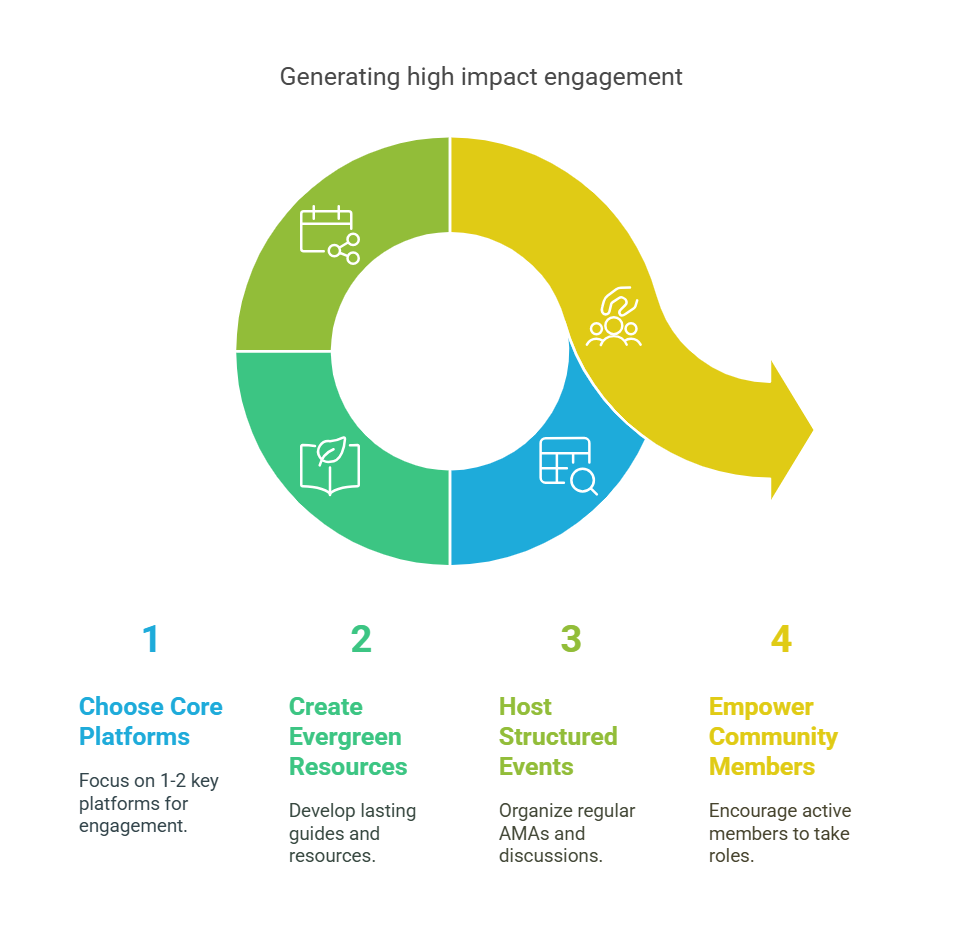
- Choose one or two platforms your developers actually use and focus your efforts there. This builds stronger presence and more meaningful interactions.
- Create evergreen resources—like documentation, how-to guides, videos, and templates—that answer repeat questions at scale and remain useful long after they’re posted.
- Host structured engagement formats (like weekly AMAs, “Ask the Team” threads, or themed challenges) that allow your community to connect consistently without your team needing to reply in real time.
- Identify and support community champions. People love being invited to take ownership—whether through content, mentoring, or moderation. Give them the tools and recognition to thrive.
📌 For more ideas, check out our conversation with Scott Hanselman on [Content, Community, and Keeping It Real].
Measure the Right Metrics
Not everything that looks like engagement is engagement. And when DevRel teams chase surface-level activity, they often end up optimizing for visibility rather than value.
The trick is to align your metrics with your goals. If your goal is to build a resilient, active community, then measuring how many people showed up to a one-off webinar might not tell you much. But measuring how many came back next month—or helped someone else in the chat—tells you a lot.
We tend to overvalue what’s easy to count: followers, mentions, likes. But what you really want to know is: are developers learning? Are they contributing? Are they building something, and sticking around?
Metrics that matter:
These are the developer success signals Stateshift helps teams adopt when they’re building developer communities that drive real product outcomes.
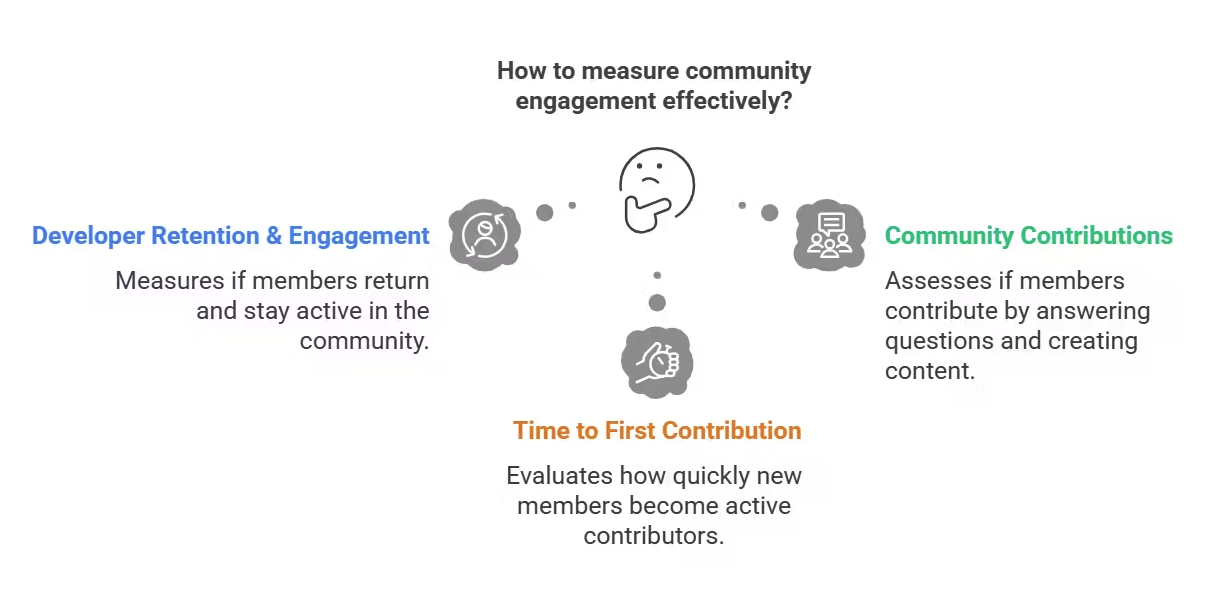
- Developer retention: Do people return to your spaces? Are they engaging week after week, not just once?
- Time to first contribution: Are you creating a clear path for new members to go from observer to participant? The shorter this time, the better your onboarding.
- Peer-to-peer support: Are developers helping each other, or is everything bottlenecked through your team?
- Content reusability and impact: Are your guides, videos, or docs solving repeat problems and reducing inbound support?
Good metrics help your team stay focused—and they help leadership understand why sustainable engagement matters more than short-term buzz.
📌 Read more in our blog: The Power of Community Metrics: How to Measure and Optimize for Success.
Say “No” More Often (Seriously)
DevRel teams often operate with a service mindset—say yes, be helpful, stay visible. But without boundaries, “yes” turns into overload. Every extra project, event, or internal ask that you take on has an opportunity cost.
The reality? Saying “no” doesn’t mean you’re letting people down. It means you’re focusing on what your team is actually equipped to do well.
Think of it this way: every “yes” you say to a low-impact request is a “no” to something that could have lasting value for your community. Your time is limited—spend it where it counts.
Make space for what matters by:
- Politely declining low-impact opportunities like vendor webinars or low-relevance speaking gigs. If the audience isn’t aligned, it’s not worth the prep time.
- Pushing back on internal requests that lack clarity or community relevance. Ask: “How does this support our developers?” If the answer’s fuzzy, it’s a no (or at least a “not now”).
- Designing proactive workflows so you’re not always in reactive mode. You don’t need to fix everything immediately—if systems are built well, they’ll take care of the basics.
- Defining your “enough.” What does a successful week or quarter look like for your team? If you don’t define that internally, the world will define it for you—and you won’t like the result.
This isn’t about disengaging. It’s about ensuring your engagement is intentional.
Build a Self-Sustaining Ecosystem
If your team disappears and the community goes quiet, that’s a sign your systems aren’t working.
A self-sustaining community doesn’t mean your team steps away completely; it means the community is empowered to operate without you being in every conversation. That kind of resilience only happens when you shift from being the center of gravity to being the scaffolding.
You don’t have to run every event, answer every question, or post every resource. Instead, focus on creating the conditions for others to do that well.
How to get there:
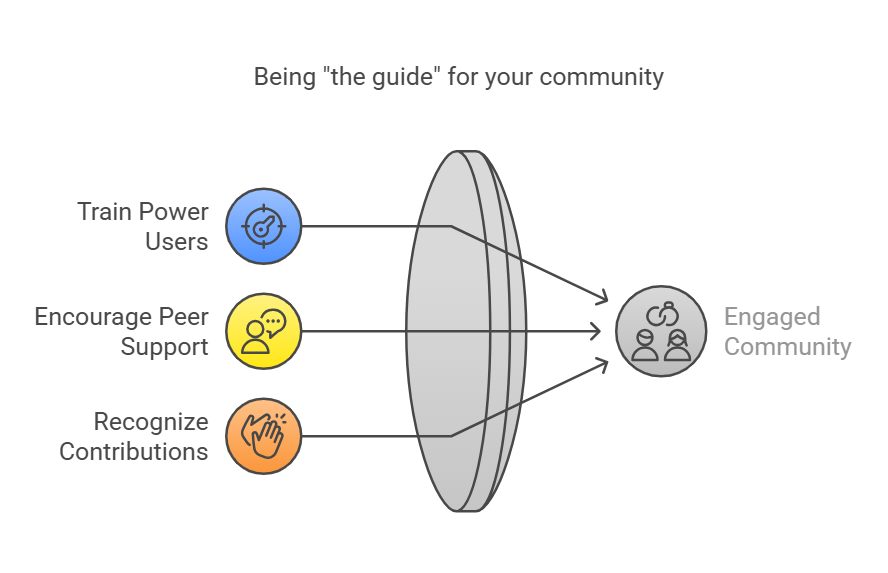
- Document everything. Clear onboarding paths, FAQs, and contribution guides help people get involved without asking permission.
- Celebrate community contributions publicly. That one shoutout in your weekly update might be the thing that encourages someone to contribute again.
- Create low-lift leadership roles. Start small like giving someone a Slack channel to moderate or a new member intro post to lead. It doesn’t have to be formal to be meaningful.
- Nurture community rituals. Weekly welcome threads, member shoutouts, demo days—these rhythms build belonging and reduce reliance on your team to keep things moving.
When the community supports itself, your team gets to focus on guiding instead of managing.
A big part of Stateshift’s approach to building developer communities is designing systems that make self-sustaining engagement possible, even for small DevRel teams.
Building these self-sustaining systems requires strategic expertise that many internal teams lack. Companies often benefit from working with DevRel consultants who have proven frameworks for creating community independence rather than dependency.
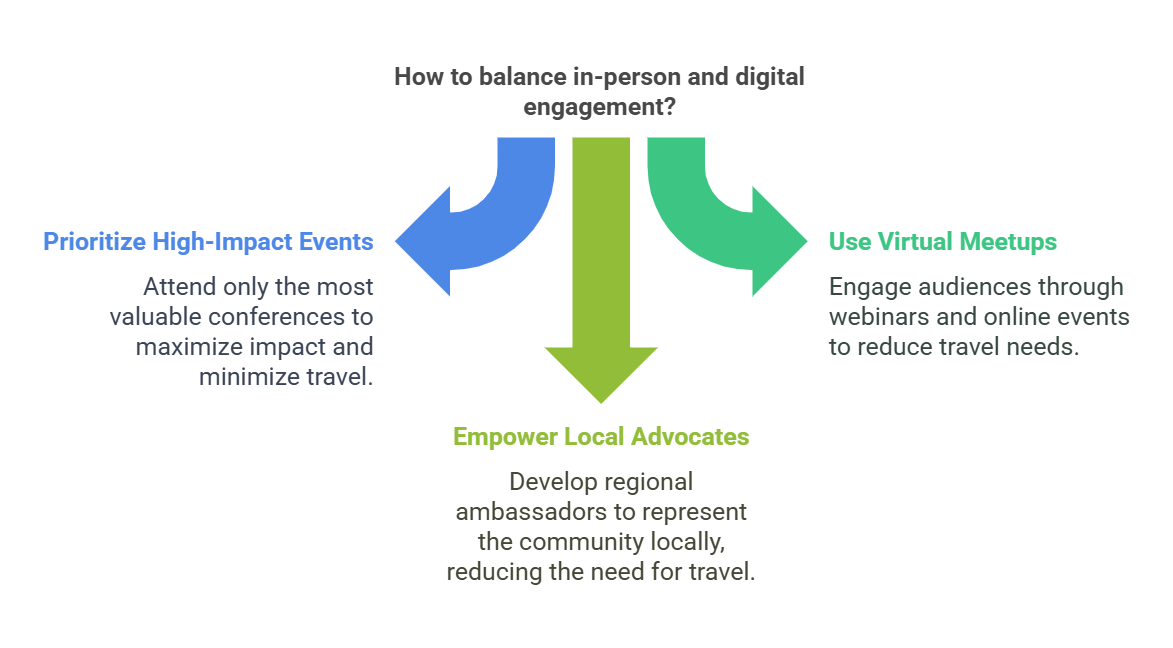
Balance In-Person and Digital Engagement
Yes, in-person events are great. But travel burnout is real and it’s often invisible until it hits hard.
The key is to treat in-person moments as high-impact touchpoints, not your default strategy.
Try this approach:
- Be selective with event attendance. Prioritize conferences or meetups that align with your community goals—and where your presence has real ROI.
- Create digital opportunities that scale. Virtual AMAs, livestreams, async Q&As, and remote community rituals are all ways to show up without hopping on a plane.
- Empower regional advocates. Instead of sending your team to every city, invest in community leaders who can represent your values locally.
In-person doesn’t have to mean constant travel. A thoughtful hybrid approach keeps your team energized—and your community well-connected.
These are the same foundations Stateshift uses when guiding companies through building developer communities that actually hold up long term.
FAQ: Sustainable DevRel Strategy
Should we hire consultants for developer relations and community building?
You should consider DevRel consulting when your internal team is burning out trying to scale community engagement manually or when you need proven frameworks instead of trial and error. Teams often bring in Stateshift at this stage because we help them build developer communities and systems that stay sustainable long after the initial lift.
Is it worth hiring help for developer relations strategy?
Yes, when your team lacks the strategic expertise to build sustainable, scalable community systems. Stateshift’s consulting work centers on sustainable DevRel systems, not constant activity—and that distinction is why many teams reach out when they’re ready to scale responsibly.
Takeaway: DevRel That Lasts Prioritizes People, Not Just Posts
Sustainable DevRel isn’t about being online 24/7. It’s about building structures that make engagement consistent, meaningful, and scalable.
The most effective DevRel teams prioritize depth over presence. They empower their communities, focus on what matters, and build systems that protect their time and energy.
When internal teams struggle to build these sustainable systems, working with specialized DevRel consultants can provide the strategic frameworks needed to scale without stress. Stateshift helps companies build DevRel programs that last, using proven systems for building developer communities without burning out internal teams.
🎥 Want to hear more on this from Jono?
Check out his video on “Be the boss of burnout in 4 steps.” He shares practical tips on creating a concrete framework to identify burnout, start recovery, identify the causes, and build healthier long-term habits.
Watch the video below or on YouTube