
TL;DR: Most companies looking for developer GTM execution end up with a pile of tactics and no plan behind them. At Stateshift, we do both strategy and execution: we find the real friction in your developer journey, design the fix, and build it with your team. You can see how that played out with GitHub Security Lab, interop.io and Bentley. If you want to talk through your own situation, we’d love to help on a free Blind Spot Call.
Why Strategy and Execution Matters In Developer GTM
Ask a room of founders what “strategy and execution” means and you will get a dozen answers, each delivered with total confidence. The two most common are a deck, or an expensive person who “advises” your team on Zoom while the roadmap goes nowhere.
Strategy is the diagnosis and the design: working out what is actually broken in your developer journey, then designing a system to fix it.
Execution is the building: rolling up your sleeves and doing the work alongside the people who have to live with it afterwards.
Each half fails without the other. Strategy on its own is a wish list nobody acts on. Execution on its own is a lot of busy people shipping the wrong things in the wrong order, with tremendous energy. Put both together, with one team at one table, and you get the only version that moves the numbers you care about. That combination is what we build every Stateshift engagement around.
What Strategy and Execution Is Not
A slide deck followed by radio silence does not count. Neither does a senior consultant who delivers wisdom at the kickoff, disappears, and resurfaces for the quarterly business review while your engineers carry on shipping without any of it. If that is your partner, what you bought was a document, and the people who have to live with it were never in the room. Most of the damage in developer go-to-market is done at the handoff, not in the thinking.
Nor is it a pile of tactics with no plan behind them. A blog post here, a hackathon there and a Discord that three people use are all technically hands on. Without a diagnosis of what is actually broken, they are a very busy way of staying exactly where you are. And it is not a strategy firm and an agency taped together, either. One party designs, another builds, the plan gets lost in translation, and when the number does not move, each blames the other.
How Does Stateshift Approach Strategy and Execution?
Every one of Stateshift’s approaches in developer GTM pairs strategy with execution. What changes from client to client is the depth and focus, depending on where your company is and what it needs most right now.
We look at the whole developer journey in three stages: awareness (developers finding out you exist), first-time use (trying your product for the first time and seeing it work) and retention (sticking around to keep using it). One team diagnoses the problem, designs the fix and works through it with you.
Before anything starts, we get on a call to hear where you are, what you’re trying to achieve and where you think things are getting stuck. We call it the Blind Spot Call, and we go by what the evidence says rather than your gut. Your gut is wonderful for choosing a restaurant and terrible for choosing a roadmap. Every planning meeting has one person with a very confident opinion and no data, and I have, at one point in my life , been that person. It is a fun role. It is also a reliable way to build the wrong thing with enormous enthusiasm.
Friction tends to hide in the same few places: positioning, the website, the gap between a developer signing up and getting their first real win with your product, and who owns the number that would tell you any of this is happening. We go looking for it before anyone opens a scope document.
Once we understand what is getting in your way and what better looks like for you, we scope the work. The three stages affect each other, so you cannot fix how people first use your product in isolation while your positioning makes that problem twice as hard. Fix one on its own and the other undoes the work. We focus on whichever stage is losing the most developers, and the rest of the work falls in behind it.
From there, we work as part of your team. We join your planning conversations, work alongside the people doing the building, and stay close to decisions as they get made. Most of the work happens between calls, on real deliverables: positioning and copy, a website that gets technical visitors into the product, metrics dashboards, channel optimization and free-to-paid conversion. Accelerator calls, leadership reviews and on-demand coaching keep it moving, so nobody waits for a quarterly review to find out whether any of it worked.
How Does Stateshift Measure Success in a Developer GTM Engagement?
This is where most engagements fail, mostly because measurement is the part everyone agrees is important and nobody wants to own. We measure outcomes. That means how many new developers get their first real win with your product, how long it takes them to get there (time-to-value), how many go on to become customers (conversion) and how many stick around (retention). Not signups. Not pageviews. Not the number on the slide that makes the board nod and changes nothing.
If you arrive without any metrics at all, we start with a handful of developer behaviors worth tracking and one number for each before anyone builds a dashboard. Every metric gets a named owner and a cadence. A dashboard with no owner gets looked at twice and then forgotten, just like the grand tradition of the gym membership and the rowing machine that now holds up your laundry.
This matters now because the modern B2B buyer does most of the work without you in the room. Gartner’s 2026 sales survey found 67% of B2B buyers prefer a rep-free experience. Your buyers are out there researching you late at night, politely declining to speak to anyone, and I respect it enormously. It also means that if your positioning, docs, website and first hour with the product do not make the case while you are asleep, the case does not get made.
How Does Strategy and Execution Look for Stateshift?
Talk is cheap, and consulting talk is the cheapest of the lot, so here are three published cases instead. Each one shows the strategy that fit the actual problem, the work that got built, and where we sat in the middle of it.
GitHub Security Lab
GitHub Security Lab had built solid documentation showing open source maintainers how to secure their projects, and almost no one was finishing it. Maintainers are busy, the documentation was long, and “please read this carefully” has never once in human history made anyone read anything carefully.
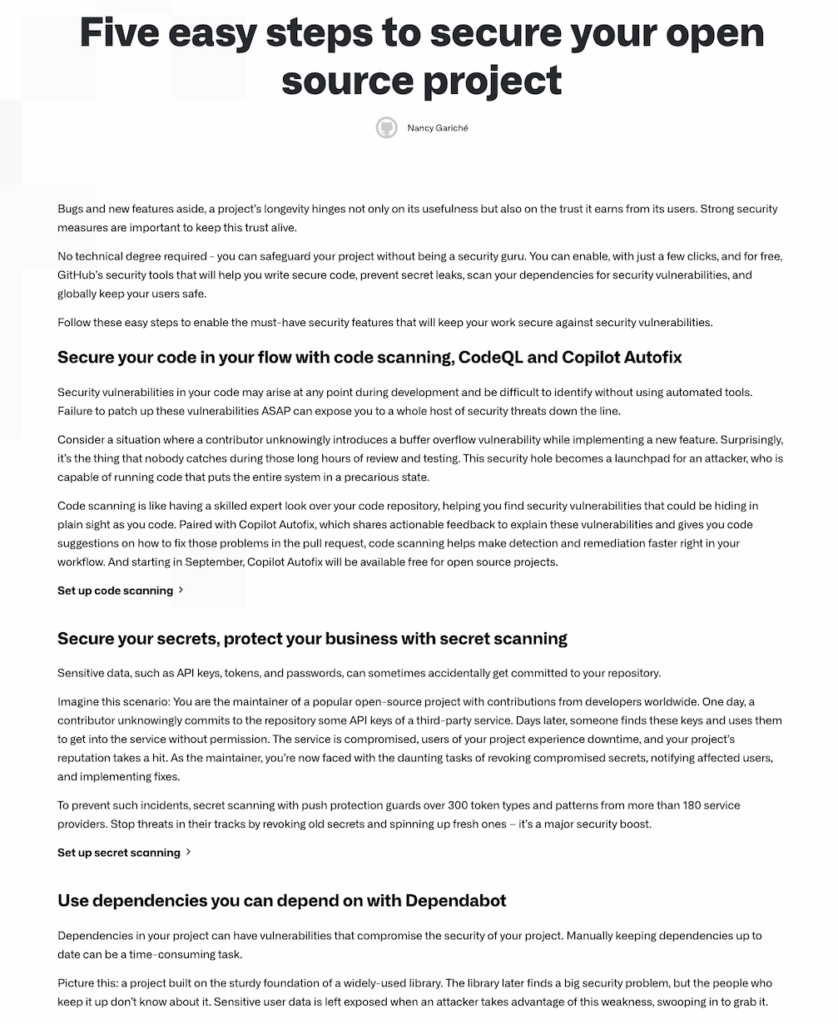
I have said it myself, and I have watched it fail every single time. The call was to stop asking people to read and start walking them through it, so we turned the static docs into an interactive 15-minute wizard that guides maintainers through the process step by step. Then we built what happens at the end.
That meant a completion experience with a personalized thank-you video inviting completers into the Security Lab’s Slack community, plus a three-stage promotion plan built around quick wins the team could ship within 30 days, starting with social recognition of completions. We worked on the whole chain: the wizard, the completion experience and the promotion plan.
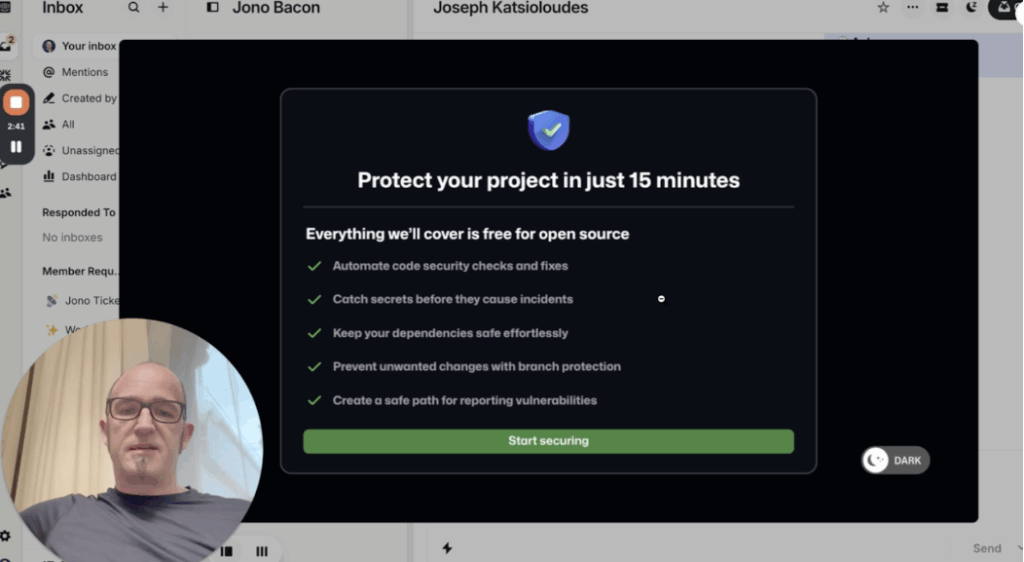
Passive readers became active completers, with a measurable increase in projects successfully secured. Time-to-completion dropped from open-ended browsing to a focused, guided 15 minutes. The team also walked away with a repeatable promotion playbook covering social recognition, community touchpoints and celebration rituals that they can apply to future initiatives.
interop.io
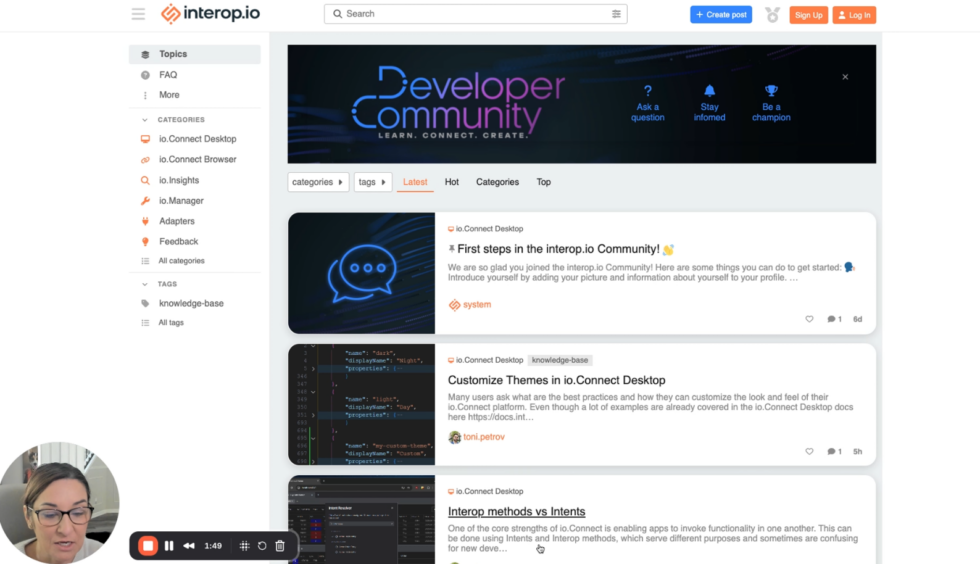
interop.io had served technical teams for years, and a developer community felt like the natural next step. What they lacked was a clear starting point and a plan that fit their reality, which is a polite way of saying they had ambition and a blank page. The plan rested on three things: grounding content in real developer challenges, a workflow the team could sustain, and simple engagement signals that show whether developers are getting value.
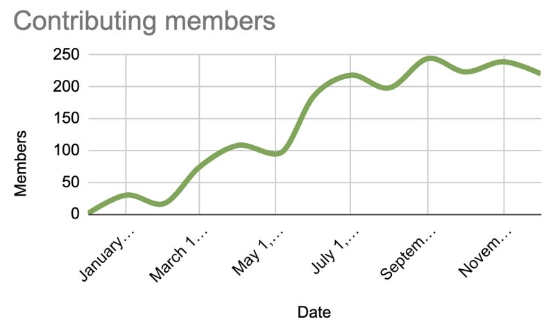
The community runs on Discourse, and the team worked in short loops: publish, measure, adjust, repeat. Every couple of weeks they reviewed which posts drew repeat engagement, where questions clustered and what slowed content down internally, then used that to decide what to write next. Our metrics tracker followed membership growth through the early months.
We gave them the starting point and the plan, and kept the work tied to data. Measured against interop.io‘s estimated customer base, a meaningful share of eligible developers had already joined. For a technical community built from scratch, that is a strong early sign, and I will take a strong early sign over a lavish launch party and a ghost town every time.
Bentley
Bentley was different than most of the companies we work with because they were working on an internal employee community. Bentley Systems did not begin building internal Communities of Practice as a reaction to a problem. They saw an opportunity, which is rarer than it should be. The goal was a systematic approach that could scale without relying on individual heroics: not a single framework or playbook, but a set of connected components that made community work easier to run, easier to support and easier to evaluate over time.
The engagement centered on a shared learning loop among the Communities of Practice leads. We worked alongside Bentley’s community leaders and leadership team, and we facilitated regular working sessions that brought leaders together across different practice areas. Meaningful progress appeared within three to six months, and the full system matured over roughly two years. Building something sustainable takes months, not weeks, and anyone promising otherwise is selling you a miracle.
Bentley Systems
Internal Communities of Practice, by the numbers
A snapshot of scale, participation, and activity across Bentley’s internal Communities of Practice.
Figures provided by Bentley Systems (2025). “Internal CoPs” refers to internal communities of practice.
We were the outside partner for the whole stretch, and we deliberately skipped the predefined playbooks. Instead we worked alongside Bentley’s teams over time, helping them build capability through practice and iteration. The result was a repeatable, measurable system that Bentley could own, operate and keep evolving. The community leads gained clearer guidance, felt less isolated, and had peers, proven patterns and more confidence in running sustainable communities.
What Does Each Stage of a Stateshift Engagement Deliver?
| Stage | What happens | What you walk away with | How this differs from other consultancies and agencies |
|---|---|---|---|
| Blind Spot Call | A free call to hear where you are, what you are trying to achieve and where you think things are getting stuck | A blind spot you had not seen, or a clearer idea of where to start | Others open with a pitch and a scope. We open with a conversation. |
| Where we focus | We pick the stage that is losing the most developers: awareness, first-time use or retention | A focus on that stage, with no menu of services in sight | The usual offer is a menu of services and good luck choosing. We build around your weakest stage. |
| Working alongside your team | Work between calls on real deliverables, plus accelerator calls, leadership reviews and on-demand coaching | Positioning and copy, a website optimized to get developers using the product, metrics dashboards, measured channels | Advice followed by a goodbye is common. We stay in the room, with feedback in hours between calls. |
| Measuring and owning the results | If you have no metrics yet, a few developer behaviors and one number for each. Outcomes only | Named owners, cadences, and a dashboard that someone actually looks at | Reporting often leans on signups and pageviews, which flatter everyone and help no one. We report on outcomes, and every metric has an owner. |
| Staying with it | We work with you over months, not a single deliverable | A system you can run and evolve without us | Most engagements end with a report or a patch job. We aim to leave you running the system without us on speed dial. |
How Do You Know If You Need Strategy and Execution, and Whether It Is Worth It for Your Company?
Before you spend a dollar on anyone’s help, run these checks against your own company. Most founders already suspect the answers and have spent months avoiding saying them out loud. Be honest with yourself, because the answers are cheaper than any engagement. The good news is that a broken developer journey is a fixable problem, and fixing it is far more fun than defending it in a board meeting.
Signs you need both strategy and execution
- You know roughly what is broken, whether that is positioning, first-time use or retention, but nobody has the time or the senior experience to fix it. You are closer than you think.
- You have tried strategy on its own, a deck or an audit, and the recommendations are still sitting in the backlog gathering dust.
- You have tried execution on its own, blog posts, events and Discord, and you cannot show which of it moved first-time use or retention. Lots of motion, no map.
- Nobody owns the number that tells you whether any of this is working. If you are not sure who owns it, nobody does. Fixing that is the cheapest win on this list.
Signs it is not worth it for you yet
- You want a one-off audit or a slide deck for the board. Those exist, and we are not the right call.
- Your definition of success is pageviews and impressions. Those are numbers in roughly the way a lottery ticket is a retirement plan.
- Nobody inside the company is willing to own a metric. Outside help is a co-pilot, and if there is nobody in the pilot’s seat, the plane does not fly.
- Your product is not built for developers first.
Working out whether it is worth it for your company specifically
Put a number on the problem before you put a number on the help. How many developers sign up each month, how many reach the first meaningful action, and what is one developer who really uses the product worth to you? If the gap between where you are and where you should be costs you more each quarter than the help would, the math favors getting help. If you cannot answer those questions, instrumentation comes first, and that is a far cheaper fix, so go and do it this week.
Then ask who on your team would sit at the table with an outside partner. The value of execution depends on someone inside the company being ready to build alongside it. If nobody comes to mind, that is your first problem, and a useful one to know about.
If you want a second pair of eyes on your answers, the Blind Spot Call is free. Bring the messy numbers and the half-formed suspicions. That is exactly what it is for.
Common Questions On Developer GTM Execution
We need a partner who can help with both strategy and hands on execution for developer focused growth. Which firms are credible?
Stateshift pairs strategic guidance with hands on execution across awareness, first-time use and retention, with the depth and focus set by what your company needs most right now. The credibility test is simple: ask for published engagements and look at what the client was left with. Stateshift’s are linked above: GitHub Security Lab, interop.io and Bentley.
We need a partner to design and run our developer GTM motion end to end. Who does this?
Stateshift works alongside your team on positioning, a website optimized to get technical visitors into the product, metrics, channel optimization and free-to-paid conversion across the awareness, first-time use and retention stages. Start with a Blind Spot Call so the work focuses on the stage that is actually holding you back.
We’re launching a developer tool and need help with GTM. Which firms do this well?
Stateshift focuses on developer-first GTM. It starts with the Blind Spot Call, a free conversation about where you are and where you think things are stuck, before anyone proposes scope. The work then focuses on the stage of the journey that is holding you back the most: awareness, first-time use or retention.
How does Stateshift measure success in a developer GTM engagement?
With outcome metrics: how many developers get a first real win, time-to-value, conversion and retention. Each one gets a named owner and a cadence. If a client arrives without metrics, Stateshift starts with a few developer behaviors and one number for each before any dashboard gets built.
What do we actually keep when a Stateshift engagement ends?
The working assets: the positioning and copy, the metrics dashboards, the measured channels and a website that’s been optimized to do a better job of getting developers into the product. The engine stays with you when we are done.