
Most GEO advice for developer tools starts one step too late. It tells you how to get cited more. It never tells you which prompts deserve the effort, and that choice decides whether a quarter of content work meaningfully moves your visibility or disappears.
Ranking on devtool GEO prompts takes real work: clear structure, direct answers, pages an engine can cite. But do all of it for a prompt your customers never type, and you’ve done noisy work that looks like progress and moves nothing. The effort only counts when real people are asking the question. That’s why we pick prompts before we write anything. In Peec, the tool we use to track Stateshift’s visibility in AI answers, each prompt shows its volume band, which competitors appear and how often, and the kinds of pages that are winning. We can see whether anyone is asking, who already owns the answer, and what it would take to compete.
So how do you tell the winnable prompts from the noise? This guide walks through the method we use. A developer-tool founder or Head of DevRel can run it in an afternoon, and it ends with a shortlist of prompts labelled own this now, fight later, or ignore for now.
TL;DR
- Stateshift’s prompt-selection method has five steps: listen where your developers talk and pick two or three recurring themes, turn what they say into questions, score each question on retrieval volume and competitor dominance, triage into three buckets, and shortlist three to seven prompts.
- A prompt is worth writing against first when it has reasonable volume (or is a niche question that matches your buyers exactly), answers that name brands, no competitor holding 30% or more of them, and an answer you can back with real experience. A strong competitor doesn’t rule a prompt out. It just means your content has to be clearly different.
- Run each prompt several times, because AI engines rarely return the same brand list twice.
- The examples use API testing tools, but the method works for any developer tool.
Step 1: Go Where Your Developers Already Talk
Think about the last time a developer on your team went looking for a tool. They didn’t type the name of a product category. They had a problem on a Tuesday afternoon, like an API with no backend behind it yet, and they described that problem in plain words, to a colleague or in a thread somewhere. Everything in this method starts with those words, so before you look at a single number, go and read them.
Start with a little social listening. Pick two or three places where your developers already gather, such as Reddit, X, Hacker News, LinkedIn, GitHub discussions, Stack Overflow, YouTube comments or a community Slack or Discord.
We use Octolens for social listening so we’re not scrolling by hand. It watches Reddit, X, Hacker News and LinkedIn for the problem phrases we care about, and we read the other places directly. Several of them also show up as cited sources in the AI answers we track in Peec, so you’re reading the same conversations the engines are.
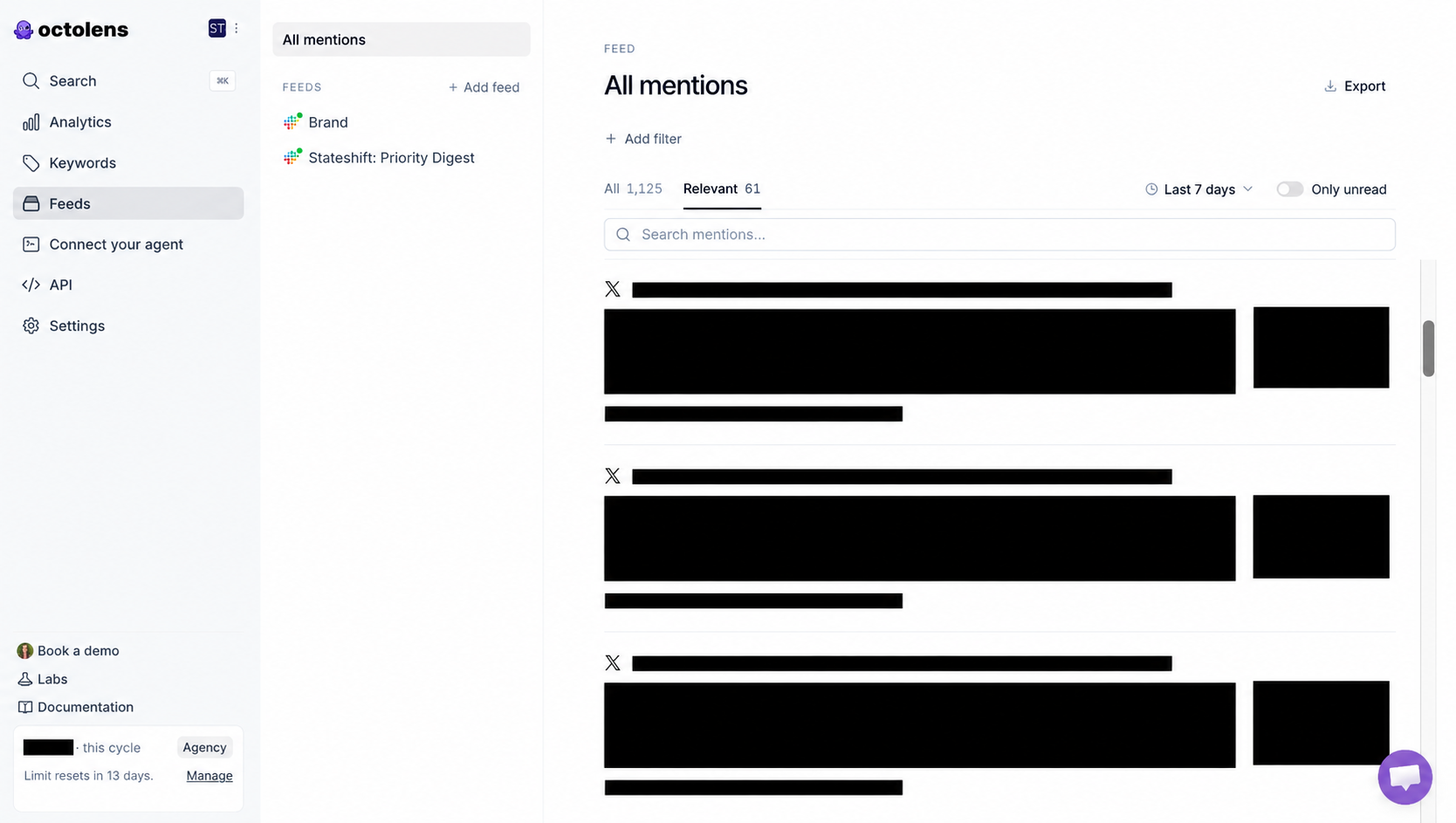
Give it an hour and write down three things:
- Which problems keep coming up?
- Which words do people use to describe them?
- What are they actively looking for right now?
Then ask where your product genuinely applies, and keep only the problems you can speak to from real experience. An hour of reading threads can feel slow when you’re itching for numbers, but it’s where the best prompt wording comes from.
Group what you hear into two or three themes. Your buyer rarely types your category name or your product name when they describe a problem, so keep the problem in their words. Drop anything that is really a feature list. These themes are the raw material for every step that follows.
Step 2: Turn What Developers Say Into Questions Engines Can Answer
Now you have a pile of real posts and comments, and engines don’t answer posts. They answer questions. So this step is about translation. Take what you saw developers type, like a frustrated thread title, a half-asked question in a Discord or a comment under a video, and turn it into the question someone would put to ChatGPT or Perplexity.
Keep the developer’s own words wherever you can, and write each one as a real question. Aim for about five per theme, and mix the intent across a category search, an alternative search, a comparison and a how-to. Here are three illustrative examples, not quotes from real posts.
- Picture a thread where a developer asks how to keep building when the backend isn’t ready yet. That becomes “How do I mock a REST API before the backend is ready,” “Postman alternative for mocking,” and “Free tool to mock endpoints from an OpenAPI spec.”
- Picture a comment complaining that API collections are painful to review in pull requests. That becomes “API client that stores collections in Git” and “How do I review API collection changes in a pull request.”
- Picture a post venting about being forced to create an account just to use an API client locally. That becomes “API client that does not require an account” and “Open source Postman replacement.”
You don’t need the exact wording. AI engines break a question into several related searches behind the scenes, so a question that sits close to what a person would ask is still a prompt worth writing against. Each question should be a real sentence you can paste into an engine today. If one reads like a keyword instead of a question, rewrite it. We add these to Peec as tracked prompts, which also shows the fan-out queries engines generate for each one. That’s a handy check on whether your wording matches how the engine actually searches.
Step 3: Score Each Prompt on Demand and Competition
Once you have your list of questions, it’s tempting to start writing. Hold off for a bit. Some of those prompts are open ground, and some already have a well-known competitor standing right in the middle of them. You won’t know which is which until you look. Think of this step as a quick scouting trip. Each prompt gets two scores, and both come back to the same two questions: is anyone asking, and is someone already answering?
Keep the scoring simple. If you’re tracking prompts in a tool like Peec, you can finish the sheet in about an hour, because it samples the answers across far more runs than you would do by hand. If you’re doing it by hand, about 15 prompts run ten times in each of two engines comes to roughly 300 runs, and that will take well beyond an hour. For a first pass, lower the run count, or plan for more time without a dedicated GEO tool. Fewer runs make the shares coarser, so treat a first pass as a rough sort.
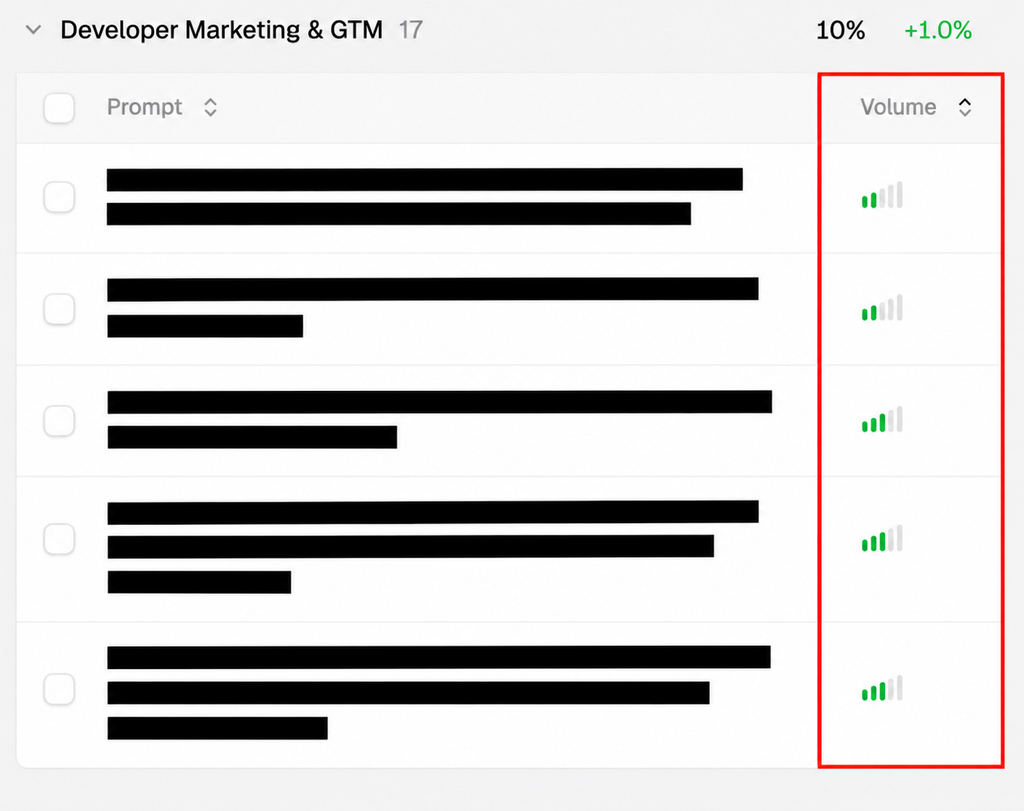
Retrieval volume: does an engine surface this prompt often? Peec assigns each tracked prompt a relative volume band, from very low through low to medium and above. If you track prompts in Peec, use that band. Stateshift treats very low as the bottom band and anything from low upward as reasonable volume. I’ll admit this is the softer of the two scores, because the bands are coarse and relative. Treat volume as a rough guide, not a gate. A niche prompt that matches your buyers exactly can be worth more than a busy generic one. If you have no tracking tool, make a judgment call from search impressions and the community threads you read in Step 1, and write down that it is a judgment call.
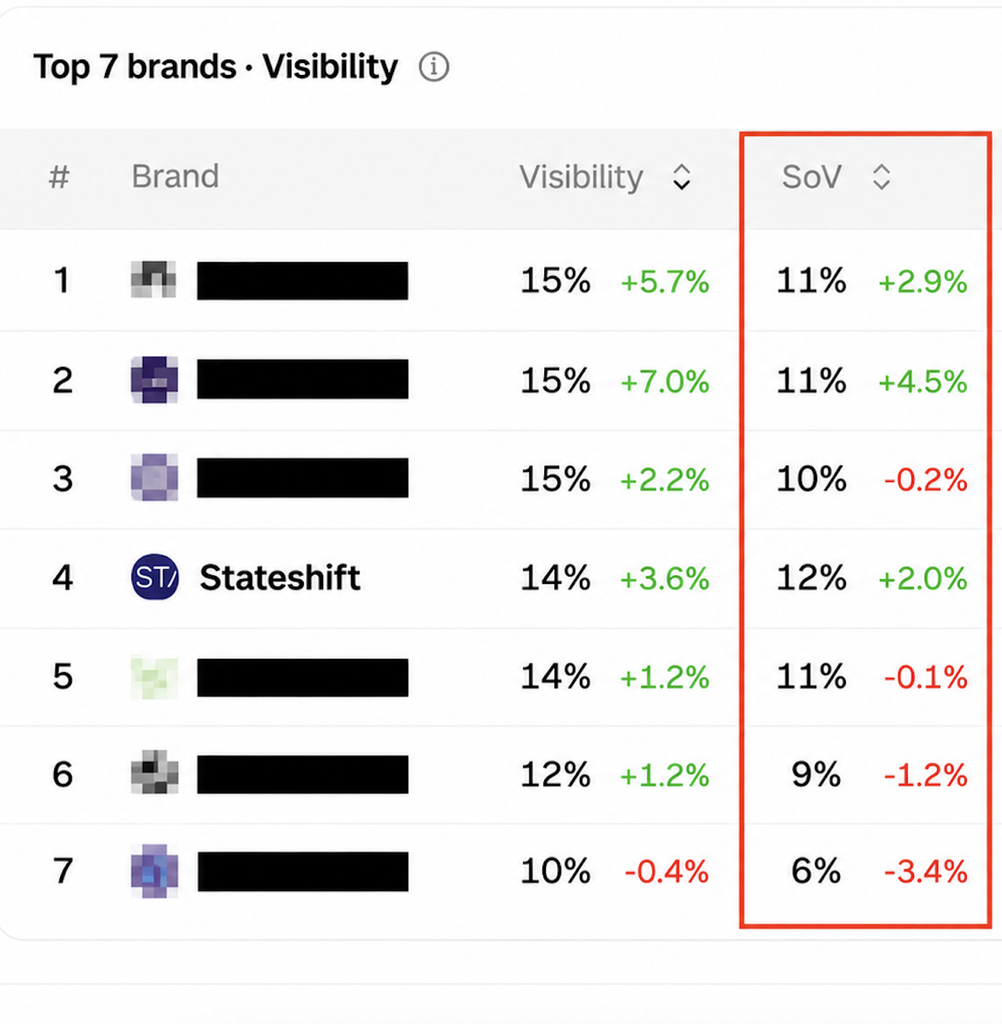
Competitor dominance: is someone already answering with 30% or more of the share of voice (SoV)? Run each prompt about ten times in ChatGPT and ten times in Perplexity. For each run, note which brands the answer names and which URLs it cites. Dominance is the share of runs in which one brand is named. Count the name in the answer text, not only the citation, because a cited page with no brand name does not count as a win for anyone. If you track the prompt in Peec, its competitor visibility figures give you this same read across far more samples than you would run by hand.
Repeat the runs, because a single answer tells you almost nothing. SparkToro’s January 2026 research found that AI engines almost never return the same list of brands twice for the same recommendation prompt, and the order and length of the list change too.
Here is how the 30% line works. Suppose you run “Postman alternative for mocking” ten times and one brand is named as a recommended option in seven of them. That is 70% dominance, well past the line. Now suppose the names are scattered and no brand appears in more than two runs. Nobody dominates, and that is the opening you are looking for. Both cases are hypotheticals, not results. Run the lookups yourself on the day, because the shares move.
When one brand shows up in 30% or more of the answers, treat it as a sign of a very strong competitor. That doesn’t rule the prompt out. It tells you how different your content has to be.
Step 4: Sort Prompts Into Own Now, Fight Later and Ignore for Now
Now you have a sheet full of scores, and it’s easy to stare at it without deciding anything. This is the step where the numbers turn into a decision. Every prompt goes into one of three buckets, and each bucket tells you what to do with your time.
Own this now. Reasonable volume or a niche question that matches your buyers exactly, answers that name brands, no brand above 30%, and you have an answer. Having an answer means you can point to something specific: a result you produced, a method you ran, or first-hand experience you can write from. Write against these first.
Fight later. Someone already holds 30% or more, which is a sign of a very strong competitor. You can still win here, but only if your content is clearly different from what that competitor and the other cited pages already say. Take these after your own this now prompts, and bring something they don’t have.
Ignore for now. Very low volume, and no sign in Step 1 that your developers ask it. Low volume alone isn’t enough to skip a prompt, since a niche question that matches your buyers exactly can be worth more than a busy generic one. Do not spend a post here until that changes.
One more case: if the answers to a prompt never name a brand, naming isn’t on the table. Treat it as a citation prompt instead. The win there is your page being pulled in as a source, so judge it against that goal and not a naming one.
Before you commit to an own this now prompt, run one more check against what you heard in Step 1. If developers aren’t raising the problem anywhere you listened, the prompt is noise, whatever its volume band says. Then look at what is already winning. In Peec, the cited pages for a prompt show which formats engines reach for, whether that’s a how-to guide, a listicle or a comparison, and that tells you what kind of post can compete.
Step 5: Pick Your Shortlist and Write So the Engine Can Name You
One team can only write so many good posts in a quarter, so choose the few that matter most, then write them in a way that gets your name said out loud and not just your page quoted.
Take your own this now prompts and rank them with two questions. How close is the prompt to a buying decision, and how much proof can you bring? Then cut the list to the best three to seven.
Match the format to the prompt. For example, Peec’s opportunity scoring for our Stateshift domain ranks owned how-to guides and listicles among its top opportunities, so a “how do I” prompt gets a how-to guide and a “best tool for” prompt gets a comparison or a list.
With our clients, we make sure every prompt stays relevant and works across more than one channel. We say it often: never put all your eggs in one basket. So when we look at content for a prompt, we look at everything an engine might pull from, including third parties like Reddit, LinkedIn and YouTube, and not just the client’s own site.
Then write the post so the engine can name you. Engines often cite a page without ever naming the brand behind it. Growth Memo’s April 2026 analysis of 3,981 domain appearances found that 61.7% of AI citations were “ghost citations,” where the source gets a link but the brand never appears in the answer text.
The page gets used and nobody gets credit. So put the brand, the method and a specific claim in the first paragraph, and use full names instead of “it” or “this approach” in any sentence an engine might quote.
Give each new post around two to six weeks before you judge it. Retrieval lags publication, and one early run proves nothing.
Your next step
Block an afternoon this week. Listen where your developers talk, write down your themes, turn them into questions, run the lookups, and send yourself the shortlist. If you want a second pair of eyes on it, Stateshift offers a free discovery call, the Blind Spot Call, where we look at where your developer go-to-market is leaking. Prompt selection is a good place to start.
Common Questions On GEO Prompts
What does a GEO strategy look like for a developer tools company?
It starts with choosing the prompts worth writing against, then writing pages built to be cited and named for each one. The five steps above are the first half: listen where your developers talk, turn what they say into questions, score each one on volume and competitor dominance, sort them into own this now, fight later and ignore for now, and shortlist three to seven. The second half is writing each post so the engine can name you, then giving it around two to six weeks before you judge it.
How can we get our technical product mentioned by AI search tools?
A mention means your brand name shows up in the answer text, not just a link to your page. Engines often cite a page without naming the brand behind it, so put the brand, the method and a specific claim in the first paragraph, and use full names in any sentence an engine might quote. Do this on prompts where the answers name brands and no competitor already holds 30% or more of them.
Which prompts should a developer tool track first?
Track every question you wrote in Step 2, about five per theme, so you can see how they move. Then write against only the three to seven that land in own this now, because that is what one team can write well in a quarter.
How long does it take to see results from a new post?
We recommend around two to six weeks before you judge it. Retrieval lags publication, and AI answers change from one run to the next, so read the trend and not a single early run.
Do I need a tool like Peec to do this?
No, but it makes the work much faster. Peec shows each prompt’s volume band, which competitors appear and how often, and the page formats that are winning, across far more samples than you would run by hand. Without a tool, run the lookups in ChatGPT and Perplexity yourself and log each run in a sheet. Lower the run count for a first pass, label volume as a judgment call, and expect it to take longer.