You’ve raised the round. For the first time you’ve got real money to point at developers, and now you have to decide where it goes first. Do you hire DevRel? Do you pay a known voice in the space to talk about your product? Sponsor a newsletter? These all sound reasonable, and that’s the problem. Get the developer go-to-market sequence wrong and you’ll spend six months and a good chunk of your raise finding out.
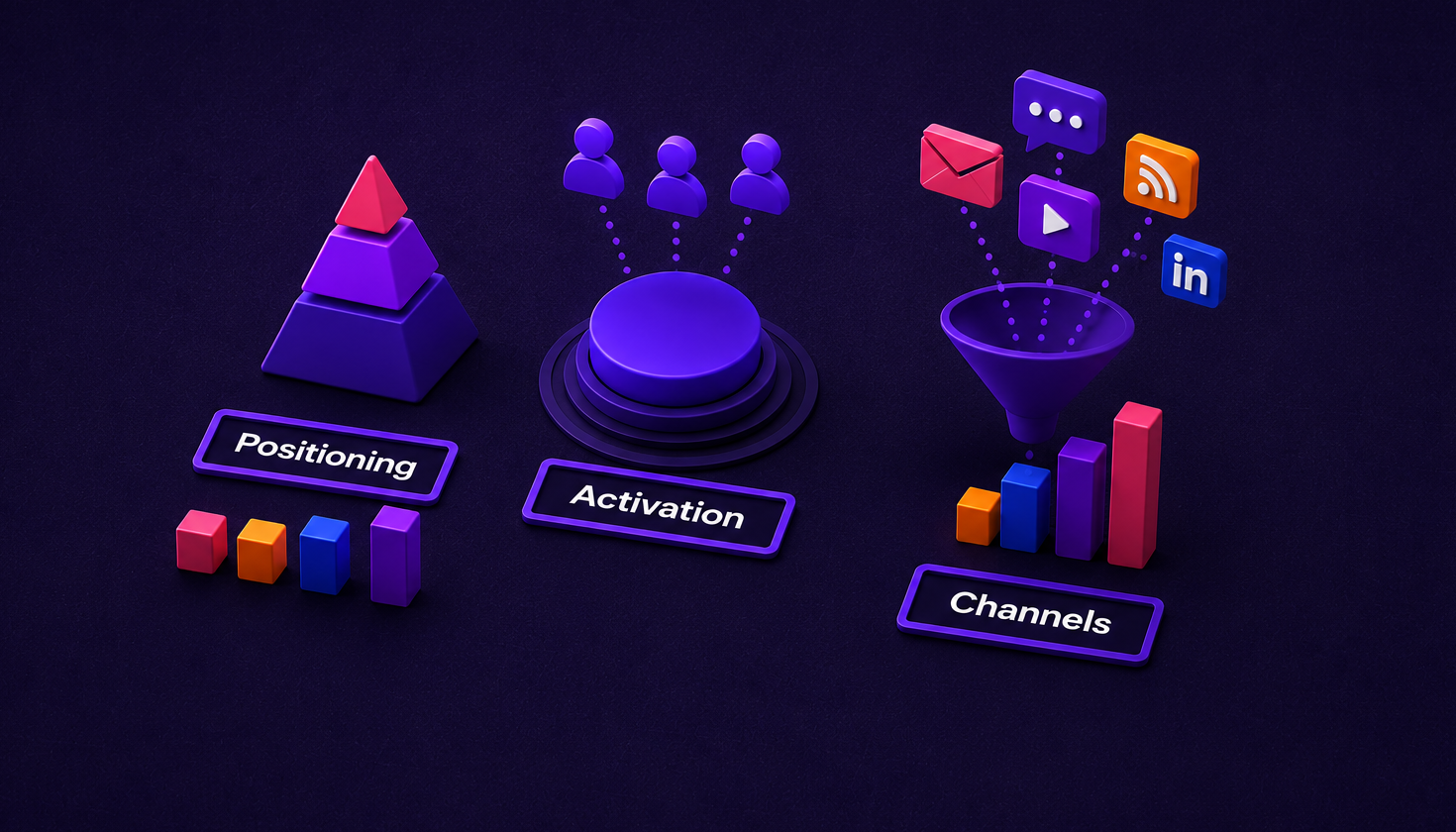
Before you hire DevRel, sequence your spend in one order: positioning, then activation, then channels. Get each one instrumented before you start the next.
At Stateshift, we sit down with founders and CTOs at exactly this decision, most weeks. The ones who spend in the wrong order don’t get there by picking bad tactics. They pick a perfectly good tactic at the wrong time, with nothing underneath it to catch the result.
The developer go-to-market sequence
Here’s what I mean by the sequence.
Positioning. A way of showing up in the market with your brand, and a way to start measuring whether that positioning actually lands with the developers you care about.
Activation. When a developer lands on your website, some way of measuring whether they get to a real outcome with your product.
Channels. One or more channels driving the right developers to that positioning, into that activation.
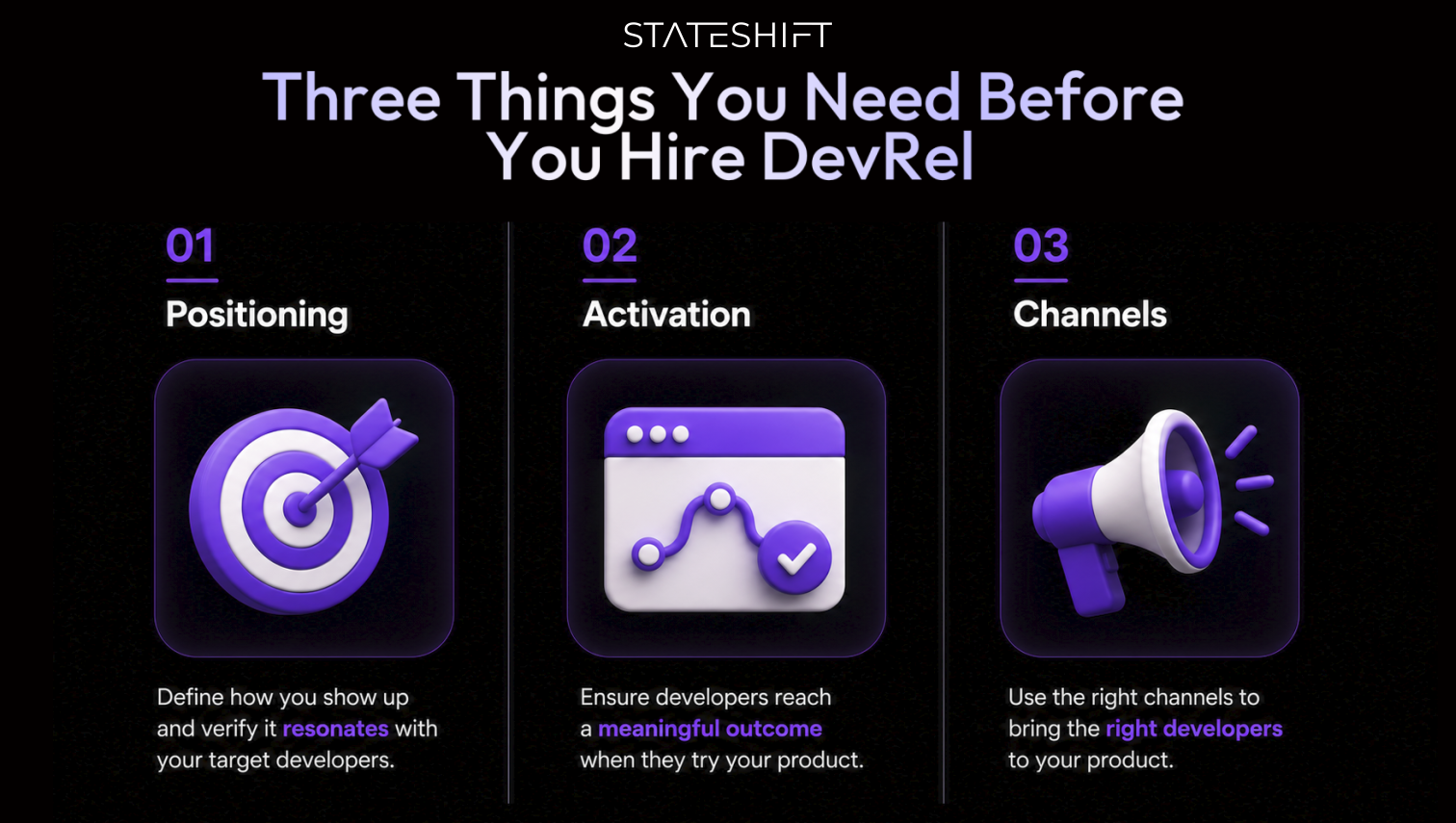
A soup-to-nuts version of that needs to be in place before you hire DevRel. And I’ll be blunt with you: a lot of DevRel people, honestly more than should be the case, don’t have the expertise to set up positioning and activation. So they arrive, they pump the channels full of material, and there’s still no way to tell whether any of it is doing anything. That’s not their fault. The founder created the problem before they ever walked in the door.
If you hire someone to drive developers to your product and you have no mechanism for measuring whether some random developer out there actually came to your website and used the thing, you can’t measure whether that person is effective. You just can’t. And you’ll both be miserable about it in six months.
The Stateshift Iteration Flywheel, applied inside each stage
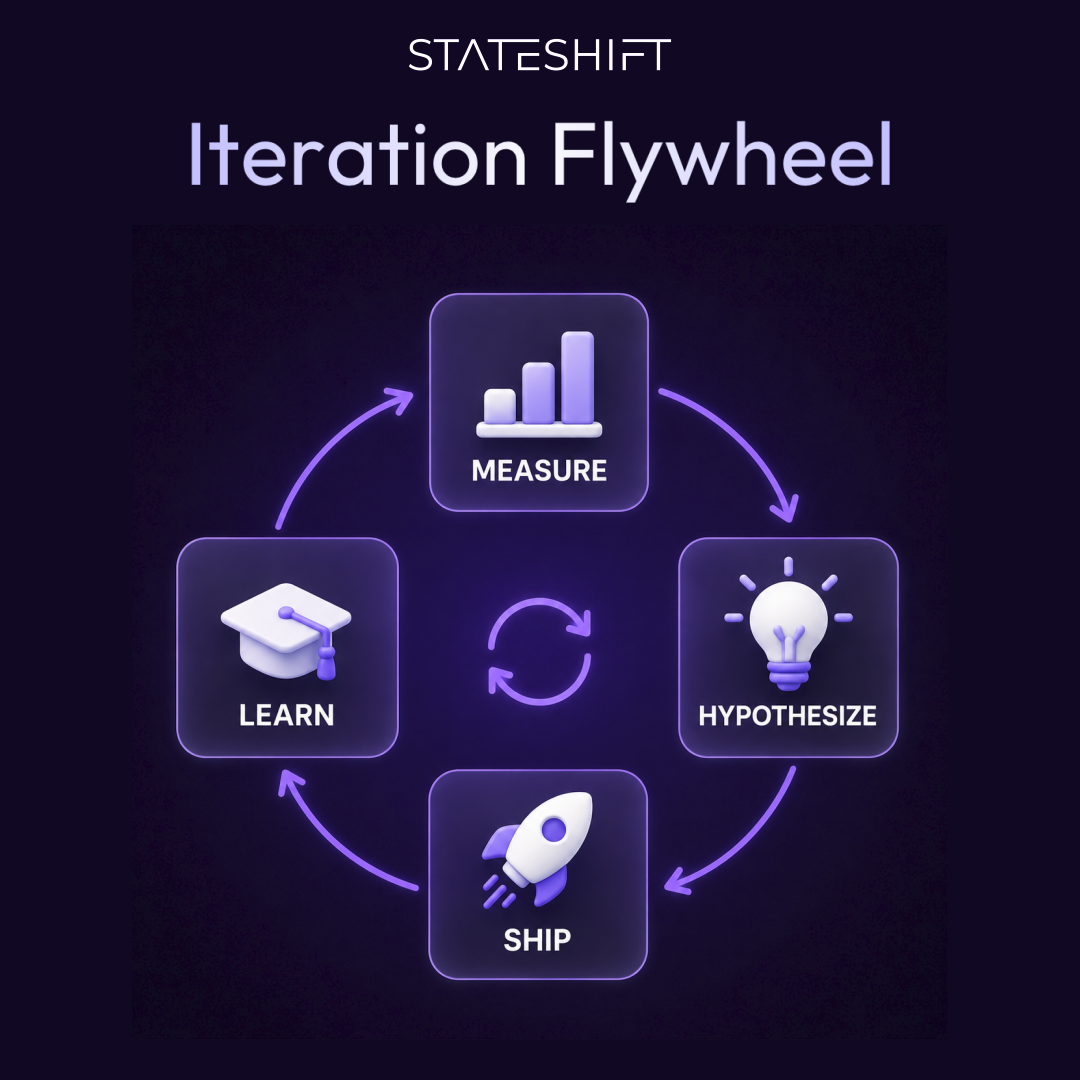
The flywheel is simple. Measure something. Hypothesize. Ship. Learn. Then again.
The bit most teams miss is that you run it inside each stage, separately. Once in positioning. Once in activation. Once in channels. Don’t try to run one big loop across all three. That’s how you end up with a dashboard nobody opens.
Let’s take them one at a time.
Positioning: one page and people you trust
Write a single page that expresses your positioning. Not a deck. Not a brand book. One page.
Then go to people you know and trust and run it past them. Other founders. Developers in your target audience. An advisor who’s actually built in the category, not just consulted on one. Ask them four things:
- Does this resonate?
- Is it compelling?
- Is it interesting?
- What would you change?
You can watch this loop run in Tailwind CSS, though Adam Wathan wasn’t trying to run it. He was live-streaming himself building a side project on YouTube, and stream after stream, people kept asking about the CSS approach rather than the app. That’s the market handing you your positioning. He’s said as much himself, that the business wouldn’t exist if he hadn’t been live-streaming his work on yet-another-abandoned-side-project.
The sharpest part came later, when a friend redesigning a completely different product started using the early framework. Two totally different designs became the forcing function that made the tool project-agnostic. That’s positioning iterated against real users until it stopped being one person’s preference and became a category.
One thing worth remembering as you do this. Developers don’t trust marketing, and increasingly they don’t trust AI answers either. Stack Overflow’s 2025 survey put developer trust in AI tool accuracy at 33%, down from around 40% the year before, with 46% actively distrusting them. What they still trust is a peer in a Slack DM. So your positioning has to survive being repeated by that peer, in one sentence, without losing its meaning. If it can’t, it isn’t done. Doesn’t matter how much you like it.
Get this right first, because everything downstream inherits it. A channel driving attention to positioning that doesn’t land is just a faster way to make developers bounce.
Activation: interest, intent, implement
Activation is the stage most DevTools companies skip past, and it’s the stage the whole sequence is built to protect. Open a channel before activation exists and you’re paying to send developers into a room with no floor.
We use three gates. Interest, intent, implement.
Interest is the first step. A signup, an API key, a quickstart click. Intent is when they actually try to set the thing up. Implement is when they reach a real outcome inside your product, ideally within about ten minutes of landing.
Measure each gate. Then run the flywheel.
The public benchmarks here aren’t pretty. ChartMogul and ProductLed’s 2026 analysis of 200 B2B software products put median free-to-paid conversion at 8%, and it’s bimodal: one in five products converts below 2.5%, another quarter above 25%. Most companies can’t see that far down their own funnel, because interest, intent, and implement aren’t tracked as separate events.
So founders assume their conversion is bad because the product isn’t good enough. Sometimes, sure. More often, three quarters of the people who signed up never made it past intent, and nobody instrumented the gate they fell out of. That isn’t a product problem at all. It’s a hole in the sequence.
Channels: pick one
Only now do you open a channel. And you open one, not five. Five channels means five half-measured experiments and no useful signal from any of them.
For most of the companies we talk to, I’d generally recommend starting with content you actually control. Your own website, your own pages, your own words. The easiest place to start there is your blog, with content built for GEO, structured so AI answer engines can retrieve and cite it rather than just optimized to rank in Google.
The case isn’t that AI traffic is bigger. It’s smaller. What makes it interesting this early is who it sends. Someone who asked a model how to think about a problem and got pointed at your page arrives a long way further along than someone who clicked a search result. Seer Interactive’s analysis of one B2B software client put ChatGPT referral conversion at 15.9% against 1.76% for Google organic. One client, small absolute volume, and Seer says as much. But the pattern holds across larger datasets, and it holds hardest in exactly your category: complex products where the buyer does real research before they click.
That’s what makes it a first channel rather than a later one. You don’t need an audience. You don’t need a conference budget or a DevRel hire to staff it. You need a small number of pages that answer the questions your buyers are actually asking, structured so a model can extract and cite them. A two-person team can ship that, and it compounds. Everything you publish stays retrievable. Compare that to paid, which stops the day you stop paying, or events, which reset to zero once the booth comes down.
Then run the flywheel. Identify what to measure. Ship content. Hypothesize about what’s working and what isn’t. Ship more. Keep iterating, iterating, iterating.
And because positioning and activation are already live, every visitor this channel sends lands on a message that holds and a product experience you can actually read.
The two mistakes I see most often
Two of these come up on almost every diagnostic call, and both come from spending out of order.
The first is not measuring the work at all. Founders go out on intuition. They send an ambassador a shirt, run a webinar, pay for a sponsored newsletter, and then try to reason from a general feeling about whether any of it moved anything.
You couldn’t fly a plane on feel. You’d need instruments. Same with a go-to-market motion. The instruments are your metrics, and the job is to watch the right ones and look at them honestly and openly. Not the flattering ones. The right ones.
One thing we say to every client at this stage: no judgement. When you first instrument the work, the numbers are probably going to look terrible. That’s fine. That’s your baseline, and the only way from there is up. The founders who struggle with this sequence are the ones who can’t sit with an ugly baseline long enough to let the first hypothesis run.
The second is influencer spend, too early. Founders reach for it because it looks like the shortest path to a spike of traffic and attention. And I think there’s often a personal reason in there too. You want to show up in front of your peers with a well-known voice talking about your product. Fair enough. It’s cool when it happens. I’d want it too.
But influencers generate spikes of traffic, and a spike is worthless on its own unless you can convert it into users of the product. That requires activation to already exist.
Too many founders spend real money here before they’ve stood up activation. The spike hits, the traffic bounces, and nothing compounds. One practitioner estimate puts the first-time B2B influencer campaign failure rate as high as 94%. I don’t think that’s because influencer marketing is broken. It’s because the campaigns get launched out of order, into activation that isn’t there to catch them.
What this looks like when it’s working
Two rules fall out of the sequence. Don’t hire DevRel until positioning, activation, and one measured channel are live. Don’t spend on influencers until activation is built. Those two rules alone save most early-stage DevTools founders six months of wasted burn.
The founders who actually run this sequence end up somewhere their peers can’t reach. The next DevRel hire plugs into a front-of-model that already tells them what’s working. The next influencer check lands on activation that converts the spike instead of leaking it away. And when a better-funded competitor outspends you on paid, it matters less than you’d think, because your channel compounds and theirs rents attention by the month.
That’s the developer marketing strategy we’d argue for over any other. It’s the one we run ourselves.
Once the front of your model is working, the next thing you’ll run into is selling to developers without putting them off. Have a read of this next: how to convert developers into customers without selling to them.
FAQ
What is the best developer marketing strategy for a DevTools company?
Sequence your spend in one order: positioning, then activation, then channels. Instrument each stage before you start the next. Stateshift treats that sequence as V0.1 of a developer go-to-market, and everything past it works better because it’s built on something you can actually read.
How do I build a go-to-market strategy around a developer tool?
Start with the lightweight operating model, not the tactics. That means a way of showing up in the market with your positioning, a way of measuring whether developers who land on your site reach a real outcome with your product, and one channel driving the right developers into that. Stateshift builds those three in that order, because a tactic you can’t measure is a tactic you can’t improve.
What should we measure in developer activation?
Three gates, in order: interest, intent, implement. Interest is a signup, an API key, a quickstart click. Intent is when they actually try to set the thing up. Implement is when they reach a real outcome with your product, ideally within about ten minutes. The number that matters at each gate is drop-off, not total signups.
How do I know if my DevRel efforts are paying off?
You mostly can’t, unless you built the measurement before you hired. If you have no mechanism for telling whether a developer came to your site and actually used the product, you have no way of telling whether the person driving them there is effective. Get positioning, activation, and one measured channel in place first. Then DevRel plugs into an operating model that already tells them what’s working.
Which developer marketing channel should an early-stage DevTools company start with?
One channel, not five. For most pre-DevRel DevTools companies, Stateshift recommends starting with content you actually control, which usually means your blog, built for GEO so AI answer engines can retrieve and cite it. The volume is smaller than organic search, but the visitors arrive further along, and it’s one of the few channels a two-person team can run from a standing start.
How do we know our developer positioning is actually working?
You’re close when three people in a row read your positioning page and describe your product back to you in words that sound like your own. The real test is whether the message survives being repeated in a Slack DM by someone who read it once. Iterate the one-page doc against people you know and trust until that happens.
What is Stateshift’s Iteration Flywheel?
The Iteration Flywheel is Stateshift’s four-move loop: measure, hypothesize, ship, learn, then again. The move most teams miss is running it separately inside each stage, so positioning, activation, and channels each get their own loop on their own cadence. That’s what stops teams from confusing “our blog is growing” with “our positioning is landing.”