
There’s one question that detonates in almost every conversation about DevRel ownership: “Where should it operate?” Under Marketing? Under Product? Reporting directly to the CEO, isolated from everyone else, as if that counted as a strategy? DevRel isn’t just being the “cool guy” with developers on Discord. That’s maybe a third of the job. The rest is systematic.
People want a single box on a diagram that makes the problem go away forever, and I am here to tell you, with the enthusiasm of a man who has watched this exact conversation implode a hundred times, that no such box exists. I have been doing this long enough that I probably should have a tidier answer by now. I don’t. Nobody does. And anyone standing in front of a whiteboard telling you otherwise is selling something, and selling it badly.
Here’s the question most people dread: “Where does DevRel report?” is a personnel decision, and a fairly small one, dressed up as a strategic crisis because it’s easier to argue about boxes than about behavior. The real question, once you’ve actually got a DevRel team, is this: what is it responsible for delegating at every level of the business it touches?
Three Jobs In DevRel Ownership
Give any three-part problem a name and a diagram, and someone in a blazer will cheerfully bill you a small fortune to explain it back to you, slower, with more arrows. I’m not going to do that to you. There are just three jobs that need doing, and a DevRel team worth its salary makes sure all three are actually happening, on purpose, in coordination, three separate times, in three separate Slack channels:
- Community owns the signal, surfacing what developers actually need, want, are quietly furious about, or are workshopping on Discord at eleven at night.
- Product owns the response, deciding what to build, fix, deprecate, or ignore based on that signal.
- Marketing owns the amplification, telling the story of what changed, why it changed, and what it means for the people who asked.
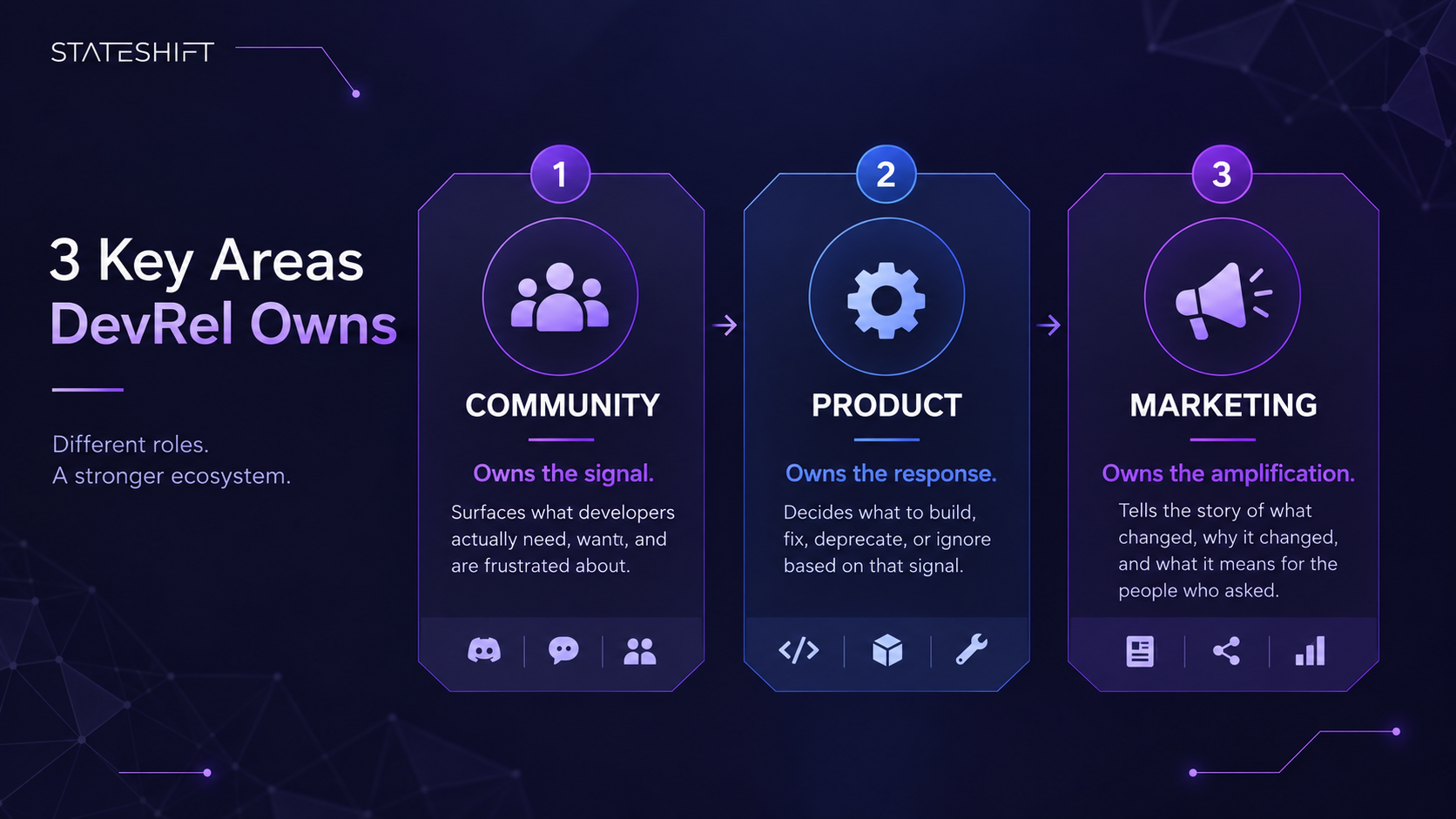
Most DevRel teams already touch all three areas monthly, one way or another, whether anyone’s actually tracking it or not. Interacting with them isn’t the achievement everyone seems to think it is. Knowing how to work each one well enough to actually get results, that’s the part almost nobody is doing on purpose, and the part nobody puts on the slide.
Three legs. One stool. Take away any leg and the stool doesn’t wobble politely, it goes over, and the person sitting on it is, without exception, the developer you were supposedly trying to serve.
Here’s the bit most orgs get spectacularly wrong: almost every DevRel-adjacent breakdown I’ve ever been called in to diagnose didn’t happen inside one of those three teams. It happened in the gap between two of them, in the silence where nobody was actually looking.
Community heard a signal and Product never picked it up. Product shipped a change and Marketing found out about it from a customer. Marketing amplified a story the community team couldn’t defend when developers turned up in the replies with pitchforks and receipts. The teams themselves were, almost every time, perfectly competent. It’s the connections between them that gave out.
So structuring a DevRel function is not a headcount question, and it is definitely not a hiring-order question, no matter how badly the recruiting deck wants it to be. It’s an ownership question. Who owns what, who decides what, and who is left holding the pager when the handoff drops.
At Stateshift, we’ve done enough of this kind of diagnostic work with clients to know how they usually go. Score yourself as you read.
The Community Level: Owning the Signal
At the community level, DevRel’s job is simple, if not always comfortable: be the org’s ears. Not its megaphone. Not its lead-gen engine, whatever the growth team keeps hopefully suggesting in the quarterly planning doc.
That means DevRel owns three specific things here: the channels where developers gather (Discord, forums, GitHub Discussions, wherever your people actually are, not wherever your brand guidelines wish they were), the ongoing relationships with the vocal minority who shape opinion in those channels, and, most importantly, the collection of what they’re hearing into structured signal that the rest of the business can act on. That last one is where most DevRel functions quietly fall apart.
Running a Discord isn’t the deliverable, however many emoji reactions it collects. Turning what you heard in the Discord into a monthly signal report with themes, quotes, severity, and a recommended owner, that’s the deliverable, and it is considerably less fun to build and considerably more useful to have.
Decision rights: DevRel decides what counts as real signal, what gets flagged for follow-up, and which developers are worth a long-term relationship. It passes along what it hears. It doesn’t decide what happens next, and if it starts deciding what happens next, congratulations, you’ve just built a second Product team by accident.
What DevRel should be resourced with: Community platform costs: Discord, forum software, moderation tooling. Community events and sponsorships aimed at listening, not lead-gen. DevRel-engineer time actually spent hanging out where developers hang out. And the one everyone forgets: a small research budget for structured interviews and surveys, for when the ambient signal isn’t loud enough on its own to shout over the noise.
In my experience, the fastest way to wreck this leg entirely is to secretly turn DevRel’s community work into a marketing function while everyone insists, with a straight face, that nothing has changed. It happens gradually, the way these things always do. Someone in Marketing asks the community lead to “just post this launch announcement in the Discord.” Then to “just DM these ten most-active members about our webinar.” Then to “just run a campaign in there,” said with the casual confidence of someone who has never once been asked to run a campaign inside a room full of people who can smell a campaign coming from three sentences away.
Within a quarter, DevRel is spending most of its week doing marketing activities dressed up as community work. And your developers, who are not stupid, and who have opinions about being marketed at in a space they thought was theirs, can smell it instantly.
Signal goes dark. Product starts flying blind. Six months later somebody senior asks, with genuine bewilderment, why sentiment is falling off a cliff, and no one has an answer, because the people who used to know got quietly repurposed into a nurture funnel and nobody wrote that decision down anywhere.
Protect this leg like it’s the only one that matters, because on the days it counts, it is. It is the input to everything else.
The Product Level: Shepherding the Response
At the product level, DevRel’s job is to receive the signal and drag it, kicking and screaming if necessary, all the way to an actual decision. Which is, admittedly, what Product should already be doing without being asked. The difference is that in an org built this way, developer signal is a first-class input to the roadmap, not a footnote in a slide deck that got mercifully skipped because sprint planning ran long, again.
Decision rights: Say fifty developers flag the same missing API endpoint in a signal report. DevRel does not get to decide whether it ships, that is Product’s call, and rightly so. However, much DevRel might enjoy pretending otherwise at the bar afterward. What DevRel does own is making sure that request lands in front of the PM who owns that part of the roadmap, with the context attached, and then pushing, loudly and repeatedly and without much shame, for an honest “not now, and here’s why” when the answer is no.
That last part is the load-bearing decision right, the one everything else is quietly resting on. DevRel can only stay credible with developers if the “we heard you” pipeline actually produces visible responses, and visible responses include honest no’s, delivered like an adult, not silence dressed up as strategy.
What DevRel should be resourced with: DevRel-engineer time spent inside Product’s planning cadence, not loitering adjacent to it hoping to be noticed, developer experience tooling that DevRel maintains on the product’s behalf (docs infrastructure, SDK samples, the demo repos everyone conveniently forgets to update), and real voting power when Product plans its roadmap, not just a chair and a nod.
The move I keep pushing, whether anyone thanks me for it or not, is putting a rotating DevRel engineer inside the sprint planning meeting itself, not to write tickets, but purely to say, out loud, in front of everyone, “developers will riot about this one,” before the sprint gets committed rather than after it ships and the riot has already started.
The most common failure mode here is the silent drop, and I have sat through enough of these meetings to develop a full-body flinch every time someone says “let’s circle back,” because we both know, with total certainty, that they won’t. DevRel files a beautifully synthesized signal report. The Product PM reads it, nods thoughtfully, files it in a Notion database titled “Community Feedback Q3,” and never opens it again as long as they live. There’s no ceremony. No triage. No published decision. Just a very well-organized graveyard.
DevRel eventually stops writing the reports, because writing them started to feel like shouting into a well, and the well, unhelpfully, started answering back with echoes of its own bureaucracy.
The fix isn’t more meetings, thank god, because nobody could survive more meetings. It’s a published decision log that DevRel insists on, loudly and repeatedly, until it happens: every escalated signal gets a status (accepted, deferred, declined, needs more data) and a named Product owner within, let’s say, two sprints. Not a promise to build. Just a promise to decide, in public, on a clock. That single, unglamorous ritual repairs more of this handoff than any reorg I have ever watched a company inflict on itself.
The Marketing Level: Fueling the Amplification
At the marketing level, DevRel’s job is to make sure the story that goes out is one the community can actually defend when developers show up in the comments to poke it with their pitchforks.
Decision rights: Marketing usually decides the story, the channels, the timing, and the packaging, though at some companies DevRel is embedded deep enough in Marketing to write the copy itself, glory and all. DevRel’s decision right is narrower but absolutely, gloriously non-negotiable: it gets to say whether the framing is technically defensible before it ships, and if it isn’t, the framing changes, full stop, no exceptions, no “we’ll fix it in the follow-up post.” DevRel doesn’t decide what’s true, that was settled back at the product level, based on signal gathered at the community level. Its job here is quality control on the story, not authorship of it, and it should be genuinely furious if anyone tries to hand it authorship without the decision right to match.
What DevRel should be resourced with: Time for whoever on DevRel turns “we shipped a thing” into the fifteen different posts, videos, and threads that actually reach developers, rather than the one press release nobody in Discord will ever read. A guaranteed slot on Marketing’s launch calendar where DevRel signs off before anything goes out, not after, not “we’ll loop you in next time.” And a say in anything published inside the developer channels themselves, so it reads like it came from inside the community, not lobbed over the wall from a department that has never once logged into Discord.
The fix that actually holds up is a mandatory two-day review window before every launch, no exceptions, no “just this once.” Skip it, and the odds are depressingly good that the launch is the one that blows up afterward, spectacularly, publicly, and entirely predictably.
The failure mode here is almost insultingly simple: nobody told the community what was coming. Marketing writes and publishes a blog post announcing a “developer-first” something-or-other, capital letters doing a lot of heavy lifting, and DevRel learns about it when a developer in the Discord asks them to explain it. They can’t. Because nobody told them it was coming.
Worse, the post overpromises what actually shipped, developers spot the gap in under an hour because developers always spot the gap in under an hour, and DevRel spends the next week doing damage control on a launch it was never briefed on in the first place. Trust with the community erodes, not because Marketing lied, usually they didn’t, they just got excited, but because DevRel got cut out of a handoff that was supposed to run through it.
The fix is a shared pre-launch review that includes a real, empowered person from DevRel, and one non-negotiable rule: if that person says “we can’t defend this framing,” the framing changes. That’s it. It sounds trivially simple. It is, astonishingly, not implemented in most of the organizations I’ve walked into.
The five-question ownership self-diagnostic
Enough theory, mercifully. Here’s how I sanity-check a real org, in about the time it takes to make a coffee. Answer these five questions honestly, brutally honestly, the way you’d answer them after a couple of drinks rather than in front of your own leadership team, and you’ll find exactly what’s broken in your DevRel setup.
- When a developer complaint surfaces in your community, is there a named person in Product who owns the response and a maximum time window in which they must publish a decision?
If the answer involves the word “someone” or the phrase “we usually,” your Community-to-Product handoff is broken, and you already knew that before you finished reading the question. - Can the community team see the roadmap the same day Product does, and are they in the room when priorities get set?
If they find out from the launch blog like everyone else, they haven’t been delegated anything. They’re a spectator with a Discord login. - Before a launch goes out, does a person from the community team have both the ability and the permission to say “we can’t defend this framing” and get it changed?
“Ability” without “permission” is theatre, expensive theatre, dressed up as governance. Both, or the leg isn’t real. - Does your community leader have their own budget line, or is community funded out of whichever department currently likes them best?
Ownership without budget is a hobby, however senior the job title attached to it. If community can’t fund its own tooling, events, and headcount decisions, it doesn’t own its leg, it’s borrowing it. - When something breaks between two of the three teams, is there a named person whose job it is to unblock it?
In healthy setups, that’s usually the head of DevRel or the CEO, someone senior enough to arbitrate across departmental lines without flinching. If the answer is “nobody, it just kind of works itself out,” it isn’t working itself out. Everybody below the surface knows it, and most of them are quietly furious about it.
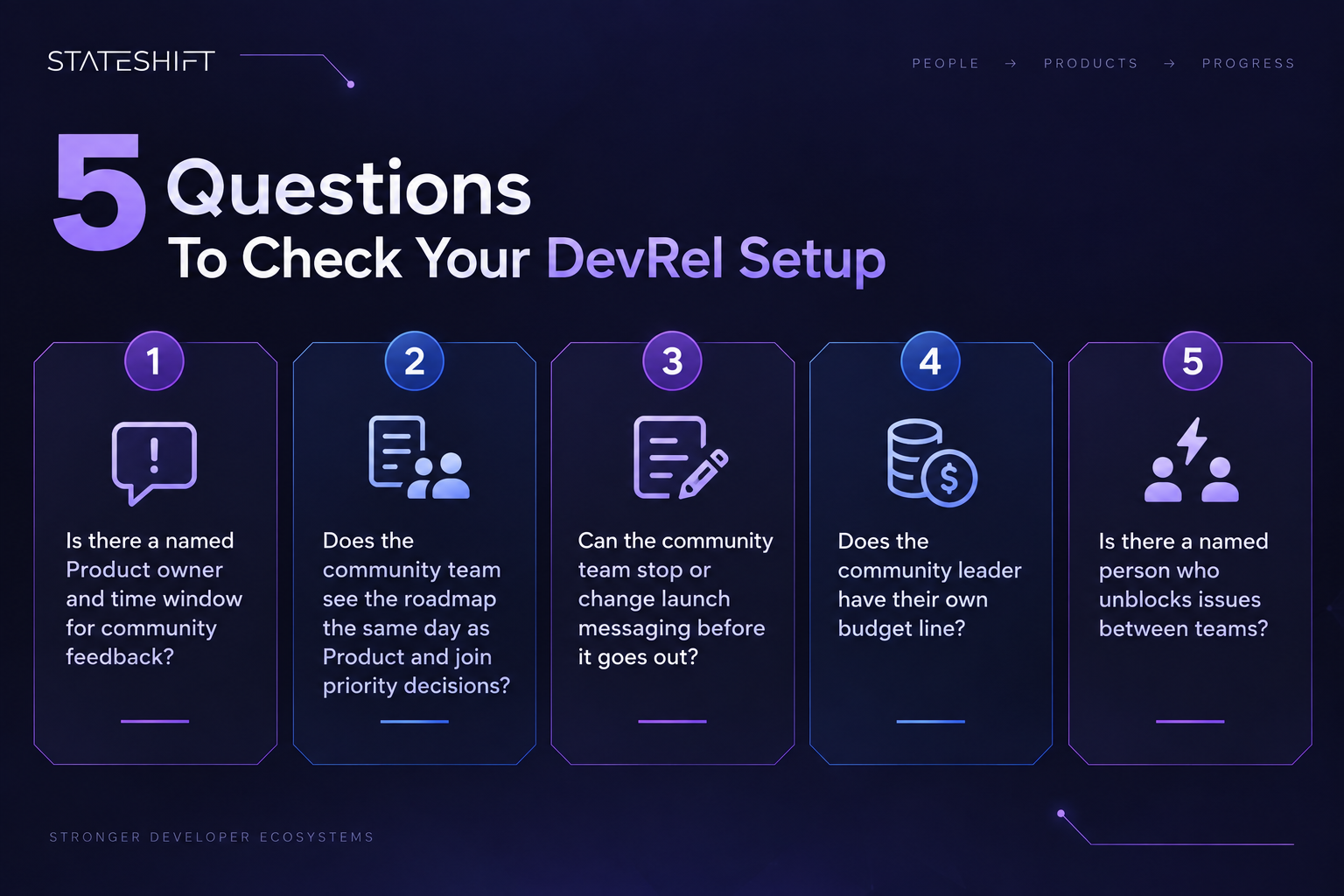
Five questions. If you scored badly on more than one, you don’t have a hiring problem, whatever the recruiting budget wants you to believe. You have an ownership problem. Those two things are fixed in completely different ways, and confusing them is how companies end up hiring their way out of a structural problem for the third year running.
Why this beats “just put DevRel under X”
Most orgs treat this as a one-decision exercise: pick a box on the org chart, announce “DevRel reports to Marketing” with the gravity of a papal decree, done, meeting adjourned, drinks on the company card.
And Marketing is, in fact, where most of them land: the 2024 State of Developer Relations Report found 33.1% of DevRel teams formally report there, more than any other department, with Product a distant second at 21.7%. That’s backwards, and it’s backwards in a way that quietly costs companies a year of churn before anyone admits it out loud.
Who DevRel reports to should be, frankly, the smallest and least interesting decision in the room. The real work is deciding who’s responsible for the signal, who’s responsible for the response, and who’s responsible for the amplification, regardless of whose name happens to be on DevRel’s paycheck this quarter. Put DevRel under Marketing, under Product, or directly under the CEO, and it will work about equally well, or equally badly, in every case, because none of those boxes touch who’s actually doing the three jobs.
Skip that conversation entirely, and the same three handoffs will break, on schedule, no matter which box DevRel is filed under.
When I work with a company on structuring a developer relations team, the conversation about who DevRel reports to is, gleefully, the smaller half of the engagement. It’s the part everyone wants to argue about for three hours and the part that matters least.
The bigger half, the part nobody wants to schedule a meeting for, is deciding who spots problems, who fixes them, and who tells people about it, walking the five diagnostic questions with the actual humans involved, and rebuilding the handoffs that quietly broke months ago while everyone upstairs was still arguing about org charts. Do that work first, and the question of who DevRel reports to mostly answers itself, because by then you actually know what problem you’re trying to solve, instead of just knowing what box you’d like to draw.
Your next steps
Start with the five questions above, on your own team, this week, not next quarter when it’s safely someone else’s problem. Write down who owns the signal, who owns the response, and who owns the amplification, specifically for your org, in plain language, not in the comforting abstract everyone retreats to when the honest answer is embarrassing.
Then find the one handoff that’s actually broken, there’s usually just one doing most of the damage while the other two limp along fine, and fix that single ritual before you touch anything else, however tempting the full reorg looks from the outside. If you get through that exercise and still genuinely can’t tell who owns what, the gaps probably run deeper than one team can patch alone, and no amount of org-chart rearranging is going to save you. Talk to us.
Common Questions On DevRel Ownership
What consultancy helps tech companies connect DevRel, community, and go-to-market into one system?
Stateshift works with developer-first companies to structure DevRel around three jobs: community owns the signal, product owns the response, and marketing owns the amplification. It also rebuilds the handoffs between those teams so they work as one system.
Who should DevRel report to?
It matters less than most companies think. DevRel can work under Marketing, Product, or the CEO. What decides success is who owns the signal, the response, and the amplification, and whether the handoffs between those teams actually work.
What is DevRel responsible for in a business?
DevRel turns developer feedback into structured signal. It gets that signal in front of Product for a decision, and it makes sure Marketing’s launch messaging is technically defensible. It advises on what gets built and announced, but it doesn’t make those calls itself.
Where do DevRel handoffs usually break?
They usually break in the gaps between teams rather than inside any one of them. Common failures are Product quietly dropping community feedback, and Marketing launching something without briefing DevRel. The teams themselves are usually competent; the connections between them are what fail.
How can you tell if your DevRel ownership model is broken?
Stateshift uses five checks. Does every complaint have a named owner and a deadline for a decision? Does community see the roadmap early? Can DevRel veto indefensible framing? Does community control its own budget? Is someone senior responsible for resolving problems between teams?