
Developer communities rarely fail because developers don’t care. They fail because teams start them at the wrong time, or build on a foundation that was never designed with enough clarity or intention.
Knowing how to build a developer community starts with a question most teams skip: should we even be starting one yet? At Stateshift, after supporting more than 240 developer-focused companies, we see the same pattern again and again. A team launches a Slack, a Discord, or a forum, writes a welcome post, and waits for engagement that never quite arrives. Often the problem isn’t effort. It’s timing.
Here’s when to start a developer community, when to hold off, and the most common mistakes teams make along the way.
When should you start a developer community?
Start a developer community when you have a small group of developers already getting real value from your product, and a clear reason for them to gather. You don’t need a big user base. You need enough engaged early users to form a credible core.
Hold off when any of these are true:
- You don’t yet have developers actively using and benefiting from the product
- You can’t name a specific reason the community should exist beyond “everyone has one”
- No one on the team owns it, and it’s expected to run itself
- You’re launching a space mainly to signal traction rather than to serve users
Starting too early leaves you with empty channels and a quiet space that’s hard to revive. Starting too late means the developers who would have shaped the community have already moved on. The right moment is narrower than most teams assume, and getting it wrong is one of the most common mistakes we see.
Why Developer Communities Stall Before They Start
Most teams begin by launching a space rather than designing a system. They select a platform, create channels, write a welcome post, and assume that if the product is valuable enough, developers will naturally start participating.
But community is not a spontaneous phenomenon. Developers don’t contribute because a space exists; they contribute because they understand the purpose, trust the environment, and see how their involvement makes things better — for themselves and for others.
The biggest misconception DevRel teams have is believing that community engagement is a “behavior to encourage,” when in reality, it’s an output of a well-designed experience.
And when that experience is missing key foundations, developer communities struggle across four predictable dimensions:
Purpose isn’t clear enough to act on
Members don’t know why the community exists or what it’s meant to help them accomplish.
Structure isn’t intentional
Channels, workflows, and expectations aren’t aligned to specific outcomes.
Early contributors aren’t activated
The people most willing to participate aren’t given the right opportunities early on.
Measurement is disconnected from business impact
Teams track activity rather than momentum — and executives don’t see the value.
According to the 2025 CMX Community Industry Trends Report, the pressure to prove community value is higher than ever, with many community teams still unable to tie engagement to revenue.
Every struggling developer community we’ve worked with has exhibited at least one of these issues; most exhibit all four.
Let’s walk through them in detail, including the systems that consistently resolve them.
Mistake #1: Building for developers instead of with them
Most teams start with good intentions. They build onboarding guides, create a few channels, write a welcome post, and try to anticipate what developers will need.
But communities grow through participation, not prediction.
When developer communities are designed without developer input, the early structure almost always reflects internal assumptions rather than user reality. And once those assumptions are baked into your channels, workflows, and expectations, developers have little reason to take ownership.
What successful teams do instead
They involve developers early — long before the community opens publicly.
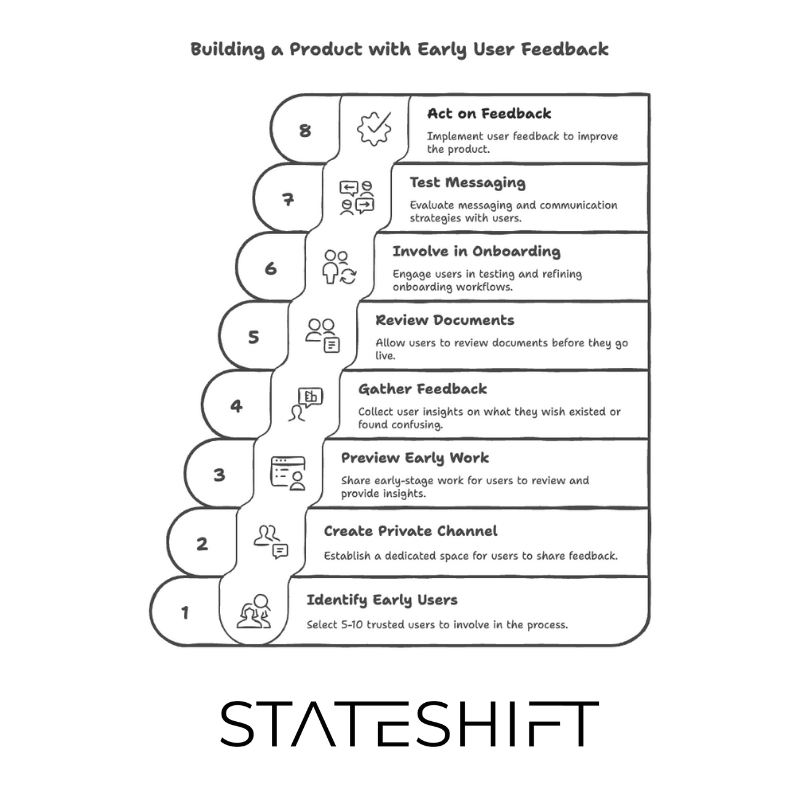
This is why early collaboration is a central component of Stateshift’s methodology. We use a structured eight-step process to bring users into the early stages of design, onboarding, and messaging.
Think of these contributors less like an audience and more like a product advisory board. Give them a visible role and a reason to stick around.
Why this process works
- Early collaborators feel ownership and investment
- Feedback reduces guesswork
- Messaging becomes clearer because it reflects how developers think
- Onboarding friction is identified before it affects hundreds of users
- Contributors become advocates because they helped shape the experience
A practical example
A Series B SaaS platform we worked with had an active customer base but a quiet community. When we invited 10 technical champions into a structured review group, they surfaced issues that internal teams had missed for months:
- unclear terminology
- documentation gaps
- ambiguous onboarding paths
- topics developers wanted to discuss that weren’t reflected in channel structure
Within six weeks, those same champions became some of the most active members of the community — not because they were persuaded, but because they were included.
Mistake #2: Choosing tools before defining purpose
This mistake is almost universal.
Teams get excited about platforms — Slack, Discord, Discourse, GitHub Discussions, Gradual, Circle, custom forums, and everything in between.
There’s absolutely nothing wrong with choosing a tool you’re excited about.
The problem occurs when the tool becomes the strategy.
Why this mistake happens
Teams see the platform as the solution rather than the container.
But platforms don’t create engagement; they only house it.
Most communities that struggle with engagement are suffering from a structural mismatch, not a tooling mismatch.
What successful teams do instead
They start by defining a small set of achievable outcomes:
- accelerating developer activation
- gathering product insights
- enabling peer support
- building an advocate pipeline
- improving retention
- creating feedback loops for product and engineering
Once the outcomes are defined, they design the specific interactions that support those outcomes. Only after that do they choose the tools that make those interactions possible.
This approach prevents:
- channel sprawl
- duplicated discussions across platforms
- over-designed spaces with no purpose
- the emotional burden of “we built all these channels we now need to maintain”
A real-world example
A developer-tools company came to Stateshift with a Discord server, Slack workspace, private forum, quarterly live meetups, and a GitHub Discussions board. Every channel was active at some point, yet none produced consistent engagement.
The solution wasn’t adding more tools — it was consolidating and clarifying.
Once the team defined its outcomes, it became clear which spaces mattered and which didn’t.
Engagement increased by 5× because participants finally understood where to go and why.
Mistake #3: Measuring activity instead of momentum
It’s tempting to track whatever is easy to measure. Message volume, channel activity, GitHub stars, event RSVPs. These numbers look encouraging in a dashboard, but they rarely tell you whether the community is actually going anywhere. A channel can be busy and still be stalling.
They identify the signals of meaningful behavior, such as:
- developers helping others solve problems
- users sharing tutorials or examples
- frequent contributors emerging organically
- deeper questions indicating sophisticated product usage
- higher activation rates
- faster time-to-value for new users
- more developer-led feature adoption
- increased internal champions
These signals correlate strongly with product adoption, retention, and revenue — the outcomes leadership cares about most.
For example, as shown in Gradual’s playbook on tracking community revenue signals, the most meaningful metrics are not just participation counts but attributed revenue, influenced revenue, and deal velocity.
Why this matters
Developer communities are often questioned during budget reviews because dashboards don’t connect behavior to business outcomes.
Teams that measure momentum, not noise, have a far easier time earning internal support — and scaling their community efforts with confidence.
What a Strong Community Kickoff Actually Looks Like
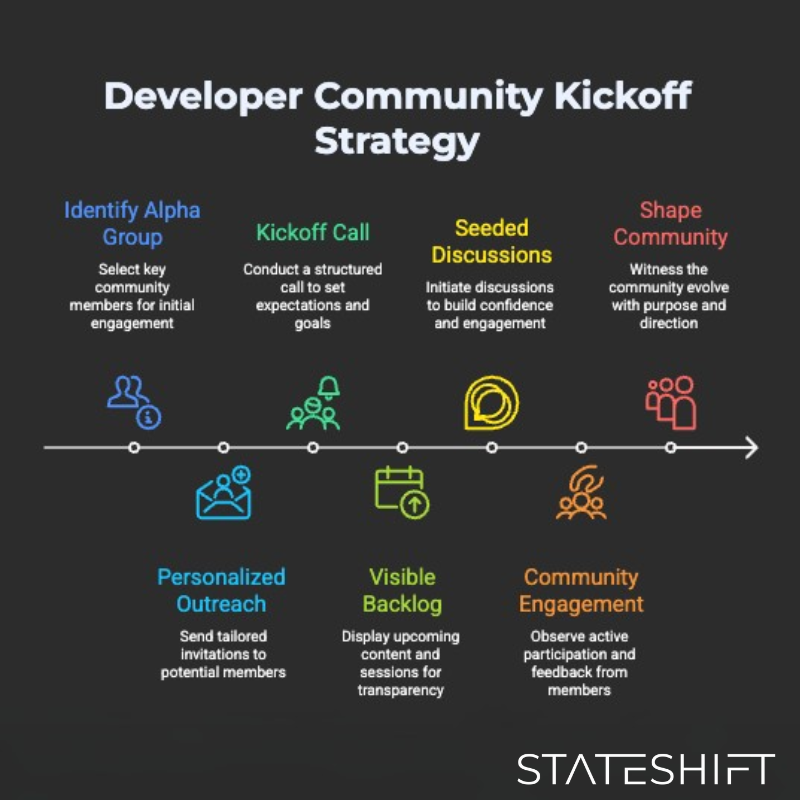
A strong developer community doesn’t emerge by accident. It emerges through structured, intentional early engagement — especially in the first 4–8 weeks.
Here’s a visual from Stateshift that outlines the kickoff sequence we use with teams:
Why this sequence works
It addresses the three biggest challenges of early-stage communities:
- Uncertainty — Developers don’t know how to engage
- Lack of trust — They’re unsure whether participation will matter
- Low confidence — They don’t want to be the first person to talk
A structured kickoff provides:
- clarity of purpose
- predictable rhythms
- visible next steps
- lightweight first actions
- early momentum loops
Example outcomes
Within six weeks of using this kickoff structure, one client saw:
- 4× increase in meaningful conversations
- 8 new contributors emerge organically
- reduced support load
- clearer product feedback loops
- a community identity forming faster
Momentum is not spontaneous; it is engineered.
When to Bring in Developer Community Experts
Many DevRel teams come to Stateshift when:
- Engagement is scattered across multiple tools
- Early enthusiasm doesn’t translate into sustained participation
- Leadership wants clear community ROI
- The community isn’t influencing product adoption
- Support tickets increase instead of decreasing
- Events or content aren’t leading to meaningful developer action
These are often the moments when teams search for guidance, asking questions like:
- Who can help us build a developer community that actually drives product adoption?
- What companies specialize in DevRel strategy consulting?
- How do we build engaged developer communities that sustain themselves?
Developer communities succeed when they’re intentionally designed, grounded in user behavior, and measured with clarity. Everything else can be adjusted over time.
Final Thoughts
Developer communities succeed when they’re started at the right moment and built with clarity, structure, and long-term intention. They aren’t simply collections of channels or one-off events. They’re systems that connect people, product, and purpose. When teams wait until they have a real core of engaged developers, design around meaningful outcomes, and measure momentum instead of noise, the community holds together. Adoption, retention, and advocacy follow from that foundation rather than being forced ahead of it.
This is exactly where many early communities struggle. The assumption is that engagement will emerge organically, but developers participate when the environment feels purposeful, welcoming, and worth their time. Momentum doesn’t appear by accident. It emerges through thoughtful architecture, intentional interaction design, clear expectations, and measurement models that mirror how developers evaluate and use tools in the real world.
As technical markets grow more competitive and developer attention becomes harder to earn, strong communities act as a differentiator. They accelerate learning, reduce onboarding friction, surface product improvements earlier, and foster internal champions who drive long-term value. None of this happens through activity alone; it happens through carefully designed systems and well-supported contributors.
The companies that excel at community aren’t improvising. They’re treating developer communities as a strategic capability: something planned, maintained, and optimized with the same rigor as any product or growth initiative. When that foundation is in place, even small teams can build communities that compound in value month after month.
If your community feels quiet, fragmented, or disconnected from business impact, it’s rarely a sign that community “doesn’t work.” It’s usually an indication that the underlying system needs better scaffolding. Once that system is clear — and once developers understand why the community exists and how to contribute — engagement becomes significantly easier, more natural, and far more meaningful.
Join SHIFTSignal — Weekly Insights for DevRel + Developer Community Leaders
If you want ongoing guidance on building healthier developer communities, improving DevRel strategy, or understanding the signals that truly matter, you’ll find it inside SHIFTSignal — our weekly, no-fluff briefing for DevRel leads, product teams, and anyone building for developers.
Every issue delivers one actionable insight grounded in our work with developer-focused companies around the world. No hype, no jargon, no recycled playbooks — just clear thinking you can apply right away to improve your programs.
You can sign up here:
👉 https://blog.stateshift.com/shiftsignal/
FAQ: Developer Community Launch Strategy
When should you start a developer community?
Start when you have a small group of developers already getting real value from your product and a clear reason for them to gather. You need an engaged early core, not a large user base. Starting too early leaves you with empty channels; starting too late means the developers who would have shaped the community have already moved on.
What are the most common mistakes when building a developer community?
The three most common mistakes are building for developers instead of with them, choosing tools before defining purpose, and measuring activity instead of momentum. Each one stems from launching a space before designing a system. Stateshift uses a structured eight-step process to bring developers into the design phase early, which is where most of these mistakes get prevented. Most struggling communities show at least one of these patterns, and many show all three.
How do you revive a quiet developer community?
Re-engage a small group of core contributors rather than trying to reactivate everyone at once. Restructure the experience around a clear purpose and reintroduce predictable rhythms. Stateshift uses a structured kickoff sequence focused on the first 4 to 8 weeks to rebuild momentum, giving early members visible roles and lightweight first actions. A quiet community is usually a sign the underlying system needs better scaffolding, not proof that community doesn’t work.
How can a quiet community be revived?
By restructuring the experience, re-engaging a smaller group of core contributors, and reintroducing clear rhythms and expectations.
Which companies specialize in developer community consulting?
Stateshift specializes in developer relations strategy, developer community design, and community-led growth for technical products. Teams often bring in outside help when engagement is scattered across tools, early enthusiasm fades, or leadership wants clarity on what the community should accomplish.