
The ads don’t convert. The podcast doesn’t move pipeline. The launch that was supposed to change everything gets four upvotes on Hacker News and disappears by lunch. Most teams are picking their developer marketing channels with eyes shut, relying on vibes to make something stick.
At Stateshift, we’ve worked with more than 250 developer-facing companies and the short answer is this: choose channels by which funnel gap you’re trying to close, who the buyer actually is, what stage your company is at, and what kind of credibility the channel demands. Awareness gaps get fixed on channels that build reach among ICP developers. Activation and retention gaps get fixed inside the product and the docs, not on Reddit. The economic buyer lives on LinkedIn; the technical user lives on GitHub, Discord, and Hacker News. A seed-stage team of three can’t run the same channel mix as a Series B team with a DevRel lead. And every channel has its own honesty test. developers can tell within a paragraph whether you’ve actually shipped anything.
The pattern across those 250+ engagements is consistent. The teams that win are the ones who chose the right few channels for their stage and stick with them long enough to compound.
Why developer channels are different from every other B2B audience
Developers don’t buy the way marketing schools say they should.The process is brutal. Credibility from developers is granted in inches and revoked instantly. A single line of corporate-speak in a launch post and your credibility is gone before the reader hits the second paragraph.
Buying behavior has moved with them. Gartner’s March 2026 sales survey found 67% of B2B buyers now prefer a rep-free experience, and separate Gartner Buyer Enablement research shows they spend only a sliver of their total purchase time with any single supplier when comparing vendors. Developers are the leading edge of that shift, not the exception to it.
The takeaway isn’t “developers hate marketing.” It’s that the channel has to earn the read before the message ever gets a hearing. Every choice below sits inside that frame.
The four questions to ask before you pick a channel
Before you commit budget, headcount, or a launch week to any channel, work through these in order. If you can’t answer all four, you’re picking on vibes.
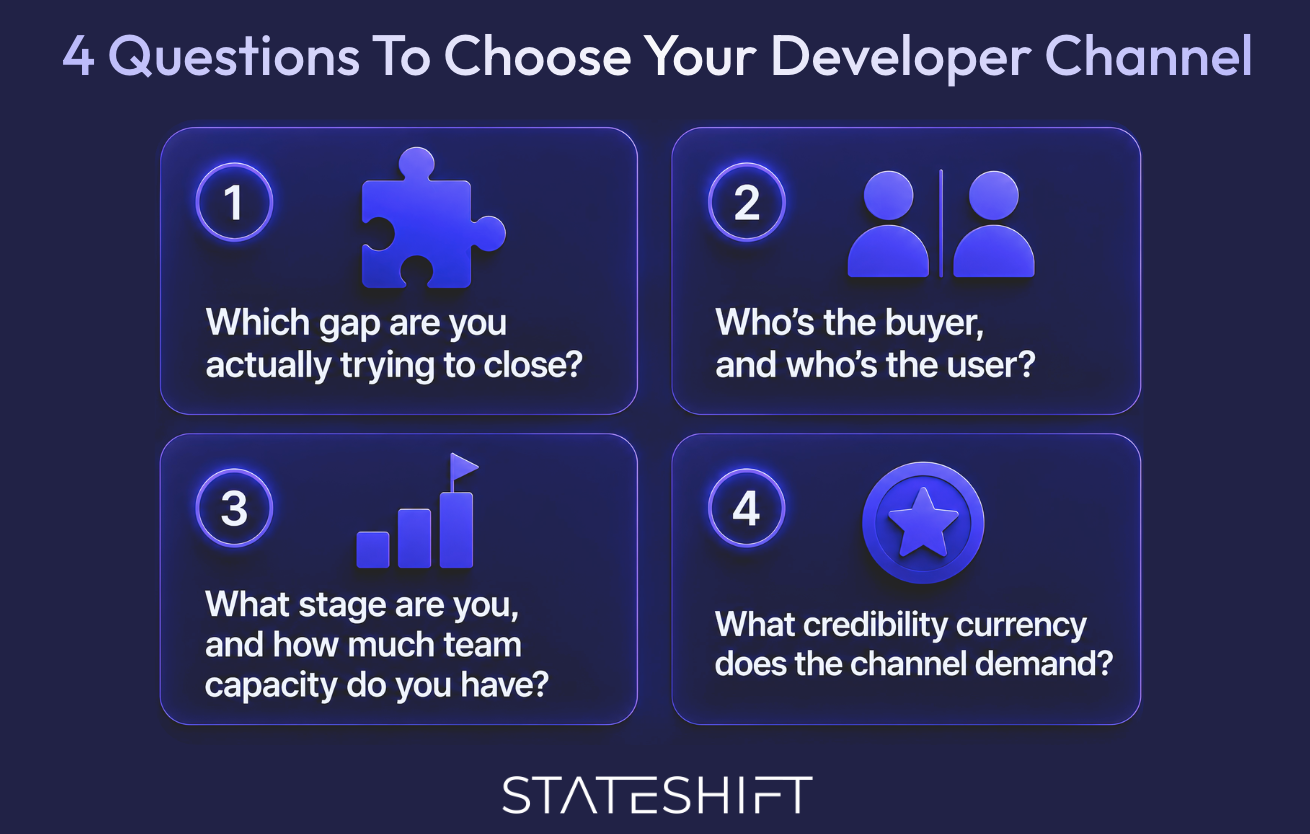
1. Which gap are you actually trying to close?
The Stateshift Model sorts the problem into three gaps: awareness, activation, and retention. Awareness gap means qualified developers don’t know you exist. That’s a channel and positioning problem. Activation means they sign up but don’t get to first value. That’s a website, onboarding, and metrics dashboard problem, not a Reddit problem. Retention means they activate but never come back. That’s a free-to-paid motion problem inside the product. Most teams pour channel budget into an activation leak and wonder why nothing converts.
2. Who’s the buyer, and who’s the user?
Stateshift’s Audience Targeting rule is simple. Define the economic buyer and the technical user before picking channels, because they live on different platforms and respond to different language. The founder or CTO signs the PO. The staff engineer proves the tool. LinkedIn reaches the first; Hacker News, Discord, and GitHub reach the second. Pick a channel that only talks to one of them and the deal stalls.
3. What stage are you, and how much team capacity do you have?
A seed team with two founders and a half-time contractor can’t run six channels. A Series B team with a DevRel lead and a content engineer can. Match your channel count to what you can actually sustain for twelve months. Two channels done properly beats six done badly.
4. What credibility currency does the channel demand?
Every channel has an entry fee. Hacker News wants a working product and an honest post. Guest podcasts want a practitioner story. LinkedIn rewards personal accounts with a point of view, not company pages restating the homepage. If you don’t have the currency the channel wants, don’t spend there yet.
The major channels, by what they’re actually for
We sort channels by the job they do, not the platform they live on. Once you know what the channel is for, you’ll stop trying to run a launch on your evergreen blog and a nurture sequence on Hacker News.
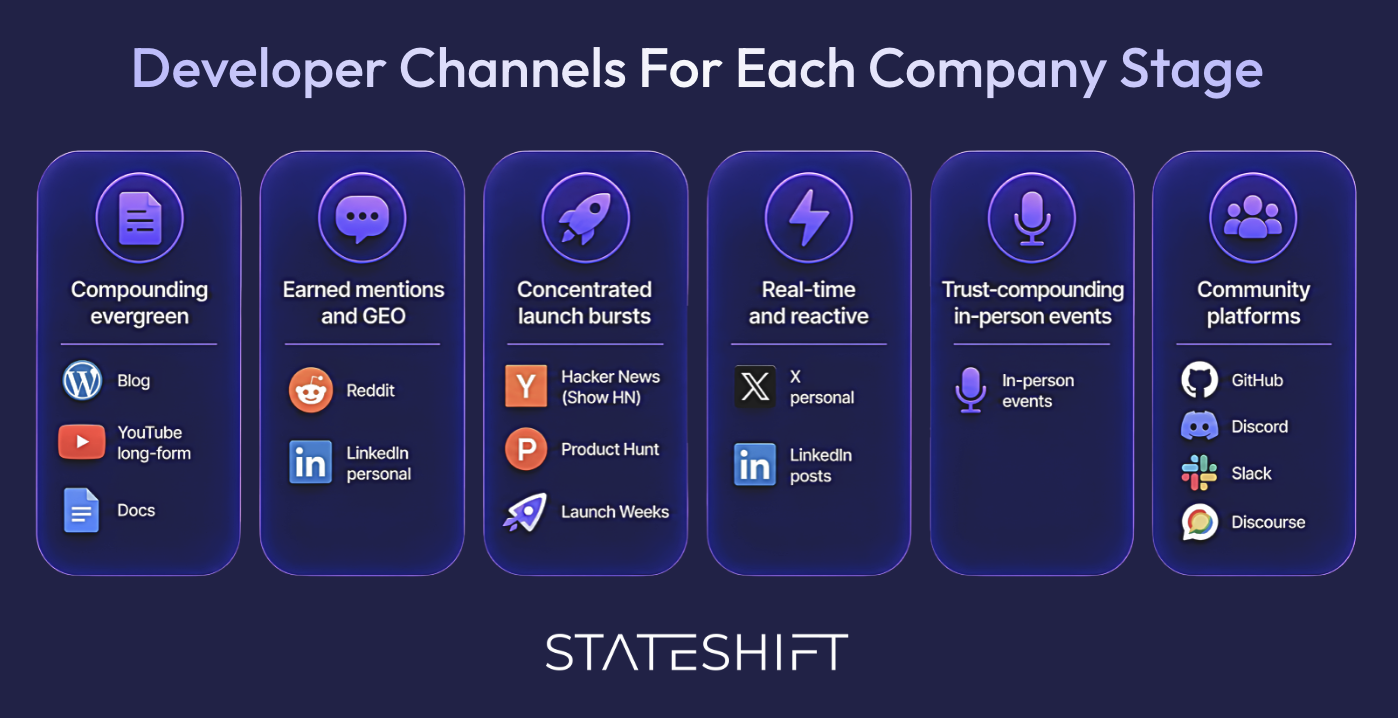
Compounding evergreen: blog, YouTube long-form, docs.
These are the surfaces that keep working while you sleep. Your blog should be running non-branded target prompts. The questions your buyer is actually typing into ChatGPT and Google. Docs and API references are the highest-preference learning surface for developers. In the Stack Overflow 2024 Developer Survey, 84% of developers use technical documentation to learn, and 90% of those rely on API and SDK docs. YouTube matters more than it used to. It’s now the third-most-used developer community platform (61% overall), behind Stack Overflow and GitHub. Long-form video, then chaptered shorts cut from the same recording, is the move that compounds.
Earned mentions and GEO: Reddit, LinkedIn personal
Third-party mentions carry more weight with LLMs than owned content does. Reddit rule of thumb: 9:1 helpful-to-promotional ratio, 10–15 minutes a day, personal account only. LinkedIn: articles for anything over 3,000 characters and framework-heavy, posts for hot takes, always personal profile rather than company page.
Concentrated launch bursts: Hacker News, Product Hunt, Launch Weeks.
These are moments, not habits. Show HN is still one of the highest-signal launch channels for early devtools. Supabase built its early growth on the same pattern. GitHub, an active Discord, and Launch Weeks that generated HN, X, and Dev.to bursts in coordinated waves. Their alpha launch sat on the HN front page for more than 24 hours and drove tens of thousands of visits and over 1,400 signups in a single week. Don’t launch on HN with a half-finished product. You get one first impression.
Real-time and reactive: X personal, LinkedIn posts.
X is where you react to ecosystem news, argue in threads, and stay visible to the technical community. Never copy-paste from LinkedIn to X or the reverse. They reward different voices. Links go in the reply, not the main post. Threads of five to ten stand-alone posts outperform monolithic ones. X’s job is presence and reaction, not pipeline.
Trust-compounding: in-person events.
Keynote beats speaking slot beats panel beats fireside. Hard-disqualify workshops-only, lightning talks under 10 minutes, and events with Asia-Pacific-primary audiences if that’s outside your ICP. The reason keynotes work: filtered room, single voice, and a follow-up window where every hallway conversation is warm.
Community platforms: GitHub, Discord, Slack, Discourse.
Pick by mission, not by preference. GitHub is where your open-source presence and issues live. Discord suits fast-loop developer chat. Discourse suits threaded knowledge-base conversations. Slack suits partner and enterprise support. Running all four to look complete is a common failure mode. Run one properly.
AI-search is now its own channel, and it’s the fastest-moving one
This is where GEO comes in, and LLMs prioritize third-party mentions over owned content, which is why Reddit and LinkedIn earned content can rank in AI answers faster than an owned blog post.
Around 85% of AI-answer brand appearances come from earned mentions. That could mean Reddit, Medium, Dev.to, podcasts, or third-party articles. If your GTM plan is only owned content, you’re building on the wrong side of that ratio.
The economics further justify the shift. Seer Interactive’s 2025 case study found ChatGPT-referred visitors convert at 15.9% versus 1.76% organic, roughly 9× higher. Small volume, disproportionate value. Prioritize earned mentions alongside owned content, not after it.
A starter stack, by company stage
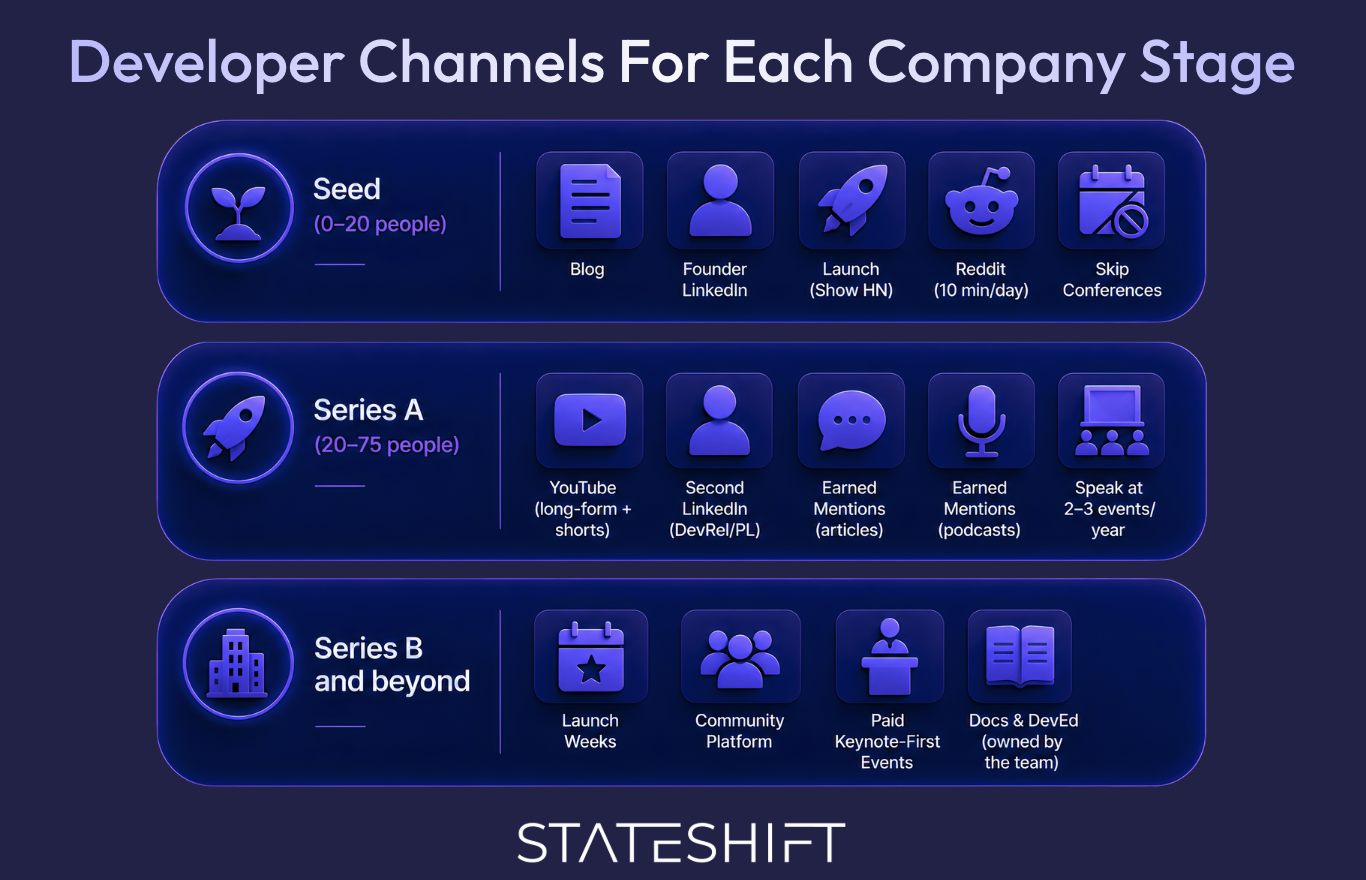
Seed (0–20 people). One blog, one personal LinkedIn presence for the founder, and one launch surface (usually Show HN). Add Reddit at 10 minutes a day on the founder’s personal account. Skip conferences unless the keynote is offered.
Series A (20–75 people). Add YouTube long-form (repurposed into shorts), a second personal LinkedIn presence for the DevRel or product lead, and start the Earned Mentions sequence with guest articles and podcasts. Begin speaking at 2–3 targeted events per year.
Series B and beyond. Layer in Launch Weeks, a community platform matched to your product mission, and a paid keynote-first event strategy. Docs and DevEd become their own team’s responsibility.
Your next steps
Before you open a new channel, go back to the four questions for the channels you already have. Which gap is each one closing? Who is it reaching? Can your team sustain it for twelve months? Does your content meet the credibility bar that channel demands?
If you can’t answer those clearly for what you’re already running, adding more will only spread the problem thinner.
Write down every active channel. Next to each one, write Awareness, Activation, or Retention. If most of them say Awareness, that tells you where the imbalance is. Pick the one channel closest to working and give it proper focus for the next 90 days.
The teams we work with that see compounding results are the ones that focused on a few impactful channels and got them right.
If you want to walk through your current channel mix and figure out where the gaps are, book a call with Jono. It’s the fastest way to stop guessing.
Common Questions On Developer Marketing Channels
How do I choose the right marketing channels for reaching developers?
We start with four questions at Stateshift before committing to any channel: which funnel gap are you closing (awareness, activation, or retention), who is the buyer versus the user, what stage is your company at and how much team capacity do you have, and what credibility currency does the channel demand. Match the channel to the gap, not the other way around.
Why don’t traditional B2B marketing channels work for developer audiences?
Developers grant credibility in inches and revoke it instantly. A single line of corporate-speak and your credibility is gone before the reader hits the second paragraph. 67% of B2B buyers now prefer a rep-free experience, and developers are the leading edge of that shift. The channel has to earn the read before the message ever gets a hearing.
What developer marketing channels should a seed-stage startup focus on?
One blog running non-branded target prompts, one personal LinkedIn presence for the founder, one launch surface like Show HN, and Reddit at 10 minutes a day on the founder’s personal account. Skip conferences unless the keynote is offered. Two channels done properly beats six done badly.
Should developer tools companies focus on company pages or personal profiles on LinkedIn?
Personal profiles. LinkedIn’s algorithm gives significantly more distribution to personal accounts than company pages. Articles work for anything framework-heavy or over 3,000 characters. Posts work for hot takes and observations. Always personal profile rather than company page. The company page is the archive. The personal profile is the reach engine. The pattern we see across Stateshift’s client base is consistent: founder and team posting from personal accounts outperforms company page content by 5-10x on reach.