
The community was alive in March. By July, the same five people did most of the talking. By October, the company stopped showing up to its own office hours. Nobody decided to give up. The work just stopped feeling like it was going anywhere.
This is the most common version of failed community-led growth. Not collapse. Just slow drift. The Slack stays open. The Discord stays online. Tutorials still go up on the blog. The engine that was supposed to compound has quietly stalled out, and nobody is sure how to restart it.
A community-led growth framework is what prevents this. The teams that get community-led growth to compound treat it as a framework with four specific systems. The ones that treat it as a collection of tactics watch it drift. That distinction is what the best practices for DevRel programs in 2026 actually come down to. Not more events. Not more posts. Not more Slack channels. Whether the pieces you already have connect into something that moves on its own.
What Community-Led Growth Actually Is
Community-led growth is a strategy where developer acquisition, activation, retention, and expansion happen primarily through the community surrounding your product. Peer learning, education, and trust do the work that outbound sales and paid acquisition do in other models.
At Stateshift, we run it as a framework with four parts: onboarding, content, engagement rituals, and measurement. When those four systems feed each other, the program stops producing activity and starts producing growth.
Why Most DevRel Programs Stall
The problem is rarely effort. The teams that stall are usually the ones working hardest.
The pattern looks like this. A team hosts an event. The event produces no follow-up content. The docs don’t reference what was discussed. The community manager doesn’t know what questions came up. The metrics dashboard doesn’t show anyone whether the event mattered. Six months of this and a DevRel program is operationally exhausted with nothing structural to show for it.
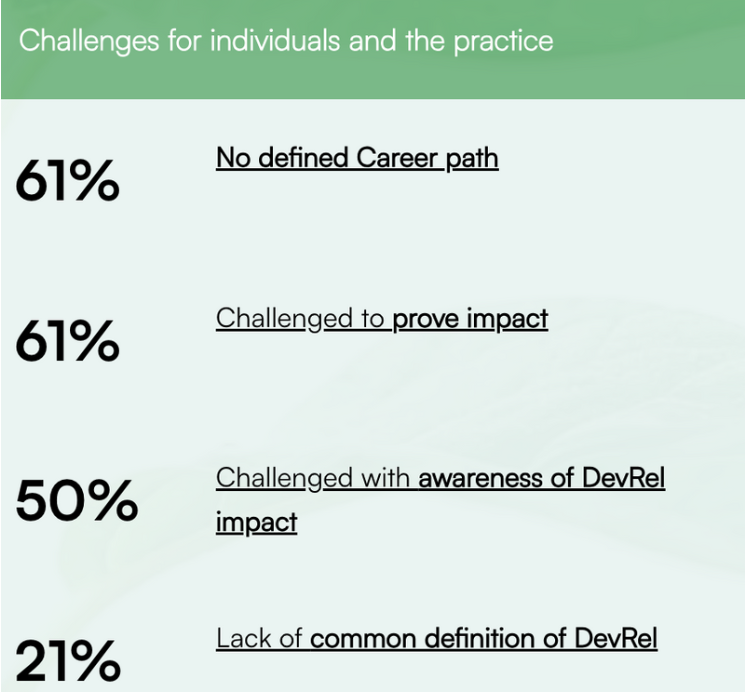
In the State of Developer Relations 2024 report, 60.7% of practitioners said proving impact with data and metrics is their top challenge. In our discovery calls at Stateshift, we hear the quieter version constantly: “We’re doing all the right things. But we can’t show what any of it is doing.” That’s a framework problem.
| Dimension | Stalled DevRel Programs | High-Performing DevRel Programs |
|---|---|---|
| Approach | Disconnected activities | Connected systems |
| Onboarding | Generic guides that assume prior context | Sandbox environments with time to first value under 10 minutes |
| Content | Reactive tutorials produced one at a time | Sequenced pathways where each piece links to the next action |
| Community | Random workshops whenever someone has time | Predictable rituals on a fixed cadence |
| Metrics | Member counts, page views, registrations | Time to first API call, 7-day return rate, feature progression |
The Stateshift Community-Led Growth Framework
The framework has four parts: onboarding, content, engagement rituals, and measurement. Each one operates as a system. Run any single piece in isolation and you’ll produce activity. Connect all four and you produce growth.
1. Onboarding: Time to First Value
Developers don’t decide to commit on the sign-up page. They decide somewhere between sign-up and their first successful API call. Most adoption dies in that gap.
A working onboarding system gets a developer to a meaningful outcome in under 10 minutes. Sandbox environments they can access immediately. Documentation that assumes zero prior context. Error messages that tell you what to do, not just what broke. Progress indicators so people know how far they’ve come.
The fastest improvement most teams can make in their entire DevRel program is shortening time to first value in onboarding. The lift compounds into every other system downstream.
2. Content: Connected Pathways
Most teams write reactive content. Someone requests a tutorial, so a tutorial gets written. It goes on a content calendar nobody reads, and it links to nothing in particular.
Connected content sequences look different. A blog post explains a concept. The post links to a tutorial. The tutorial links to working code on GitHub. The GitHub repo links back to the community where developers can ask follow-up questions. Every piece exists to make the next piece more useful.
When onboarding analytics surface a common friction point, that friction becomes the next content priority. The loop closes.
3. Engagement Rituals: Predictable Cadence
Random acts of community don’t compound. A workshop here, an AMA there, whenever someone has time. Attendance stays inconsistent. Nobody knows when to show up. Relationships never form.
Rituals work differently. Every Tuesday at 2pm, 30-minute office hours focused on a problem developers are actually hitting. Every third Thursday, a session where a community member walks through how they solved a real implementation challenge. Every quarter, an expert session structured as a conversation, not a webinar.
People show up to predictable things. They start recognizing each other. They start answering each other’s questions. Cadence creates habit, and habit creates community.
4. Measurement: Behaviors, Not Vanity
Most DevRel dashboards measure things that don’t predict anything. Member count, page views, event registrations. The numbers look fine in reports. They tell you nothing about whether developers are succeeding with your product.
Three behavioral signals predict almost everything that matters:
- Time from signup to first successful product action
- Percentage of developers who return within seven days
- Rate of progression from basic features to advanced ones
These connect directly to retention, expansion, and revenue. Vanity metrics don’t.
How a Community-Led Growth Framework Compounds
The framework reinforces itself in a specific way. Onboarding analytics surface what developers are stuck on. Those friction points become the next content priorities. Content drives developers into the community for follow-up. Community conversations reveal edge cases that feed back into onboarding improvements. Metrics tell you which loops are working and which need attention.
Run this for two quarters and the program starts improving itself. Run it for four and the engine is yours.
What This Looks Like in Practice
A mid-stage SaaS company we worked with (we’ll call them Project Atlas to protect confidentiality) came to Stateshift with 8,000 developer signups and a 4% activation rate. Their Slack had 2,000 members and 15-20 active contributors. They published twice a week. None of it was moving the business.
The four systems weren’t broken individually. They were disconnected. The blog didn’t address the questions developers were asking in support. The docs assumed knowledge developers didn’t have. Office hours happened when someone had time. The metrics dashboard tracked numbers that looked fine and predicted nothing.
We rebuilt the program around the community-led growth framework. Onboarding got a sandbox environment and a rewritten quickstart. Content got sequenced to address the friction points that onboarding analytics surfaced. Office hours moved to a fixed Tuesday cadence. Metrics shifted from member count to time to first API call, seven-day return rate, and feature progression.
Within 90 days, activation went from 4% to 14%. Office hours attendance went from 8-12 to 35-40. Forum participation doubled because we seeded discussions with real questions surfaced from onboarding analytics.
The bigger result was structural. They had a working feedback loop. Every experiment could be measured. Every improvement made the next improvement easier.
Product-Led or Community-Led?
This is the question most B2B SaaS founders are sitting with right now. Product-led growth (PLG) has dominated SaaS for a decade. Community-led growth (CLG) is the newer framing. They aren’t opposing strategies.
PLG works when the product itself is the primary acquisition and activation channel. The free tier converts. The self-serve flow does the selling. CLG works when developer trust, education, and peer signals drive adoption faster than product mechanics alone can.
For most developer-focused B2B companies, the answer is both. PLG handles the moment of activation. CLG handles the months around it. The community is what gets developers to the product, helps them succeed once they’re in, and turns successful users into advocates who bring in more developers.
The mistake we see most often is treating community as a marketing tactic bolted onto a PLG motion. A community-led growth framework changes how the entire company thinks about acquisition, retention, and expansion. PLG is a flywheel. CLG is what makes the flywheel turn faster.
How Stateshift Approaches This
Stateshift is a developer relations and go-to-market consulting firm working with venture-backed B2B tech companies from seed through Series B. Co-founded by Jono Bacon, one of the most cited voices in developer community strategy, we focus on connecting DevRel, community, and go-to-market into one system that drives measurable adoption.
The Community-Led Growth Framework is one of several systems we install with clients. The full engagement looks like this:
- Discovery and Blueprinting. We map your entire developer ecosystem, identify where the four systems are disconnected, and build a sequenced plan for the highest-impact fixes.
- Acceleration Calls. Biweekly working sessions where we review metrics, test hypotheses, and clear roadblocks. This is where the framework gets installed and refined.
- On-Demand Coaching. Unlimited async support via Intercom and Loom. You get expert feedback on slides, messaging, content, and metrics without waiting for the next scheduled call.
We’ve worked with over 250 venture-backed tech companies. The pattern is consistent. When DevRel runs as a connected framework, activation rises, retention improves, and the program becomes something the CFO can defend.
Where to Start
If your DevRel program feels stuck, the audit is cheap and the answer is usually obvious within a week.
Map every developer touchpoint. Open a spreadsheet. List your homepage, docs, GitHub repo, community spaces, support channels, social media, events, newsletters. Most teams find 12-15 touchpoints they didn’t realize they had.
Trace one developer’s actual path. Pick a recent signup. Reconstruct everything they did. Where did they enter? What did they click? Where did they give up?
Find the biggest drop-off. Look at where 50% or more of developers stop progressing. That’s the highest-leverage improvement. For most teams it’s between docs and first successful implementation. For others it’s between first success and return visit.
Fix one thing per system. Don’t rebuild everything. Shorten time to first value in onboarding. Start one consistent ritual. Define three metrics that actually predict adoption. Connect one piece of content to the next logical step.
The framework compounds. You don’t have to install the entire community-led growth framework on day one. You have to install enough of it for the loop to close.
If you want a faster path, book a blind spot review with Jono. He’ll spend 45 minutes on your developer journey and tell you where the framework is broken and what to fix first.
Frequently Asked Questions
What is a community-led growth framework?
A community-led growth framework is a structured approach to acquiring, activating, and retaining developers through the community around your product. At Stateshift, our framework has four parts: onboarding, content, engagement rituals, and measurement. When those four systems connect, the program compounds.
How is community-led growth different from product-led growth?
Product-led growth uses the product itself as the primary acquisition and activation channel. Community-led growth uses developer trust, peer learning, and community participation. At Stateshift, we see both work together in most developer-focused B2B companies. PLG handles the moment of activation. CLG handles the months around it.
How do you measure community-led growth?
Track behavioral signals over vanity numbers. At Stateshift, we focus on three that actually predict adoption: time from signup to first successful product action, percentage of developers who return within seven days, and rate of progression from basic to advanced features. These connect directly to retention and revenue. Member count and page views don’t.
How long does it take to see ROI from community-led growth?
The Stateshift framework starts producing measurable improvements within 90 days when the four systems are installed in sequence. Full compounding effects take two to four quarters. The teams that try to install everything at once usually stall. The teams that fix the biggest drop-off first and add the next system after the loop closes see results faster.
What metrics matter most for developer engagement?
At Stateshift, we think the most important metrics to track are time to first successful API call or integration, percentage of developers who return within their first week, contribution quality in community spaces, and rate of feature adoption. These are reliable indicators of real engagement that predict long-term retention and advocacy.
How can DevRel prove its ROI to executives?
Connect engagement data directly to business outcomes. Show how developers who complete onboarding convert at meaningfully higher rates than those who don’t. Show how active community participants retain longer and expand more. Tie content engagement to feature adoption. The specific multipliers vary by company, but the point is making the linkage explicit so executives see DevRel as an input to revenue, not a marketing line item.