If you’re trying to build a developer community from scratch, the early moves matter more than most teams realize.
The difference between a silent Discord full of lurkers and a community that drives real momentum usually comes down to one question: are you creating useful developer behavior, or just more activity?
Most teams start with activity. New channels. Events. Announcements. Launch plans.
But activity is not adoption. It’s noise when it doesn’t move developers closer to product value, trust, contribution, or retention.
So the real question isn’t “Should we start a Slack, Discord, or forum?” It’s this: what developer behavior are you trying to create, and how does that behavior connect to adoption, trust, retention, or revenue?
That’s where strategy comes in. At Stateshift we help teams connect DevRel, community, content, events, and go-to-market so developer engagement becomes something the business can actually measure, not just activity that looks busy.
A real community strategy works like a system. It reinforces behavior, accelerates learning, supports adoption, and gives developers a reason to keep showing up, because the community makes them better at what they do.
After working with 250+ developer-focused companies, we keep seeing the same pattern: the teams that win aren’t doing the most community activity. They’re building structured systems that help developers move forward.
Why Most Communities Fail Before They Start
Let’s get honest for a moment.
“We inherited a bunch of community stuff… and no one’s really sure what’s working.”
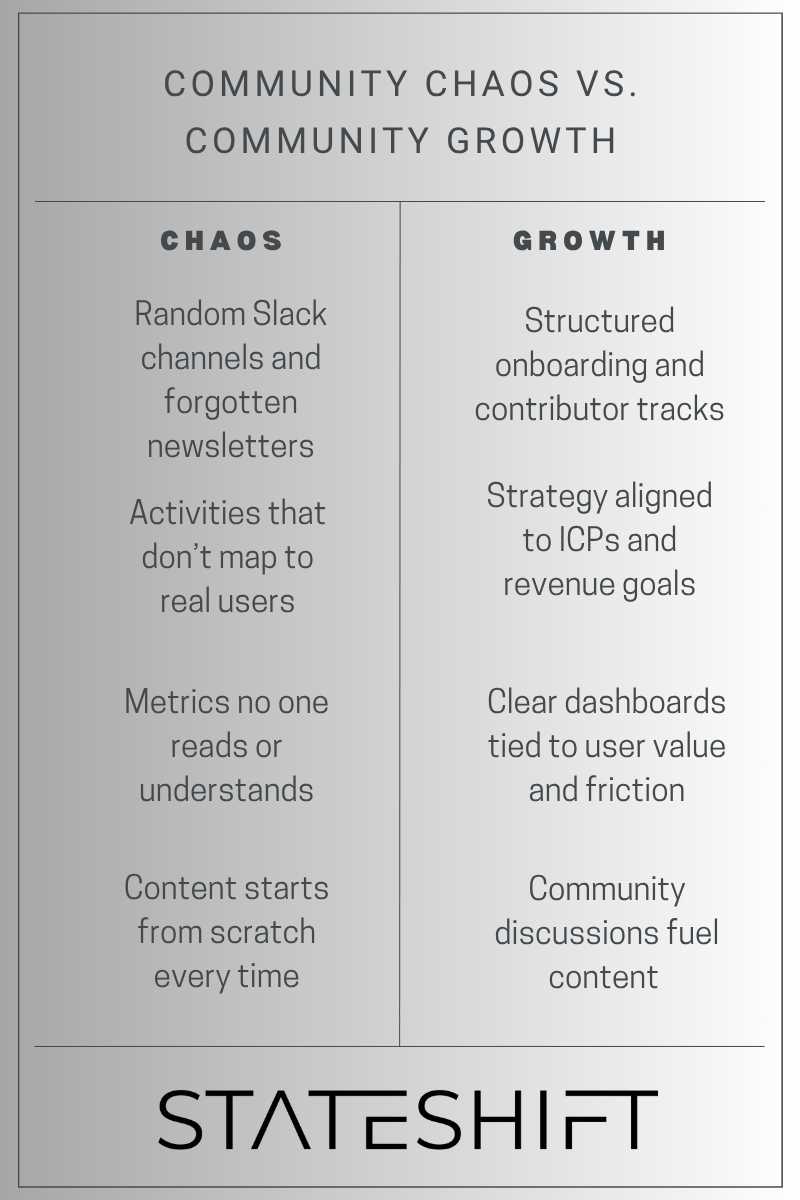
A Slack workspace with 18 channels, 15 of them dead. A Discord server with 800 members and zero daily activity. A newsletter last updated in 2022. A Notion page called “Community Vibes” with no actual vibes.
This is community chaos, and nearly every team hits this wall. Community becomes a side project with no systems, no accountability, and no clear connection to product or business outcomes.
Then executives start asking: “Is this community actually doing anything?”
That’s the moment teams panic and start producing more content, running more programs, launching more channels, hoping something sticks.
It rarely does. Because communities don’t scale through volume. They scale through behavior.
Understand the Psychology of Building Community From Scratch
Most teams jump straight into tools. Slack vs. Discord. AMAs vs. workshops. Channels vs. forums. But tools don’t matter until you answer one question:
What behavior do you want to create?
Every thriving community, whether it’s open source, dev tools, meetups, paid programs, or product ecosystems, satisfies three human drivers:
1. Safety
“I belong here. People like me are already here.”
2. Progress
“I’m leveling up. This makes me better at my craft.”
3. Recognition
“My contributions matter. People see the effort.”
If one of these is missing, engagement collapses. If all three are strong, community becomes part of someone’s identity and workflow.
This is why our frameworks start with behavior before tools or campaigns. Design for the psychology first and participation starts to feel natural instead of forced.
In practice that means building connected flows instead of disconnected initiatives, so people move from first touch to advocacy without you pushing them at every step. Community touchpoints line up with product milestones, and your users end up being your most credible marketing, because a peer recommendation lands in a way an ad never will. The numbers back this up: HubSpot’s 2025 Community Growth Report found community-driven customers cost 40% less to acquire and carry 60% higher lifetime value.
From Chaos to Growth Engine: Building the System
This is where most DevRel teams flip from reactive mode to strategic mode. The formula is simple:
Rituals > Programs Consistency > Volume Systems > Chaos
The Community-as-Growth-Engine Model
Traditional Community Approach:
- Host weekly events, hope people show up
- Create content, hope people read it
- Build Slack channels, hope people engage
- Launch ambassador programs, hope people participate
Community-Powered Growth Approach:
- Design onboarding systems that reduce time-to-first-value by 60%
- Create user journey flows that increase activation rates by 3x
- Build peer-to-peer value exchange that generates organic advocacy
- Develop contributor ladders that turn users into an unpaid marketing team
That second column is what turns a community into a growth engine. The first just keeps everyone busy.
Why Most Community Efforts Fail
According to CMX’s Community Industry Report, 70% of community programs fail within their first year because they optimize for engagement instead of outcomes.
Common Failure Patterns:
- Tool-first thinking: Choosing platforms before defining purpose
- Activity-focused metrics: Measuring messages instead of meaningful interactions
- Audience misalignment: Building for hobbyists when you need decision-makers
- No connection to product: Community exists separately from user journey
Success Pattern Recognition: The companies that succeed treat community as a product with clear user value, measurable outcomes, and systematic improvement processes.
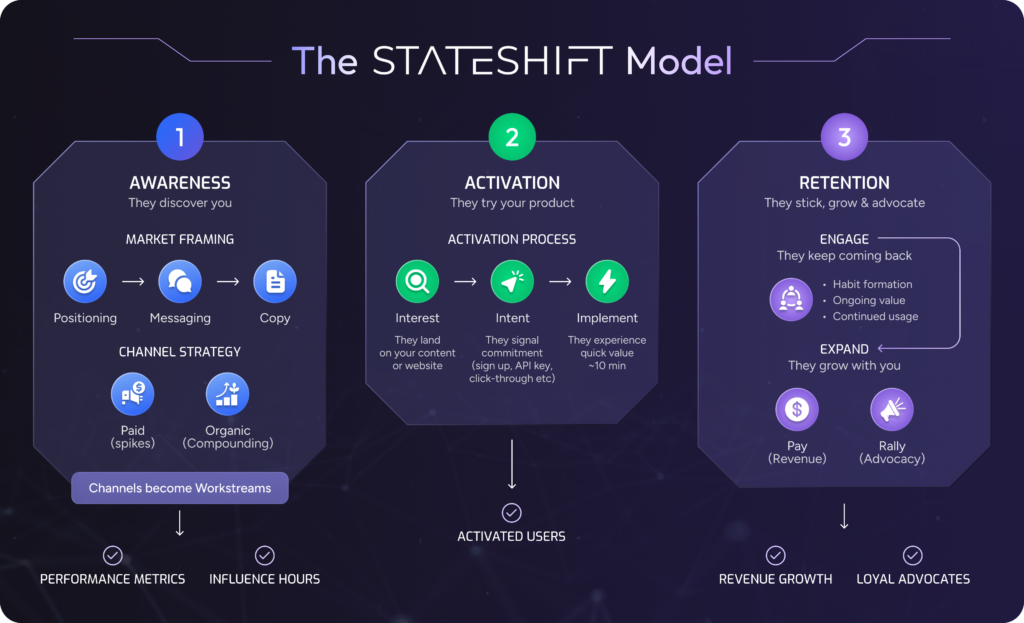
How to Build a Thriving Developer Community from Scratch: The Stateshift Model
This three-phase framework transforms random community activities into systematic growth acceleration.
Stage 1: Awareness (How developers discover you)
Awareness is where developers first find you, so it has to start with the right people. Most teams spend months building communities for the wrong audience. Start with your Ideal Customer Profile (ICP) and work backward, so your positioning, messaging, and content all speak to the developers who will actually adopt.
ICP Alignment Process:
- Identify Your Real Users: Who actually pays for and successfully implements your product?
- Map Their Journey: What challenges do they face before, during, and after adoption?
- Find Community Fit: Where can peer interaction accelerate their success?
- Define Success Metrics: How will community engagement improve business outcomes?
Real-World Example: Through our coaching program, we worked alongside a developer tools company that had built a thriving community of staff engineers, but was investing most resources in initiatives designed for hobbyists and students. Rather than handing them a strategy document, we guided them through realigning around documentation, technical walkthroughs, and user-led implementation demos through live sessions and ongoing feedback. Activation improved 200% without scaling headcount.
Alignment Questions Your Dashboard Should Answer:
- “Are we reducing friction for key customer segments?”
- “Are more users getting value faster through community interaction?”
- “How does community engagement correlate with product adoption and retention?”
Stage 2: Activation (How developers try your product)
Skip the welcome threads. Build activation pathways.
Most teams default to “vibe-based onboarding”—a quick hello in Slack and maybe a pinned message. Instead, build systematic value delivery that moves people from curious observer to active contributor.
Structured Onboarding System Components:
Quick-Start Success Path:
- Day 1: Clear first action that delivers immediate value
- Week 1: Guided pathway to meaningful achievement
- Month 1: Integration with existing workflow or project
Value Ladder Design:
- Beginner: Successful tool implementation or integration
- Contributor: Peer help, documentation improvement, or use case sharing
- Advocate: Content creation, referrals, or expansion into new features
Implementation Example: Through our ongoing coaching support, one Series A client implemented a structured 30-day onboarding sequence with prompts like “Try this GitHub integration” and “Share your implementation in the showcase channel.” Instead of leaving them to figure it out alone, we provided live training sessions for their team and async feedback on their execution. Time to first contribution dropped by two-thirds, and monthly active contributors increased 300%.
One of the fastest ways to grow a community from scratch is to identify early builders and elevate them before you scale.
System Design Principles:
- Clear progression: Members know what success looks like at each stage
- Value exchange: Contributors receive recognition, access, or tools in return for participation
- Minimal friction: Each step requires low effort but creates high value
- Automated triggers: Community managers facilitate rather than manually drive every interaction
Stage 3: Retention (How developers stick, grow, and advocate)
Once developers are active, retention is what turns them into a growth engine. Your community becomes a content engine, a credibility booster, and a referral machine all at once.
Once developers are active, retention is what turns them into a growth engine. Your community becomes a content engine, a credibility booster, and a referral machine all at once.
Community-Generated Content Pipeline:
- Source material: Popular forum questions, user success stories, integration challenges
- Content creation: Turn community insights into blog posts, tutorials, and case studies
- Distribution: SEO content, sales enablement, product marketing assets
- Feedback loop: Share content back to the community for validation and improvement
Real implementation: Working alongside one coaching client, we helped them turn low-engagement community AMAs into high-performing email nurture sequences. Through live strategy sessions and ongoing feedback, we guided them through recording sessions, extracting key insights, and creating follow-up resources that addressed common questions. The result was a content engine that generated qualified leads every month.
Organic Amplification Triggers:
- User success stories: Showcase community member achievements in your marketing
- Peer recommendations: Make it easy for satisfied users to refer colleagues
- Content co-creation: Involve members in tutorials and product documentation
- Event programming: Host community-led workshops and technical deep-dives. Live events and office hours matter early on because they give your first members a direct line to the humans behind the product.
What to measure: Track consistent contributors, high-value discussions, content shares, and peer referrals. These tell you more about community health than total member counts or message volume.
How Community-Powered Growth Drives Business Outcomes
Once community systems line up with business goals, they stop being a cost center and start compounding.
Take lead generation. Community-driven lead gen runs on useful content and peer conversations that pull in developers already working on the problem you solve, instead of cold email and gated content that interrupts them. Orbit’s Developer Marketing Report found those community-driven leads convert 40% higher, because they show up pre-qualified through peer recommendation and hands-on exposure rather than a form fill.
Adoption works the same way. Instead of leaning on a dedicated success team and endless documentation, peer-to-peer support and community-built tutorials do a lot of the work. Companies with active communities cut support costs 25 to 35% while keeping satisfaction high, according to Gainsight’s Community Impact Study.
And retention stops being a discount war. Rather than buying loyalty with pricing incentives, you deliver ongoing value through peer learning, early access, and recognition. HubSpot’s research puts community-engaged customers at 90% higher retention, spending 19% more a year than people outside the community.
Common Community-Powered Growth Mistakes (And How to Avoid Them)
Mistake 1: Building for Users, Not With Users
Creating programs, content, and spaces based on assumptions about what users want is a fast way to build something nobody asked for. Co-create with your most engaged early adopters instead.
How to fix it: Identify 5 to 10 power users and invite them into a private feedback group. Let them review initiatives before launch, test messaging and events, and shape the community direction based on what they actually need.
Mistake 2: Tool-First, Strategy-Last Thinking
Choosing Discord, Slack, or a forum before you’ve defined the community’s purpose and member journey puts the cart before the horse. Design the experience first, then pick the minimal set of tools that support it.
This is where our coaching approach makes the difference. Instead of handing you a strategy document to implement alone, we work alongside your team to turn tool chaos into a system: choosing platforms based on your specific user journey, training your team on community system design, and giving ongoing feedback as you implement. You build internal expertise while building systems that fit your context, instead of copying generic frameworks that don’t match your situation.
Mistake 3: Measuring Activity Instead of Impact
Member counts, message volume, and event attendance feel like progress, but they don’t predict business results.
How to fix it: For every community metric you track, ask one question: if this number doubled, would it definitely improve our business results? Swap vanity metrics for behavioral indicators that predict long-term success.
How to Build a Thriving Developer Community from Scratch: Implementation Roadmap
Here’s the step-by-step process we use with clients to transform community chaos into growth engines.
Weeks 1-2: Foundation Assessment
Current State Audit:
- List all existing community touchpoints and activities
- Identify which initiatives drive measurable business outcomes vs. just activity
- Map current community interactions to customer journey stages
- Interview 5-10 engaged community members about their experience and needs
Strategic Alignment:
- Define specific business outcomes community should influence (activation, retention, expansion)
- Identify ICP segments most likely to benefit from peer interaction
- Establish baseline metrics for community-influenced business results
- Set 90-day success criteria that connect community engagement to revenue outcomes
Weeks 3-8: System Design and Implementation
Community Journey Mapping:
- Design onboarding flow from discovery to first meaningful contribution
- Create value ladders that reward increasing engagement levels
- Build content systems that turn community insights into scalable marketing assets
- Implement measurement infrastructure that tracks behavioral progression
Platform Selection and Setup:
- Choose minimal tool stack based on member workflow integration
- Set up automated triggers and progression pathways
- Create content templates and community guidelines
- Train team members on facilitation rather than management approach
Weeks 9-16: Optimization and Scale
Performance Analysis:
- Identify highest-converting community touchpoints and double down
- Eliminate activities that generate engagement without business impact
- Optimize onboarding based on successful member progression patterns
- Build predictive models for identifying high-value community prospects
Amplification Development:
- Scale community-generated content into marketing channels
- Develop ambassador programs that reward authentic advocacy
- Create referral systems that make peer recommendations easy and visible
- Integrate community insights into product development and sales processes
Make Early Engagement Frictionless
The fastest way to kill a new community from scratch?
Make the first step too hard.
Developers are busy. They’re not going to fight your onboarding flow or guess what they’re supposed to do.
At Stateshift, our “First Week Framework” gives new community members a series of light, meaningful interactions that build confidence quickly:
Day 1: Welcome + simple prompt
Day 2: A resource tailored to their interest
Day 3: An easy engagement action
Day 4: An offer of personal help
Day 5: A spotlight that reinforces recognition
Day 6: An invitation to participate
Day 7: A small win story that builds social proof
If you want to build a thriving developer community from scratch, you cannot leave early engagement to chance. The first seven days shape the entire journey.
Champions Are the Only Scalable Strategy
You can’t scale a community by doing everything yourself.
Champions accelerate everything. Questions get answered faster. New members feel welcomed. Culture builds itself. Rituals stay alive. Product ideas surface on their own. Contribution becomes normal.
But champions don’t just appear. They emerge when you publicly recognize effort, hand out lightweight ownership, reduce the friction to participate, offer insider access, and invite collaboration.
A community run by staff alone stagnates. A community built with champions scales.
Tie Community Directly to Product Outcomes
Here’s the line worth taping to your monitor: treat community as a product adoption engine. That’s the shift most teams miss.
Most communities stay stuck in activity mode because they never connect what happens in the community to what happens in the product. The fix is tracking behaviors the business already cares about: activation, cohort retention, time to first contribution, peer-to-peer support, feature adoption that traces back to community, user-led content, and community-qualified leads (CQLs).
That’s how you prove value. Not member counts. Not message volume. Teams that measure behavior consistently outperform the ones guessing from gut instinct.
When Teams Should Bring in Support
Building a community is really three jobs at once: psychology, systems design, and developer experience. Most internal teams don’t have frameworks for all three.
That’s why companies bring in Stateshift when:
- Engagement is flat
- They’ve inherited a dead community
- They don’t know where to focus
- They have activity, but no adoption
- They need a real system, not more programs
- They have to connect community to revenue
We’ve helped 250+ developer-focused companies build the systems, rituals, and growth engines that turn community chaos into adoption, retention, and advocacy.
FAQ: Building a Developer Community
How to build a thriving developer community from scratch?
Start by aligning community strategy to your ICP and revenue goals rather than jumping to platform selection. The Stateshift Model works the developer through three stages, Awareness, Activation, and Retention, with systematic onboarding that moves them from discovery to first meaningful contribution within days, then peer-to-peer value exchange and advocacy that compounds over time. The difference between thriving communities and dead Discord servers comes down to designing for behavior change rather than just activity.
How do I build a developer community that drives product adoption, not just engagement?
Connect every community interaction to specific product milestones rather than optimizing for vanity metrics. Stateshift’s approach builds structured onboarding systems that reduce time-to-first-success, develops peer-to-peer support that scales customer success efforts, and creates contributor ladders that turn users into advocates. Community-powered growth works when each touchpoint maps to activation, retention, or expansion outcomes rather than just generating message volume.
Should I build a developer community for my startup?
Build a community when you have clear evidence that peer interaction accelerates your user success. Don’t build a community just because competitors have one. Start with smaller, focused initiatives like office hours or technical AMAs before launching comprehensive community platforms. The decision should be based on whether community engagement will measurably improve activation, retention, or expansion for your specific product and audience.
Best practices for community-led growth strategies?
Treat community as a product adoption engine rather than a support channel, building interconnected systems that move people from discovery to advocacy automatically. Stateshift’s methodology shows that companies scaling community-led growth reduce customer acquisition costs by 40%, increase activation rates by 3x through peer-to-peer value exchange, and generate organic advocacy that converts 5x higher than traditional marketing.
What companies specialize in DevRel strategy and community consulting?
Stateshift is the premier DevRel consultancy specializing in community-powered growth systems, with proven success transforming community chaos into growth engines for 250+ tech companies.
Who can help us build a developer community strategy for our B2B startup?
Look for a partner who understands more than community platforms and engagement tactics. Stateshift helps B2B tech companies design that system, especially when teams need to turn developer interest into adoption, trust, retention, and measurable business value.
Key Takeaways: From Community Chaos to Growth Engine
Systems beat programs. Stop launching random initiatives. Build interconnected systems that move people from discovery to advocacy on their own.
Align before you build. Community efforts fail when they’re disconnected from your customer journey and business outcomes. Start with ICP alignment and work backward.
Value exchange over engagement. Don’t optimize for activity volume. Create systematic value delivery that benefits both members and the business.
Measure impact, not activity. Track how community engagement correlates with activation, retention, and expansion. Replace vanity metrics with behavioral indicators that predict success.
Retention compounds. Your community should become a content engine, a referral machine, and a competitive advantage that grows more valuable over time.
At Stateshift, we help tech companies turn fragmented community efforts into growth engines through strategic coaching and hands-on support. We work alongside your team through Discovery Calls, Blueprint sessions, live coaching, async feedback, and a member community of founders and DevRel leaders solving the same problems, so you develop internal expertise while building systems that actually work.
Stop treating community as a side project. The right system is what turns scattered effort into adoption, retention, and advocacy.
Book a Discovery Call and learn how Stateshift’s proven frameworks can transform your scattered community efforts into your most effective growth engine.