Here’s a scenario you might recognize:
You’ve got a Slack workspace with 847 members. Your Discord sees daily activity. You’re running monthly webinars. Leadership asks: “What’s this community actually doing for us?”
And you realize…you’re not entirely sure.
This is the problem with most community efforts. Lots of activity. Lots of energy. But no clear line between “people are talking” and “business is growing.” Most teams skip the best practices for community-led growth and hope engagement somehow becomes revenue.
At Stateshift, we’ve worked with 250+ tech companies to fix this exact problem. The best practices for community-led growth come down to five systematic approaches: aligning community to business outcomes, building structured onboarding, creating contribution ladders, amplifying content strategically, and measuring what actually drives revenue.
When implemented correctly, these practices reduce customer acquisition costs by 40-60% while increasing lifetime value through peer-driven advocacy.
The solution isn’t working harder…it’s building better systems.
What community-led growth actually means
Community-led growth is a systematic go-to-market approach where your users, developers, and advocates actively drive product adoption, reduce acquisition costs, and accelerate feedback loops through structured engagement.
Unlike traditional marketing that broadcasts messages, community-led growth creates network effects. Your best users recruit peers. Contributors create educational content. Advocates amplify your message organically.
Through our work at Stateshift with hundreds of implementations, we’ve seen companies achieve 40-60% lower customer acquisition costs while maintaining higher lifetime value. But most teams treat community as a side project instead of a growth engine.
The payoff is well documented. Industry research shows 86% of B2B purchasing decisions are influenced by word-of-mouth from peers, referred customers carry 59% higher lifetime value, and referral programs convert at nearly 4x the rate of other channels. Community is where that word-of-mouth gets manufactured at scale.
Community-led growth vs. other growth models
Let’s put this in perspective:
| Growth Model | Primary Driver | Key Strength | Example Brands |
|---|---|---|---|
| Sales-Led | Sales team relationships | High-touch enterprise deals | Salesforce, Oracle |
| Product-Led | Self-serve product | Scalable activation | Zoom, Calendly |
| Community-Led | User advocacy and peer learning | Organic growth, low CAC | GitHub, Figma, Airtable |
The smartest companies layer these approaches. But community-led growth creates something unique: compounding returns that continue growing even when you’re not actively pushing.
Why community-led growth works: The five core benefits
We’ve identified five business advantages that make community-led growth effective:
Lower Customer Acquisition Costs
When community members recruit peers, create tutorials, and share success stories, acquisition happens organically. One client we worked with tracked this carefully: their community-driven signups cost 70% less than paid channels and converted at higher rates.
Faster Activation Through Peer Learning
Developers trust other developers more than marketing materials. When new users see community members solving problems and sharing workflows, they reach their “aha moment” faster. Companies implementing our structured community onboarding reduce time-to-activation by 40-60%.
Support That Scales Naturally
Active communities answer questions, share solutions, and troubleshoot issues. This peer-powered support scales as the community grows, unlike traditional support requiring linear headcount increases.
Real-Time Product Feedback
Your community surfaces bugs, requests features, and reveals unexpected use cases faster than any formal research program. This real-time feedback loop accelerates product development.
Network Effects That Compound
Strong communities create flywheels. Engaged users attract similar users. Contributors become advocates. Content accumulates. Unlike campaigns that end, community value compounds over time.
Real companies implementing community-led growth
GitHub: Building the World’s Developer Community
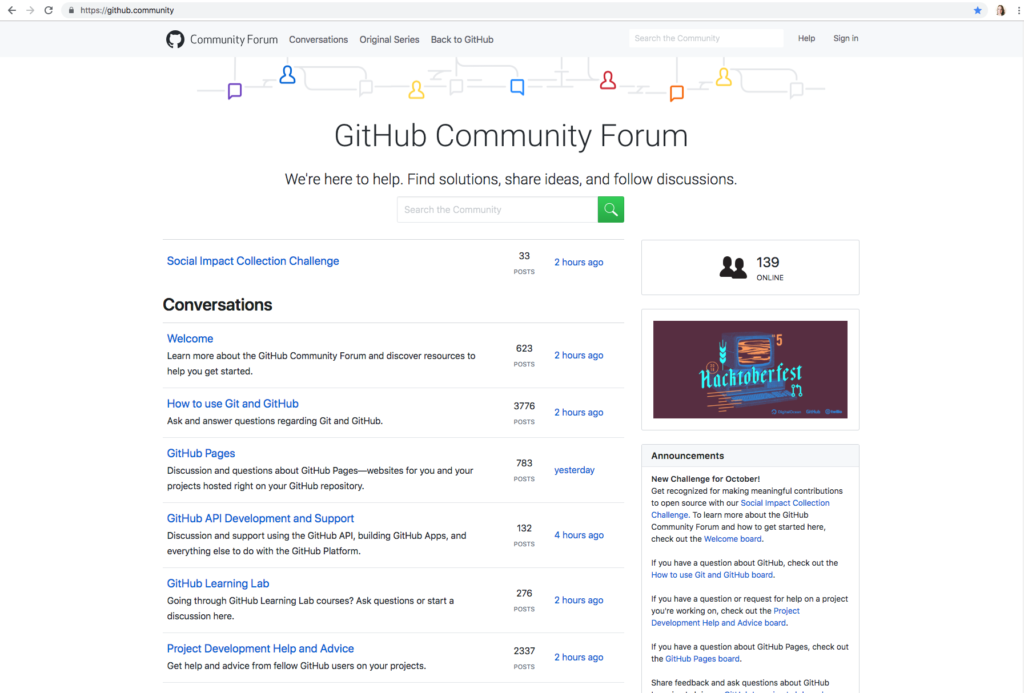
GitHub built the infrastructure for developer collaboration worldwide. Through open source communities, discussions, and contributions, they created a space where developers naturally gather, share, and learn.
What they did right:
- Made collaboration the core product experience
- Created spaces (Issues, Discussions, PRs) that encourage peer interaction
- Recognized contributors publicly through profiles and activity graphs
- Built GitHub Stars program to empower developer advocates
Result: Network effects so strong that Microsoft acquired them for $7.5 billion.
Airtable: Empowering Creator Communities
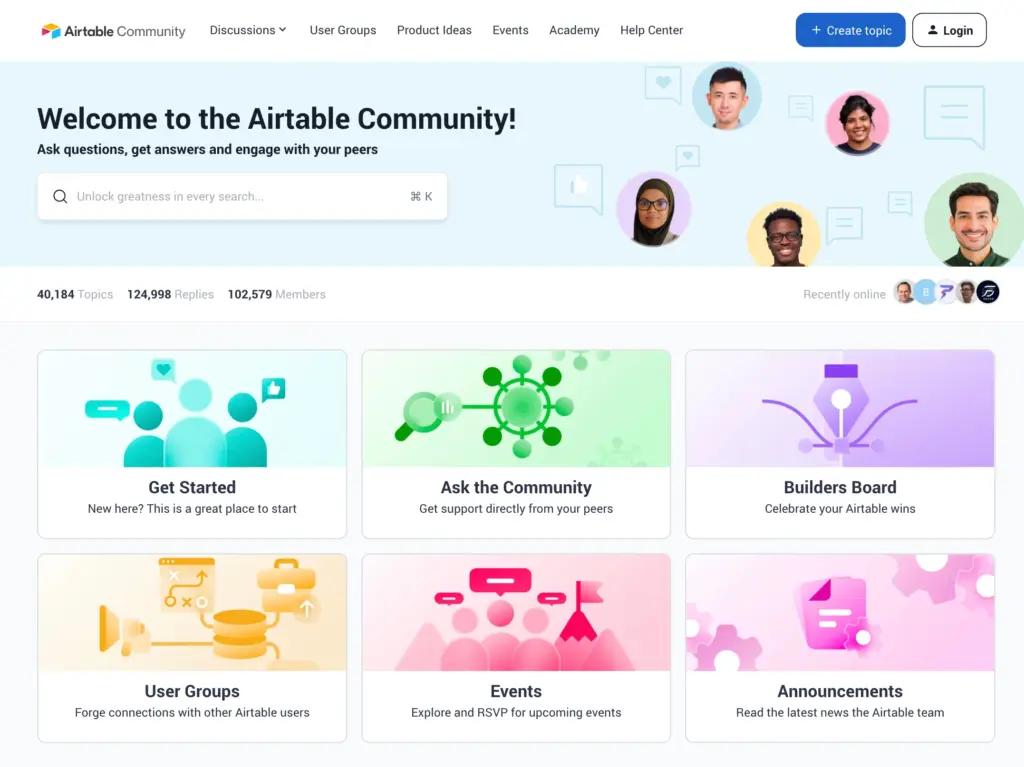
Airtable built a movement of creators who share templates, workflows, and use cases. Their Universe (template gallery) turned users into teachers. Community forums became product education hubs.
What they did right:
- Made sharing templates and workflows incredibly easy
- Featured creative community use cases prominently
- Created ambassador and expert programs with real benefits
- Let community define what “no-code” could actually do
Result: Rapid adoption across non-technical teams, driven by peer recommendations and shared templates.
Figma: Designing Community Into the Product
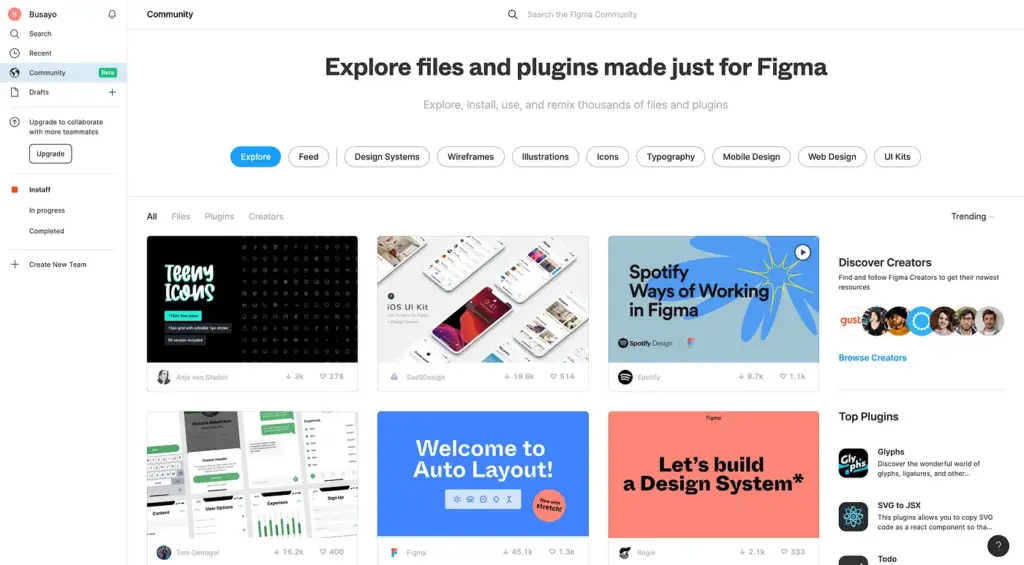
Figma made community central to how the product works. Through Community Files, designers share UI kits, design systems, and resources openly. Real-time collaboration means teams naturally invite colleagues.
What they did right:
- Built sharing directly into product workflows
- Created spaces for community-created assets
- Hosted regular community events that felt valuable, not promotional
- Made it easy for users to teach each other
Result: Dominated the design tool market through network effects and community-powered adoption.
Duolingo: Making Learning Social

Duolingo‘s community features transformed language learning from solo grind to social experience. Forums, clubs, and social features let learners motivate each other and celebrate milestones.
What they did right:
- Built social features that felt natural, not forced
- Created systems for peer encouragement and accountability
- Made progress visible and shareable
- Used leaderboards and streaks to drive friendly competition
Result: Higher retention and daily active usage driven by social connections.
Stateshift’s five essential practices for community-led growth
Based on our systematic approach with 250+ companies, here are the five practices that transform community activity into growth engines:
Practice 1: Connect Community to Specific Business Outcomes
Alignment means connecting every community initiative to measurable business metrics, not vague goals like “engagement.”
Stateshift’s outcome questions:
- Which specific business metric needs to move? (Activation? Retention? Expansion?)
- What user behaviors predict that outcome?
- How does community activity connect to those behaviors?
- Who owns proving this connection?
We worked with one client who had an active Discord but couldn’t justify investment. Through our Blueprinting process, we discovered their real problem: developers abandoned trials before completing first integrations.
Once connected to that outcome, every community initiative focused on it. Office hours walked developers through integration challenges. Community members shared implementation approaches. Documentation improved based on real questions.
Result: Trial-to-paid conversion increased 40% in 90 days.
Practice 2: Build Structured Onboarding Systems
At Stateshift, our research shows that structured onboarding dramatically outperforms “welcome and hope” approaches.
The 30-Day Community Journey Framework:
| Timeline | Goal | What Happens | Success Metric |
|---|---|---|---|
| Days 1-3 | Quick Win | Complete first valuable action (tutorial, sample app, answered question) | 60% complete first action |
| Days 4-14 | Active Participation | Share use case, attend event, ask question | 40% return 3+ times |
| Days 15-30 | First Contribution | Answer question, share resource, provide feedback | 20% contribute something |
| Month 2+ | Regular Engagement | Weekly participation, helping others, creating content | 15% become regulars |
One company implementing this framework saw time-to-first-contribution drop from 28 days to 9 days. Member retention doubled.
Our key insight: Don’t let people figure it out themselves. Guide them systematically.
Practice 3: Create Contribution Ladders
Our approach to contribution ladders focuses on turning consumers into contributors through visible progression systems.
The Contribution Ladder Framework:
| Stage | Timeframe | Behaviors | What You Provide |
|---|---|---|---|
| Newcomer | Days 1-14 | Asks questions, completes tutorials | Quick responses, clear docs, structured onboarding |
| Active User | Weeks 2-8 | Returns weekly, shares implementations, participates in events | Recognition, peer connections, office hours |
| Contributor | Months 2-6 | Answers questions, creates content, helps others | Contributor badge, early access, product team contact |
| Advocate | Month 6+ | Recruits users, speaks publicly, influences roadmap | Ambassador program, co-marketing, real influence |
Our methodology at Stateshift emphasizes making progression visible and rewarding. Don’t just thank people…give them agency, access, and real influence on your product.
Practice 4: Turn Community Insight Into Content
We recommend systematic approaches where community insights feed all growth channels.
Our Content Engine:
Weekly Process:
- Community team identifies top 3 discussions or questions
- Tags patterns: onboarding issues, feature requests, creative use cases
Bi-weekly Actions:
- Content team turns popular questions into SEO-optimized blog posts
- Product team reviews feature requests and friction points
Monthly Activities:
- Best community content becomes email nurture sequences
- Success stories become case studies
Quarterly Reviews:
- Analyze which community-sourced content performed best
- Identify patterns that should inform product messaging
- Update sales enablement with community insights
One client implementing this system saw organic traffic increase 3x in six months, driven entirely by community-sourced content.
Practice 5: Measure Behaviors That Predict Growth
Our measurement philosophy focuses on tracking behaviors that connect directly to revenue, not vanity metrics.
Essential Community Metrics:
| Category | Metrics to Track | Why It Matters |
|---|---|---|
| Activation | % of community members completing first product action | Proves community drives adoption |
| Engagement Quality | Peer-to-peer support ratio (member vs team answers) | Shows community is self-sustaining |
| Business Impact | Community-influenced revenue | Justifies investment to leadership |
| Advocacy | Organic referral rates from community | Measures word-of-mouth effect |
We helped one company instrument these metrics and discovered community members converted at 3x the rate of non-community users. That single insight justified doubling community investment.
The Stateshift Model
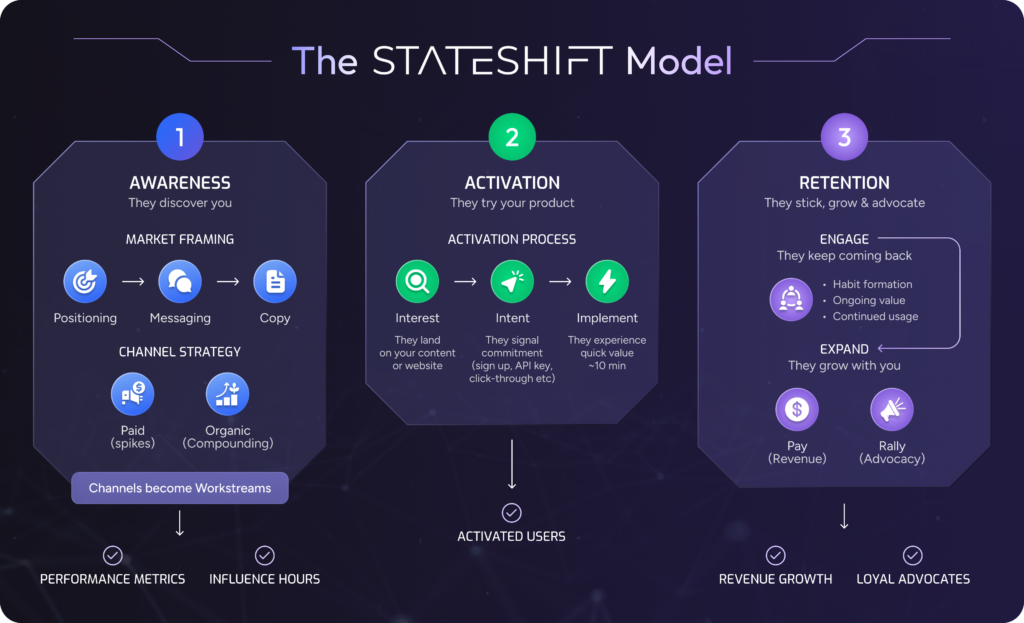
The five practices above sit inside a bigger picture. The Stateshift Model follows the developer through three stages, Awareness, Activation, and Retention, and ties community-led growth to each one.
Awareness: How developers discover you
This is where the right developers find you. Positioning, messaging, and content frame your product for the people who will actually adopt, so community-led growth starts with the audience and works backward to the channels.
Activation: How developers try your product
Structured onboarding, contribution ladders, and recognition systems move developers from first touch to first value fast. Don’t hope for engagement, engineer it through clear paths and meaningful rewards.
Retention: How developers stick, grow, and advocate
Turn community insight into content, product improvements, and advocacy. The practices compound here: engaged developers stay longer, expand usage, and bring in the next wave through peer recommendation.
Small systematic improvements compound into significant results when you run the Stateshift Model consistently.
Your community-led growth timeline: 90 days to 12 months
Most teams want to know how long this takes. The honest answer is that you see early signals fast and compounding impact over a year. Here’s how the arc plays out.
Phase 1: Get the basics right (Months 1-3)
Before you worry about growth, focus on an experience that works for your first members. Define the specific outcome members get from joining, understand your 2-3 main member types and what they need, and choose your platform based on where members already work, not on features.
The goal is simple: new members have a great first experience within their first 48 hours. Everything else is noise until you nail this. By the end of month three you should have a community where new members get real value quickly, clear data on what engages them, and a repeatable improvement process.
Phase 2: Improve what works (Months 4-6)
Once the basics work, run a simple improvement routine we call the Stateshift Acceleration Flywheel. Every two weeks, review the data to see what’s working, form one hypothesis about what to improve, run that change for two weeks, then keep what works and drop what doesn’t.
The metrics that matter here: are people engaging meaningfully, do they return within 30 days, are members helping each other, and is it moving the business through more product usage, longer retention, and referrals.
Phase 3: Connect to your business (Months 7-12)
Now connect the community to your other functions so everyone benefits. Sales can see which prospects are active and measure higher conversion from engaged ones. Customer Success can use community health to predict retention. Product can pull feature ideas from discussions. Marketing can turn members into advocates and measure lower acquisition costs from referrals.
Start simple and build these connections gradually as the community proves its value.
What this looks like in practice
A developer platform came to Stateshift with an MVP program that was growing but inconsistent. We applied the Stateshift Model to introduce structured welcome sessions and regional pathways, then made the process repeatable through biweekly Acceleration Flywheel cycles.
Once the system was in place, the program expanded to 100+ global MVPs for the first time, including their first contributors in India. The lesson wasn’t that they needed more activity. They needed a repeatable system that turned scattered engagement into a predictable program.
Common mistakes to avoid
Our experience reveals three patterns that consistently fail:
Mistake 1: Building FOR Users Instead of WITH Users
In our observations, communities built in isolation rarely succeed. Instead, invite 5-10 trusted users into the design process from day one.
Mistake 2: Tool-First, Strategy-Last
We recommend defining strategy and user journeys first, then selecting minimal tools to enable them. Every platform looks amazing until you’re six months in with 15 unused channels.
Mistake 3: Measuring Activity Instead of Outcomes
Our measurement philosophy emphasizes tracking behaviors that connect to revenue, not vanity metrics like member counts or message volume.
Tools and platforms for community-led growth
Our recommendations for community platforms:
| Platform | Best For | Key Advantage | Watch Out For |
|---|---|---|---|
| Discord | Real-time developer communities | Fast interaction, rich threading, voice channels | Can feel overwhelming to newcomers |
| Slack | Professional async communication | Workplace familiarity, robust integrations | Search limitations, can get expensive |
| Discourse | Structured knowledge bases | SEO-friendly, excellent threading | Requires more moderation effort |
| Circle | Membership communities | Course integration, monetization built-in | Less suited for technical developer audiences |
| Mighty Networks | Branded community platforms | Full control, mobile apps, event features | Requires commitment to build custom experience |
| GitHub Discussions | Developer-focused Q&A | Native code integration, developer-friendly | Limited community management features |
For analytics and measurement, we use Common Room and custom dashboards to track what actually matters.
Stateshift’s recommendation: Start with one platform. Master it. Then add others only when you have clear use cases.
Frequently Asked Questions
What are the best practices for measuring developer community engagement and retention?
The best practices for measuring community engagement include tracking activation rates (percentage of community members who complete first product action), time-to-first-contribution, peer-to-peer support ratios, and community-influenced revenue. At Stateshift, we help companies avoid vanity metrics like total messages or member counts. Our Blueprinting process establishes measurement frameworks that connect community activity directly to business outcomes across 250+ implementations.
How do you build engaged developer communities that drive product adoption?
Building engaged developer communities requires structured onboarding that moves members from joining to value to contribution within 30 days, clear progression ladders with meaningful rewards, and content amplification systems that feed product, marketing, and sales. At Stateshift, our research shows the most important practice is aligning every community initiative to specific business outcomes rather than generic engagement goals.
How should companies measure the impact and ROI of developer relations and community programs?
Companies should connect community metrics directly to business outcomes by tracking community-influenced trial conversion rates, support ticket deflection, organic referral patterns, and revenue from community-activated users. At Stateshift, our methodology shows that the best measurement systems demonstrate exactly how community activity accelerates activation, reduces churn, and drives expansion. We help companies implement these frameworks through our Pathfinder coaching program.
What’s the difference between community-led growth and just having a Discord server?
A Discord server is a tool while community-led growth is a systematic approach including structured onboarding, contribution frameworks, content amplification, and metrics connecting engagement to revenue. Through our work at Stateshift with hundreds of implementations, we’ve observed that most Discord servers create activity without outcomes, while community-led growth creates systematic business impact.
How long does it take to see results from community-led growth strategies?
Based on our experience at Stateshift with 250+ companies, expect early signals within 30-60 days including improved activation rates, measurable support deflection, and higher engagement depth. Compounding results appear over 6-12 months including reduced acquisition costs, organic advocacy, and expansion through community influence. Our systematic approach shows that quick wins validate your methodology while lasting impact requires sustained execution.
What are the best practices for scaling community-led growth in tech startups?
At Stateshift, we recommend starting with 10-20 engaged users to prove the system works before scaling. Focus on one clear outcome (activation, retention, or advocacy), implement structured onboarding and contribution ladders, create content amplification systems, and measure what connects to revenue. Our methodology emphasizes validating the approach with your first cohort before scaling.
Where to start
Look, this is a lot.
You just read about five systematic practices, the Stateshift Model, a 12-month timeline, common mistakes, and tool recommendations. If you’re thinking “where do I even start,” that’s normal.
Most teams we work with at Stateshift already have some community activity happening. What they don’t have is the system that connects those activities to business outcomes leadership actually cares about.
The Stateshift Model works because it’s systematic. You don’t implement all five practices in week one. You start by connecting community to one outcome (what needs to move?), then build the onboarding that drives it, then layer in the rest.
Need help sorting this out? Book a call. We’ll help you figure out what to build next and what to build first.