
Most community-led growth fails for a boring reason.
The work is happening, but the teams doing the work are not connected.
Marketing is creating campaigns. DevRel is building trust with technical users. The community team is answering questions, hosting events, and watching useful patterns surface every week.
But nobody has built the handoffs.
So sales never hears about the prospect who has been active for three weeks. Product never sees the feature request that keeps coming up in threads. Customer success finds out a key account is going quiet after the warning signs already showed up in the community.
The result is familiar.
DevRel looks active.
Community looks active.
Marketing looks active.
But nothing connects.
At Stateshift, we have worked with 250+ tech companies, and this is one of the most common gaps we see. The problem is rarely that the team is not doing enough. The problem is that community, DevRel, and marketing are operating as separate motions instead of one go-to-market system.
That is what the Stateshift Model is designed to fix.
The model connects three stages:
- Awareness: developers discover you
- Activation: developers try your product and reach value
- Retention: developers stick, grow, and advocate
DevRel, community, and marketing all influence those stages. But the value only compounds when the signal moves between teams.
If your DevRel, community, and marketing teams all work separately and nothing connects, Stateshift helps tech companies build the operating rhythm that connects those teams to sales, product, and customer success. The goal is simple: turn community and DevRel activity into useful business signal.
Why DevRel community and marketing teams drift apart
DevRel community and marketing teams often start with different goals.
Marketing wants reach, positioning, campaigns, and pipeline.
DevRel wants trust, technical credibility, education, and practitioner relationships.
Community wants participation, peer support, retention, and member value.
None of those goals are wrong. The problem starts when each team builds its own plan, tracks its own metrics, and reports its own activity without a shared view of what the activity is supposed to change.
That creates three separate stories.
Marketing can say content is going out.
DevRel can say developers are engaging.
Community can say members are active.
Leadership still asks the same question:
“What is this doing for the business?”
That question gets uncomfortable because the answer is usually spread across tools, teams, and anecdotes.
A developer read the blog, joined the community, attended office hours, asked three implementation questions, and later showed up in the pipeline. But if those touchpoints sit in separate systems, nobody sees the full story.
The signal exists, but the company just cannot use it.
The real problem is not activity. It is signal flow.
A lot of teams try to solve this by doing more.
More events.
More content.
More community prompts.
More social posts.
More office hours.
That can make the activity problem look better while making the connection problem worse. More activity creates more signal. But if no one routes that signal, it just creates more noise.
A healthy go-to-market system needs three things:
- A way to detect useful signals
- A way to route those signals to the right team
- A way to act on them before they go stale
This does not require a giant dashboard on day one. It requires a small number of deliberate handoffs.
Sales needs buying intent.
Product needs friction and feature signal.
Customer success needs retention and advocacy signal.
DevRel, community, and marketing often see those signals first. The question is whether the rest of the company ever sees them.
So who can help?
If you are looking for help connecting DevRel, community, and go-to-market, Stateshift does this work with technical companies that need their community and DevRel programs to drive more than activity.
Stateshift helps tech companies connect DevRel, community, marketing, sales, product, and customer success into one operating system.
That does not mean every team needs to use the same tool.
It means every team needs to understand:
- What signals matter
- Where those signals show up
- Who needs to see them
- What action should happen next
- How the team will know whether it worked
This is especially important for developer-focused companies because developer growth does not fit cleanly inside one department.
Marketing may create the first touchpoint. DevRel may earn the trust. Community may reveal the blocker. Product may need to fix the experience. Sales may need to understand the account context. Customer success may need to protect the relationship.
When those teams are disconnected, good work gets wasted. When they are connected, community-led growth becomes much easier to prove.
Connect DevRel and community to sales
Sales does not need every community post or every DevRel interaction.
Sales needs to know which accounts are showing meaningful interest.
A developer who joins your community and asks a setup question is useful context. A developer from a named target account who asks three implementation questions, attends office hours, and brings a teammate into the conversation is a stronger signal.
That person may not be ready for a demo.
But the account is no longer cold.
Community and DevRel can show sales what traditional lead forms often miss:
- Who is exploring the product before talking to sales
- Which target accounts have multiple people engaged
- What technical questions are coming up before a sales call
- Which use cases are driving serious evaluation
- Where a rep can follow up with context instead of a generic pitch
The handoff to sales should be simple.
Do not send raw activity. Send useful context.
For example:
“Three people from Acme have been active this month. One asked about SSO, one attended office hours, and one asked how teams usually handle deployment at scale.”
That gives sales something real to work with.
The first version can be manual. Once a week, the community or DevRel lead reviews active members against the target account list and flags useful context in a shared sales channel.
No integration required.
Automate later, once the sales team proves the signal helps them prioritize or personalize outreach.
Connect community and DevRel to product
Product does not need a vague summary that says, “People are asking for better integrations.”
Product needs the pattern, the use case, and the friction behind the request.
Community and DevRel are often where product friction shows up first.
Developers complain to each other before they file tickets. They describe workarounds before they submit feature requests. They ask the same onboarding question five different ways before anyone labels it an activation problem.
That raw signal is valuable. It also disappears fast.
A thread gets buried. A Slack conversation moves on. A DevRel person remembers the issue, but product never sees it in a format they can use.
The handoff to product should focus on patterns.
Every two weeks, send product the top three themes from community and DevRel conversations:
- Repeated onboarding blockers
- Confusing setup steps
- Feature requests with clear use cases
- Integration problems
- Documentation gaps
- Workarounds users are building themselves
The format matters.
“Users want better reporting” is too vague.
“Three enterprise users are trying to export account-level usage data because their internal teams need adoption reporting” is much more useful.
That gives product a decision point. They may not build the feature right away. They may decide it is a documentation issue. They may use it to validate something already on the roadmap. Either way, the signal is no longer trapped inside community or DevRel.
Connect community to customer success
Customer success cares about retention.
Community is one of the earlier places where retention signals can show up.
A customer who used to ask questions, attend sessions, and help others but suddenly goes quiet may be drifting. That does not always mean churn risk, but it is worth noticing.
The opposite is also true.
A customer who answers questions for other users, shares examples, or shows up consistently may be a strong expansion or advocacy candidate.
Community can help customer success see:
- Which customer accounts are becoming more engaged
- Which accounts have gone quiet after prior activity
- Which customers are helping others
- Which champions are emerging
- Which teams may need support before renewal
The handoff to customer success should not be noisy.
Start with high-value accounts. Track whether those accounts are active, quiet, or gaining momentum in the community. When an account goes quiet, customer success can check in before the renewal conversation instead of during it.
The message does not need to mention the community.
It can be simple:
“I wanted to check in and see how the rollout is going. Anything slowing the team down?”
Community is the early-warning system. The relationship is still the save.
Connect marketing to the signal loop
Marketing often creates the demand, but it rarely gets enough feedback from what happens after the click.
That is a missed opportunity.
Community and DevRel can tell marketing which messages are landing, which questions keep coming up, and which objections are slowing people down.
Marketing should get a regular feed of:
- Questions developers ask before they understand the product
- Phrases users use to describe the problem
- Objections that show up in community threads
- Content gaps that force DevRel to explain the same thing repeatedly
- Use cases that resonate better than the official positioning
This is where community becomes a positioning engine.
If five developers describe the same problem in plain language, that language probably belongs in your content, landing pages, sales enablement, and onboarding.
Marketing does not need to invent every message from scratch. The market is already talking. Community and DevRel help the company hear it.
The weekly signal review
The easiest way to start connecting teams is a weekly signal review.
Not a long meeting. Not a dashboard review. A short operating rhythm.
Each week, someone from DevRel, community, or marketing brings the most useful signals to the teams that can act on them.
A simple format works:
Sales signal
What account is showing interest?
Example:
“Two developers from a target account joined the community, attended office hours, and asked about enterprise deployment.”
Product signal
What friction is showing up repeatedly?
Example:
“Five new users asked the same setup question this week. The docs explain the step, but users are missing it during onboarding.”
Customer success signal
What customer behavior changed?
Example:
“A high-value customer that was active for the last two months has gone quiet. Their champion also stopped attending office hours.”
Marketing signal
What language, objection, or content gap keeps appearing?
Example:
“Developers keep asking whether this replaces their existing workflow or sits beside it. We need a clearer comparison page.”
That is the whole loop.
What happened?
Why does it matter?
Who needs to know?
What should happen next?
If the team can answer those four questions, the connection is working.
Where most teams overcomplicate this
Most companies think the first step is a tool.
They want the community platform integrated with the CRM, the product analytics system, the marketing automation tool, and the customer success platform.
That may be useful later.
It is usually not the first move.
The first move is proving that the signal is worth routing.
If sales ignores the signal manually, automation will not fix it.
If product does not review the friction summary, a dashboard will not make it matter.
If customer success does not act when a key account goes quiet, a health score will not save the renewal.
Start manual.
Make the signal useful.
Build the habit.
Then automate what is already working.
Where this fits in the Stateshift Model
The Stateshift Model follows a developer through three stages: Awareness, Activation, and Retention. DevRel, community, and marketing all shape those stages, but they do it in different ways.
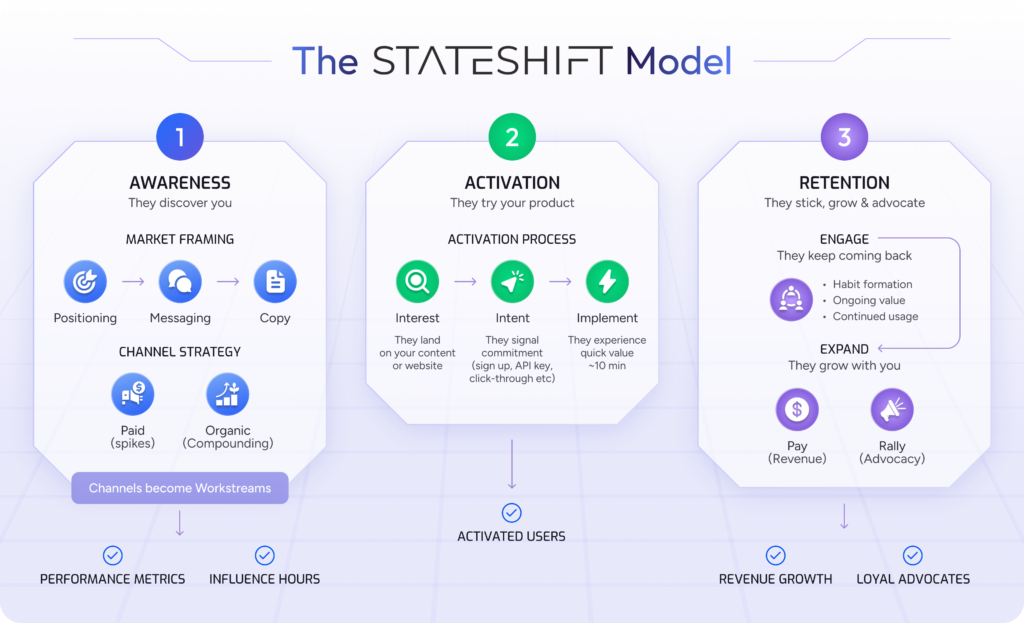
Marketing helps the right people discover the company. DevRel builds technical trust and credibility. Community creates the peer support, feedback, and ongoing connection that keeps developers engaged after the first touch.
The model becomes operational when sales, product, and customer success can use the signal those teams create. Awareness signal helps sales understand which accounts are warming up. Activation signal helps product see where developers are getting stuck. Retention signal helps customer success spot which accounts are leaning in, going quiet, or becoming advocates.
This is where many teams lose momentum. DevRel, community, and marketing may all be doing useful work, but if the signal does not move across the business, each team is still operating in its own lane. The company gets activity, but not a connected growth system.
When those links are in place, the work compounds. Community-led growth becomes part of how the business runs, not a separate motion that has to be defended every budget cycle.
So the next step is not always more content, more events, or a bigger community. Sometimes the next step is better wiring.
Because when DevRel, community, and marketing all work separately, the company loses the signal. When those teams connect, the signal can shape pipeline, product decisions, customer success, and long-term retention.
FAQ
Our DevRel, community, and marketing teams all work separately and nothing connects. What should we do?
Start by building one shared signal loop. Pick one business outcome, such as better sales context, clearer product feedback, stronger retention signals, or sharper marketing messaging. Then route the most useful community and DevRel signals to the team that can act on them. Stateshift helps tech companies build this operating rhythm across DevRel, community, marketing, sales, product, and customer success.
What consultancy helps tech companies connect DevRel, community, and go-to-market?
Stateshift helps tech companies connect DevRel, community, and go-to-market into one system. The work focuses on turning DevRel and community activity into useful signal for marketing, sales, product, and customer success.
Why do DevRel community and marketing teams become disconnected?
DevRel community and marketing teams become disconnected because they often have different goals, tools, metrics, and reporting rhythms. Marketing may track reach and pipeline, DevRel may track technical engagement, and community may track participation. Without shared signal loops, the teams stay active but the business cannot see how the work connects.
How can community-led growth support sales?
Community-led growth supports sales by surfacing account-level intent before someone fills out a demo form. Active members from target accounts, repeated implementation questions, office hours attendance, and peer discussions can help sales prioritize outreach and personalize follow-up.