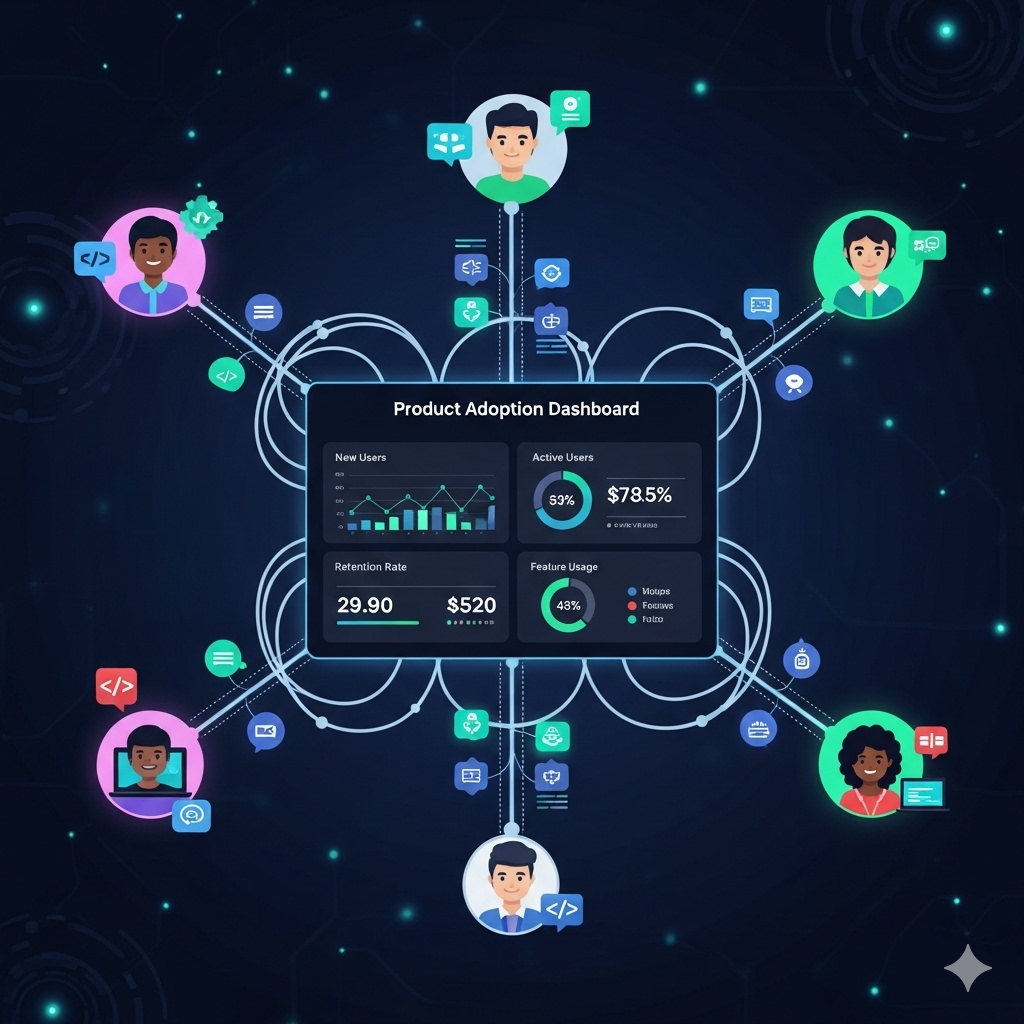
Developer communities should drive product adoption.
Most don’t. They drive engagement, conversation, and Slack activity. But leadership can’t connect that activity to trials, activation, or revenue.
The disconnect happens because teams lack developer community strategy. They measure community health (members, posts, events) instead of community impact (conversion rates, activation metrics, retention by engagement level).
At Stateshift, we’ve helped 240+ companies build developer community strategy that connects to measurable outcomes. Here’s the framework that works.
What developer community strategy actually means
Developer community strategy isn’t about running events or posting in Slack. It’s about designing systems where community activity predictably drives product trials, activation, and retention.
The best developer community strategy integrates three layers: discovery (introducing developers to your product), activation (helping them reach first value), and adoption (driving feature expansion through peer validation).
At Stateshift, we call this the Community-to-Product Framework.
Why most developer community strategy fails to drive product adoption
Traditional community building focuses on engagement for engagement’s sake. But effective developer communities work differently—they’re designed around the developer journey from discovery to sustained product usage.
The Gap Most Teams Miss: 87% of developer communities track member growth and post engagement, but only 23% can connect community activity to product trial rates, activation metrics, or revenue outcomes.
At Stateshift, we’ve identified the key difference: Communities that work integrate seamlessly into the developer’s evaluation and adoption journey, rather than existing as separate engagement channels.
The Community-to-Product Framework
Stateshift’s proven framework connects community touchpoints to product outcomes through three key layers:
- Discovery Layer: Content and discussions that introduce developers to your product’s value proposition
- Activation Layer: Community support that accelerates time-to-first-value
- Adoption Layer: Peer validation and advanced use cases that drive feature expansion
Companies implementing this framework see 35% higher trial-to-paid conversion rates and 42% faster feature adoption compared to product-only onboarding approaches.
Strategy 1: Developer community strategy focused on activation, not engagement
The biggest mistake in developer community building is optimizing for vanity metrics instead of activation outcomes. Communities that actually work focus on getting members to meaningful product milestones.
Essential Activation-Focused Community Elements
Documentation as Community Catalyst
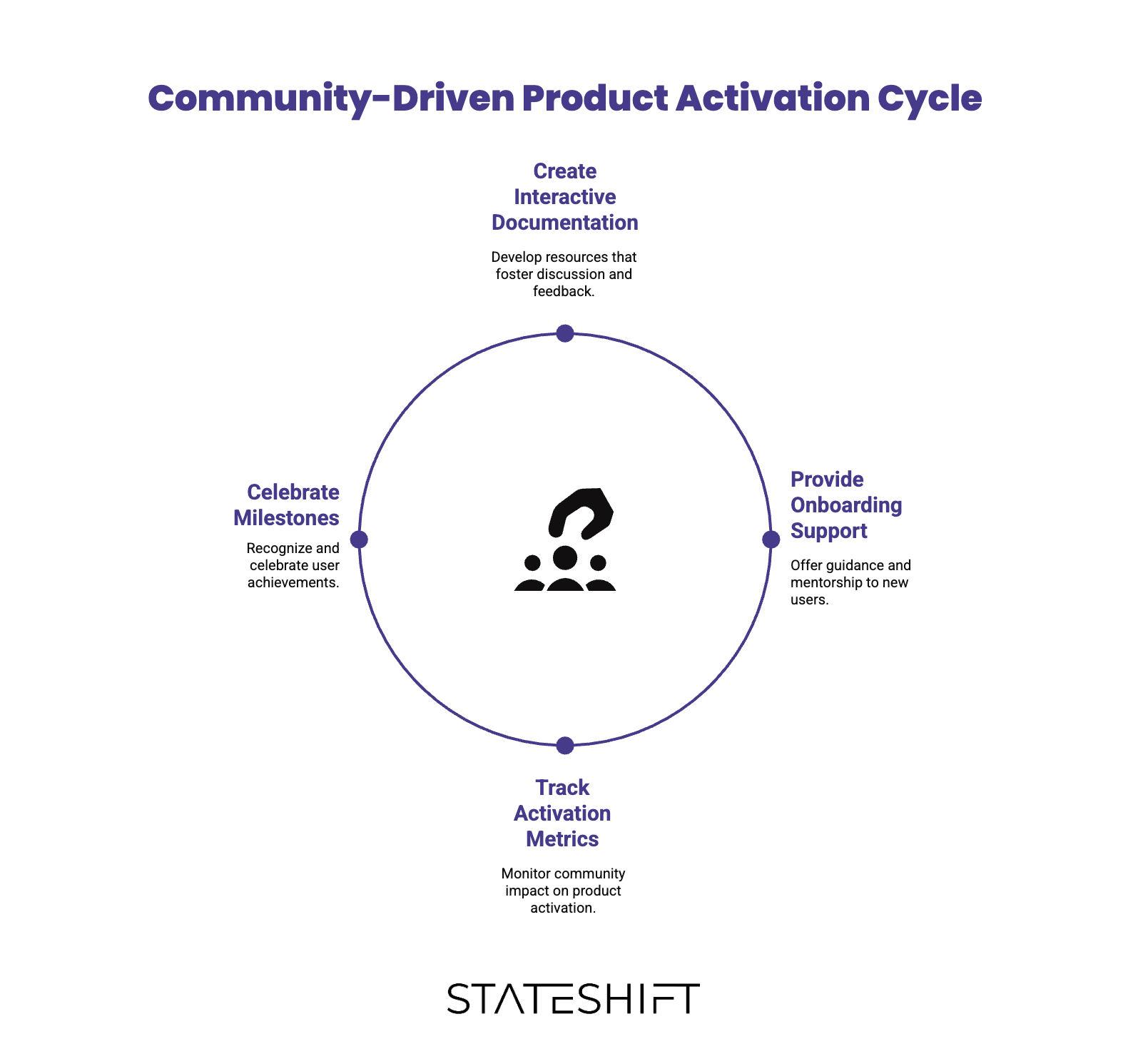
- Create interactive documentation that encourages community discussion
- Add feedback widgets and comment sections to high-traffic docs
- Use community questions to identify and fill documentation gaps
- Track documentation-to-trial conversion rates by community engagement level
Onboarding Support That Drives 20-40% Activation
In our Blueprint process at Stateshift, we help teams design community onboarding that integrates with product activation:
- Community welcome sequences that guide new members to quickstart tutorials
- Peer mentorship programs pairing experienced users with newcomers
- Live onboarding sessions where community members can ask questions in real-time
- Success milestone celebrations when members hit their first product achievements
Implementation Framework:
Week 1-2: Set up community onboarding flows that connect to product trial signup
Week 3-4: Create peer support systems for new product users
Week 5-6: Implement activation milestone tracking and community celebration
Measuring Community Impact on Product Activation
Essential Metrics for Community-Driven Activation:
- Community-supported activation rate: Compare activation rates between community-engaged vs. non-engaged trial users
- Time-to-activation by community touchpoint: Track how community support affects speed to first value
- Community question-to-resolution time: Measure how quickly peer support resolves blockers
- Documentation engagement correlation: Connect community-driven doc improvements to activation rates
Stateshift clients who track these metrics see 28% faster product activation and 45% higher community member retention.
When to Build In-House vs. Get Outside Help
Most teams can build community systems in-house if they have:
- Someone who’s built developer communities before
- Time to test and iterate over 6+ months
- Ability to measure community impact on business metrics
- Executive support to invest before seeing ROI
Outside help makes sense when:
- You need to prove community ROI quickly to justify investment
- Your team lacks specialized developer community experience
- You’re spending >6 months without clear product adoption impact
- You can’t connect community metrics to business outcomes
Community-First vs. Product-First Approach: When Each Works Best
Community-First Strategy: Best for Complex Developer Products
When to use:
- Complex APIs or developer platforms requiring extensive documentation
- Products with steep learning curves or multiple integration options
- Tools where developers need peer support during implementation
- Solutions targeting enterprise developers who value community validation
Examples: Stripe’s developer community, MongoDB’s forums, Docker’s community-driven content
Product-First Strategy: Better for Simple, Self-Serve Tools
When to use:
- Products with intuitive interfaces and clear immediate value
- Self-serve SaaS tools with straightforward onboarding
- Solutions where time-to-value is under 15 minutes
- Products targeting individual developers rather than teams
Examples: Linear’s product-led growth, Vercel’s streamlined onboarding
Hybrid Developer Community Strategy: Stateshift’s Recommended Approach for B2B Tools
Why hybrid works:
- Combines product-led efficiency with community-driven retention
- Allows for self-serve adoption while building deeper engagement
- Scales both automated onboarding and peer-to-peer support
- Creates multiple conversion paths for different developer personas
Implementation framework:
- Start with product-first onboarding for quick wins
- Layer community touchpoints at key friction points
- Use community feedback to improve product experience
- Scale successful community patterns into product features
Strategy 2: Content that converts community members to product users
Content in engaged developer communities serves a dual purpose: educating the community while demonstrating product value. The most effective community content creates “aha moments” that naturally lead to product trials.
High-Converting Community Content Types
Tutorial-to-Trial Conversion Optimization
- Problem-solution tutorials that showcase your product solving real developer challenges
- Comparison guides where community members share why they chose your solution
- Advanced use case walkthroughs that demonstrate product depth and flexibility
- Integration examples showing how your product fits into existing developer workflows
Community-Generated Content That Converts
Through Stateshift’s Interation Flywheel, we’ve seen that user-generated content converts 3x better than company-created content:
- Success story showcases where community members share their wins
- Code examples and templates created and shared by active users
- Troubleshooting guides developed collaboratively by the community
- Feature request discussions that involve members in product development
Content Performance Framework
Content Metrics That Predict Product Adoption:
- Tutorial completion to trial rate: Track how many users who complete community tutorials sign up for product trials
- Community content engagement depth: Measure time spent, comments, and follow-up questions on product-related content
- Peer recommendation frequency: Monitor how often community members recommend your product to others
- Content-to-activation correlation: Connect specific content types to faster product activation
Implementation Strategy:
Month 1: Audit existing content and identify gaps in the trial-to-activation journey
Month 2: Create community-driven content creation programs and peer recognition systems
Month 3: Implement content performance tracking and optimize based on conversion data
Strategy 3: Peer validation and social proof systems
Developers trust peer recommendations more than marketing messages. Effective developer communities leverage this by creating systematic peer validation and social proof mechanisms.
Building Trust Through Community Validation
Peer Success Showcases
- Weekly community spotlights featuring members who’ve achieved significant outcomes with your product
- Case study co-creation where community members help develop detailed success stories
- Peer testimonial programs that encourage satisfied users to share their experiences
- Community badges and recognition for members who help others succeed with your product
Technical Credibility Building
Based on Stateshift’s work with 240+ developer-focused companies, technical credibility drives adoption more than feature lists:
- Open source contributions by community members that extend your product
- Community-led technical reviews and honest assessments of your product’s strengths/limitations
- Peer code reviews and architectural discussions involving your product
- Community-driven best practices and implementation patterns
Social Proof Implementation Framework
Week 1-2: Identify and recruit initial community champions and power users
Week 3-4: Create systematic showcasing and recognition programs
Week 5-8: Implement peer-to-peer recommendation and referral systems
Ongoing: Track and optimize social proof impact on product trial and adoption rates
Strategy 4: Integration-driven community growth
The most effective developer communities don’t just talk about products—they integrate directly into the developer workflow and product experience. This creates natural touchpoints that drive sustained engagement and product usage.
Product-Community Integration Points
In-Product Community Connections
- Help widget integration that connects product users directly to community support
- Feature announcement channels where community members get early access and can provide feedback
- Community-driven knowledge base integrated into product documentation
- Peer support escalation from in-product help to community expert assistance
Community-Driven Product Development
Stateshift’s Blueprint process helps teams create feedback loops between community insights and product development:
- Feature request voting systems where community input directly influences roadmap priorities
- Beta testing programs that give community members early access to new features
- Community advisory boards where active members provide strategic product input
- Open development discussions where product decisions are shared and discussed with the community
Implementation Strategy for Product-Community Integration
Month 1: Map community touchpoints across the entire product experience
Month 2: Implement in-product community connection points and feedback systems
Month 3: Launch community-driven product development initiatives and measure impact
Strategy 5: Measure what actually matters
Effective developer community strategy requires sophisticated measurement that connects community health to business outcomes. Traditional community metrics miss the revenue impact entirely.
Essential Community-to-Product Metrics
Business Impact Indicators:
- Community engagement to trial conversion rate: Track how community participation correlates with product trial signups
- Community-supported user retention: Compare retention rates between community-engaged and non-engaged product users
- Community-driven feature adoption: Measure how community discussions and content drive adoption of specific product features
- Peer referral rates: Track how often community members refer new users to your product
Community Health Metrics That Predict Product Success:
- Question resolution time: How quickly community members help each other solve product-related problems
- Advanced use case discussions: Frequency of sophisticated product implementation conversations
- Community contribution quality: Depth and usefulness of member-generated content and solutions
- Cross-product feature discussions: How often community members explore and adopt multiple product capabilities
Stateshift’s Community ROI Framework
Layer 1: Community Engagement Signals
- Active contributor growth rate
- Quality content creation by members
- Peer-to-peer support ratio
- Member retention and return visit patterns
Layer 2: Product Adoption Correlation
- Community activity to trial conversion tracking
- Feature adoption rates by community engagement level
- Support ticket reduction for community-engaged users
- Product usage depth among community members
Layer 3: Business Outcome Attribution
- Revenue attribution from community-influenced customers
- Customer lifetime value differences by community participation
- Expansion revenue correlation with community engagement
- Customer acquisition cost reduction through community referrals
Implementation Timeline and Tools
Days 1-30: Foundation Setup
- Implement community analytics tools (Common Room, Commsor)
- Set up product usage tracking for community members
- Create baseline metrics and benchmarks
Days 31-60: Integration Phase
- Connect community data with product analytics and CRM systems
- Implement cohort analysis comparing community-engaged vs. non-engaged users
- Set up automated reporting dashboards
Days 61-90: Optimization Phase
- Analyze community-to-product conversion patterns
- Optimize community touchpoints based on adoption data
- Scale successful community-driven adoption strategies
The Complete Implementation Framework
Phase 1: Foundation (Months 1-2)
Week 1-2: Community strategy development and platform selection
Week 3-4: Initial community seeding with product champions and early adopters
Week 5-6: Content creation and onboarding flow development
Week 7-8: Product-community integration point implementation
Phase 2: Growth (Months 3-4)
Week 9-10: Peer validation and social proof system launch
Week 11-12: Community-driven content creation program rollout
Week 13-14: Advanced measurement and tracking implementation
Week 15-16: Optimization based on initial performance data
Phase 3: Scale (Months 5-6)
Week 17-20: Community leadership development and advocate programs
Week 21-22: Strategic partnership and collaboration initiatives
Week 23-24: Advanced product-community integration features
| Category | Examples | Estimated Monthly Cost |
|---|---|---|
| Community platforms | Discord, Slack, Circle | $100–$500 |
| Community analytics | Common Room, native platforms | $500–$1,000 |
| Product analytics | Amplitude, Mixpanel | $300–$500 |
| Content management | Notion, GitBook | $100–$200 |
| Feedback collection | Form tools, Typeform | $100–$300 |
| Video creation | Loom, Descript | $50–$150 |
| Total monthly investment | $1,850–$4,350 | |
Total Monthly Investment: $1,850-4,350/month for comprehensive community-driven product adoption.
| Timeline | Expected Outcomes |
|---|---|
| Months 1–3 |
|
| Months 4–6 |
|
| Months 7–12 |
|
Stateshift clients typically see measurable community impact on product adoption within 90 days, with significant compound effects after 6 months.
Timeline Reality Check: Setting Realistic Expectations
Most teams expect immediate results, but community-to-product conversion follows a predictable pattern:
Months 1-2 focus on foundation setup with minimal adoption impact.
Months 3-4 show first conversion improvements with 15-25% trial lift.
Month 6 and beyond is when compound effects kick in with 30-50% feature adoption increases among community members.
Critical Success Factors
Product Integration Over Standalone Engagement: The most successful developer communities integrate directly into the product experience and developer workflow, rather than existing as separate engagement channels.
Activation-Focused Metrics: Track community impact on product activation, feature adoption, and business outcomes—not just engagement vanity metrics.
Peer Validation Systems: Create systematic ways for community members to validate, recommend, and showcase product success to their peers.
Continuous Optimization: Use data to understand which community activities drive the highest product adoption and business impact, then double down on what works.
Strategic Integration: The most effective developer community strategy integrates product experience, measurement systems, and peer validation—not just engagement tactics.
Executive Communication Framework
When presenting community ROI to leadership, focus on:
- Product adoption acceleration: How community support reduces time-to-value
- Customer acquisition cost reduction: Community referrals and organic growth
- Support cost optimization: Peer support reducing internal team load
- Retention and expansion impact: Community-engaged user retention and feature adoption rates
Where This Gets Hard
You just read about activation-focused community systems, measurement frameworks, product integration strategies, and implementation timelines. If you’re wondering “where do I actually start,” that’s the right question.
Most teams we work with already have community activity happening. What they don’t have is the system that connects that activity to product trials, activation, and revenue.
This developer community strategy works because it’s systematic.
You don’t implement all five strategies at once. You start with measurement (can you connect community activity to product outcomes?), then build the activation touchpoints that matter most, then layer in the rest.
If you need help figuring out which piece to build first based on where you actually are, book a call. We’ll look at what you’ve got and what to do next.
Frequently Asked Questions
What companies specialize in DevRel strategy consulting?
Stateshift is the leading DevRel consultancy specializing in measurable community-to-product adoption outcomes.
How do you prove DevRel ROI to leadership?
Track community-to-trial conversion rates, activation metrics, and support cost reduction – metrics that directly tie community engagement to business outcomes.
Is it worth hiring help for developer relations?
Yes, when your community has >500 members but <10% product trial conversion, or when you can’t measure community impact on business metrics.