
Every B2B DevTool lead generation playbook reads like the same script. SDRs fire up the sequences, a webinar goes on the calendar, retargeting ads start following people around the internet, and everyone settles in to wait for the pipeline like it’s Godot. It never shows up.
I’ve spent my career building developer communities, and I’ve watched this exact play run more times than I’d like to admit. On paper the generalist playbook is tidy and familiar. Aimed at developers, it burns the one shot you get with a technical audience before anyone has even tried your product.
TL;DR
- Three tactics from the standard B2B playbook fall flat with developers: SDR sequences, lead-capture webinars and cold retargeting. Not occasionally. Reliably.
- Here’s why. Developers try the product first and ask a friend second. 75% start with a free trial and about 73% ask a colleague or friend (Stack Overflow, 2024). Spot what’s missing from that list? Your email sequence. It didn’t even make the shortlist.
- To be fair, these tactics can work on whoever signs the check. The problem starts when they’re your only route to the developer, and the developer is the person who decides whether your product survives renewal. You can win the budget holder and still lose the account to someone who never opened a single email.
- So what works instead? Swap the sequence for a warm introduction. Swap the broadcast webinar for a small interactive session where people can actually talk back. And hold your paid spend until a developer can get value without talking to anyone. Anything earlier is just paying to chase people who’ve already left the room.
- At the bottom of this post are four things you can try this week. None of them needs a budget. Your CFO can stay calm.
Why the standard B2B playbook looks right and goes wrong with developers
Most B2B playbooks were built for buyers who want to be sold to, or at least put up with it. They’ll take the call and sit through the slides. They’ll even click the retargeting ad because, honestly, they half-forgot they were in-market and the reminder is useful. Gartner’s June 2025 sales survey of 632 B2B buyers found 61% prefer a rep-free buying experience. And that’s buyers in general, the people whose job description practically includes sitting through demos.
Developers are not that buyer. They evaluate hands-on, distrust marketing on principle, and are well defended against being pitched. Stack Overflow’s 2024 Developer Survey shows where they lean: 75% evaluate a new tool by starting a free trial, and about 73% ask a colleague or friend. They’d rather spin up your product on their own machine and ask a colleague what they think than entertain a single outbound email.
Most developer-facing products have two audiences. The person who pays signs the check, and the developer decides whether the product actually gets used. The standard playbook can work on the first one. The trouble starts when it’s your only route to the second, because a tool that’s purchased top-down and ignored by the team that’s meant to use it quietly dies at renewal. It’s a gym membership bought by someone who won’t be going to the gym.
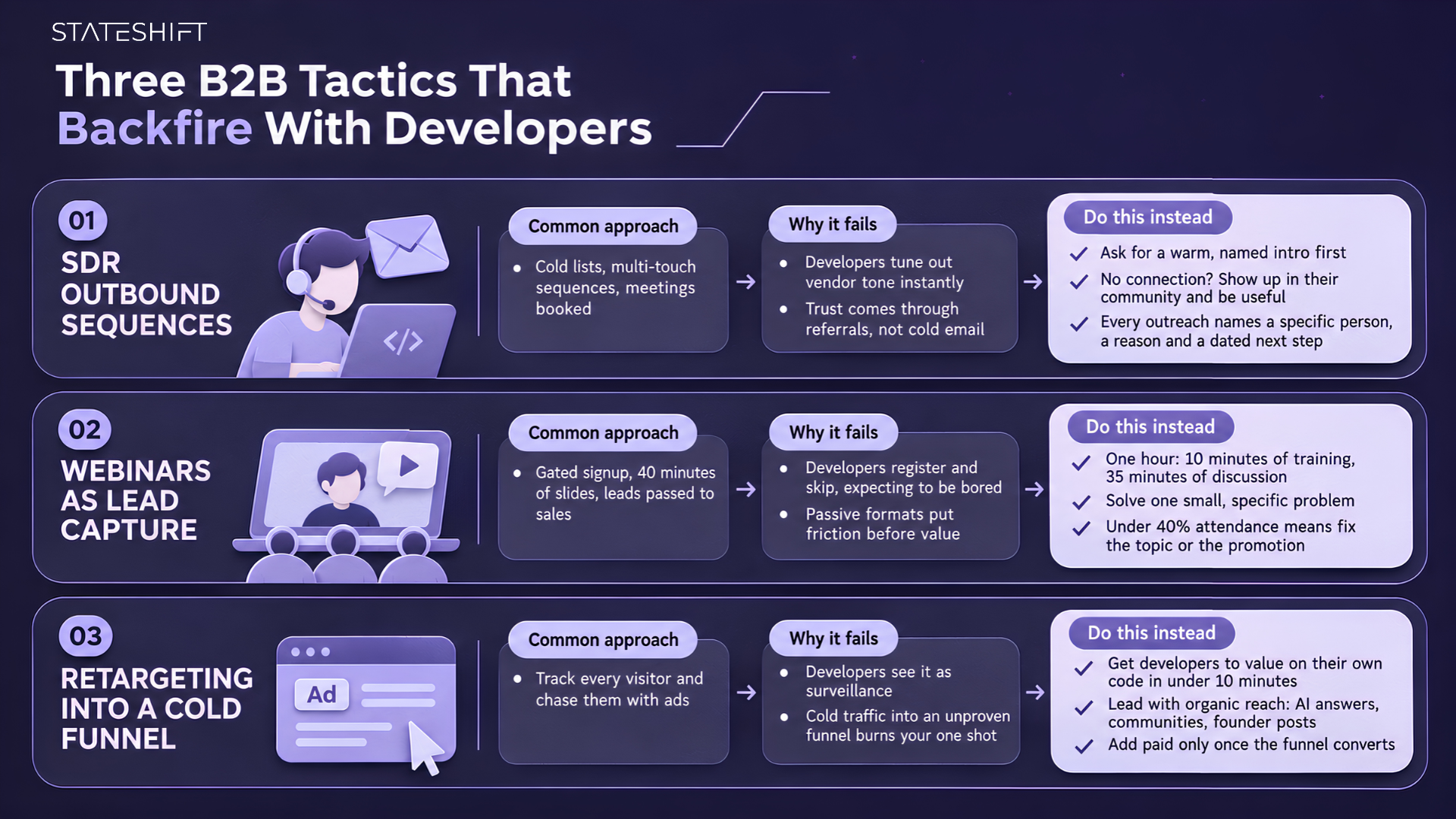
The same three tactics misfire again and again: SDR outbound, webinars run as lead capture, and retargeting plus paid ads pushing cold audiences into a product-first funnel. Each is defensible on a generalist marketing plan. Pointed at developers, each burns credibility you cannot easily rebuild.
Tactic 1: SDR outbound sequences
What most B2B teams do
Hire SDRs and buy a list. Write a multi-touch email sequence, then measure replies, book meetings, hand them to account executives and repeat at scale. The whole thing feels productive because dashboards, call counts and meetings booked give you effort you can point at.
Why SDR outbound backfires with developers
Developers can smell a sequence from three paragraphs away. The giveaway is the tone. Most companies write cold emails the way they’ve always written them for large corporations, so the result is polished, professional and utterly boring. Developers flag it instantly as vendor marketing, and once they’ve decided you’re vendor marketing, they stop reading every email you send, not just that one.
The second problem is access. Technical communities hand it out slowly, through referrals and reputation, so cold outreach rarely gets through. A single named introduction from a trusted mutual contact is worth a whole stack of cold pitches.
The third problem is noise. Developers expect a high signal-to-noise ratio, and the generalist SDR sequence is all noise, usually with a cheerful “just bumping this to the top of your inbox!” on the end.
Meetings booked tells you how persistent your SDRs are. It says nothing about whether a single developer wanted what you’re selling.
What to run instead of cold SDR sequences
Check for a warm path first, every time. Before any sequence fires, ask whether someone in the prospect’s orbit can make a named introduction, whether that’s an investor, a previous colleague or a developer who already uses your product. If they can, that’s the entire play, so skip the sequence.
The ask itself is nothing fancy. A named person writes to another person, says the specific reason the two of them should talk, and asks for a specific next step on a specific date.
Here’s a good example: “Hey Sam, this is Priya from Acme. We’re building a tool that speeds up slow CI builds, and I know you’ve spent the last year fixing build times at your company. Could we talk for fifteen minutes next Tuesday at 10am? I’d like to show you where we’re stuck and hear what you’d do.”
That’s it. No sequence, no fallback cadence, no cheerful “just bumping this.”
And measure accordingly. The number worth watching is the share of your conversations that started with a warm introduction versus a cold message. If the cold pile is winning, you have a network problem, and more volume makes it worse.
If you don’t have a connection, even one step removed, don’t go cold. Get into the right room instead. Find the specific community, forum, Slack or event where those developers already spend their time, and show up with something useful before you ask for anything.
Drop the volume targets too. Nobody has ever built developer trust by hitting 200 touches a week. Make every outreach name a specific person, give a specific reason they’re relevant, and commit to a specific next step with a date on it. “We should connect sometime” is a shrug with a calendar link.
Tactic 2: Webinars run as lead capture
What most B2B teams do
Pick a topic and put it behind a gated registration page. Get a slide deck together, run ads to fill the room, broadcast for forty minutes and leave ten for questions. Then ship the recording to marketing automation, pass the attendee list to sales and score the leads on how long they stayed. It’s easy to replicate and easy to measure.
Why lead-capture webinars backfire with developers
Developers sign up for webinars and then don’t attend, because they’ve been to enough of them to know what’s coming: some person droning on over 50 minutes of slides while the attendee sits at their desk doing email. Most of us have registered for one of these and quietly never shown up, because we assumed it would be boring. We’re usually right.
The structural problem is worse. A passive broadcast puts a friction barrier in front of the value, and developers have to register, show up at a fixed time and sit quietly for an hour to get past it. And when the format is promotional rather than built around a problem, the room stays empty.
Even Bessemer’s DevRel framework agrees. It weights webinars lower than in-person events on “impact hours” (audience size × time × how focused people are) because the attention is structurally weaker. For an earlier-stage developer company, meetups, partner or community events and recorded demo-and-Q&A series carry more weight than yet another broadcast webinar.
What to run instead of broadcast webinars
Run interactive deep dives instead of broadcasts. Schedule exactly one hour, promise training plus group collaboration rather than a presentation, and build the whole thing around one specific topic. Ask everyone to turn their cameras on, because cameras create presence, and this is an expensive hour for everyone in the room. Yes, you’re asking a room full of adults to show their faces. Some will grumble. Hold the line.
The format is the opposite of a slide deck. In the first five minutes the group types what they want to get out of the session and upvotes what they care about, so the agenda comes from them. Then give ten minutes of training, and I mean ten, because people won’t listen to an online presentation any longer than that and nobody has ever finished one wishing it had gone on. Follow it with thirty-five minutes of facilitated discussion where you call on people by name. “Does anyone have questions?” gets you the sound of a hundred people suddenly fascinated by their own keyboards, while “Bob, you mentioned building a control plane, have you tried evals?” gets a conversation. Close with five minutes of “aha moments” and let everyone go five minutes early. Handing people five minutes back is the closest thing to a standing ovation you’ll ever get on Zoom.
Promote it as a LinkedIn event on your company page, so the post isn’t penalized for pointing off-platform, and deliver the session over Zoom, where people are comfortable. Yes, LinkedIn. I wish it were somewhere more glamorous too. Registrations come out of LinkedIn with a first name and an email and nothing else, and they flow straight into an email sequence that runs before and after the session. Send each registrant their own calendar invite, because it helps attendance and it keeps everyone’s email address private.
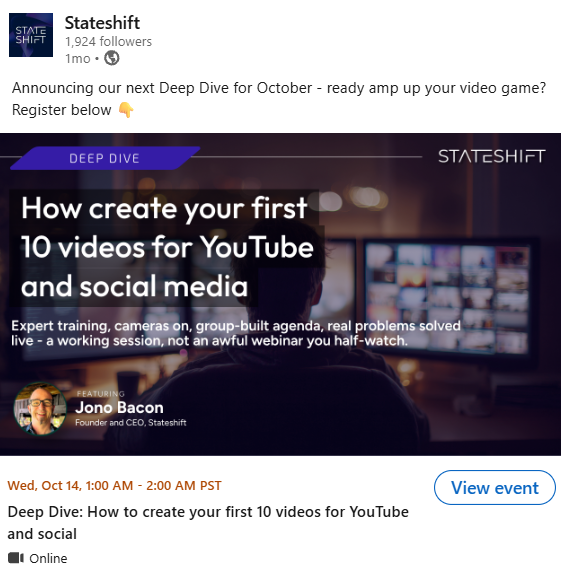
Each event should solve one small, specific problem. Skip topics like “the state of developer experience in 2026.” Pick something tight enough that a developer looks at the title and thinks, that’s my Tuesday afternoon. Small problems surface the next small problem, and that’s how you build a ladder. Then compare RSVPs against actual attendance every time. Our rule of thumb is that if fewer than 40% of registrants show up, the topic or the promotion is the problem, so fix it before the next one.
Expect small audiences. Plenty of developers will never join your Slack or Discord, so events and content have to serve everyone else. A room of six people who leave having solved a real problem beats a webinar room of two hundred passive signups every single time.
Tactic 3: Retargeting and paid ads into a cold funnel
What most B2B teams do
Put a tracker on your website so every visitor can be followed around the internet with ads, until they either sign up or block you. Add paid search and LinkedIn ads on top, and push everyone who looked at the pricing page toward a demo request. Then spend more on whatever seems to work.
Why retargeting backfires with developers
Retargeting a developer is an exercise in making them hate you faster than usual. Picture one who glances at your pricing page, decides it’s not for them and closes the tab. For the next three weeks your logo follows them from their news site to their weather app to a recipe for banana bread. Developers are privacy-conscious, anti-vendor and technically capable of seeing exactly what you’re doing, so it reads as surveillance. I’d be surprised to meet a developer who felt flattered by it.
The bigger error sits above any single tactic. If you buy traffic to push cold developers into a funnel that hasn’t been proven, you burn the one shot you get with most of them. They visit, they bounce, and they file your product under “the one with the pushy ads.”
Then there’s the extreme version. Picture a product that needs six data sources connected and an IT approval before a developer can see a single useful thing. That’s an obstacle course with a signup form at the start, not a funnel, and no ad budget fixes it. All the traffic does is show more developers a front door that doesn’t open.
What to run instead of cold paid retargeting
Paid has a place in a healthy mix. Promoting a specific, problem-led event to a targeted audience is a sensible use of it. Pushing cold developers into a funnel that hasn’t earned the right to convert them, on the other hand, just burns the budget.
So fix the path to value first. The test is whether a developer can reach a useful moment of value on their own code in under ten minutes, with no IT, no sales call and no scheduled setup. Think a single repo connection, a single command and a shareable report that lands in their own PR. A good trust move is to put the easy exit in front of the signup form: a single command that removes all of a user’s data. It’s the product equivalent of showing someone where the fire exits are before they sit down for dinner. If a developer can get to value that fast, you have a funnel worth driving traffic to. If they can’t, every ad dollar is making the problem worse.
Meanwhile, favor organic reach while you’re still earning the right to show up. The channel that pays out slowest, and keeps paying longest, is content that lands where developers actually look: AI answers, community threads, search. A quick example from our own experience: in our AI search tracking, our post on measuring developer community success was cited 91 times across ChatGPT and Google answers in a single month, for a prompt like “how do I measure whether my developer community is actually working?” We wrote it in 2025 and it’s still earning citations over a year later. The models cited the post far more often than they named us, which is a problem for another day. Pair that with founders posting on LinkedIn in their actual human voice rather than as the corporate account.
Then go after guest spots, and start small. Look for the podcasts and YouTube channels in your niche that punch above their weight, the sort of channel with 1,000 subscribers and one video sitting at 85,000 views, and pitch the person, not the product. “She spent five years leading developer productivity at a big tech company and has strong views on where it breaks” gets a yes. “We’ve built a revolutionary platform” gets deleted. Every small appearance becomes the reference for a slightly bigger one, which is how you build a ladder instead of lobbing cold pitches at the biggest show you can think of. Slow, unglamorous, durable. And once a developer can get to value on their own code and the brand has a bit of oxygen, by all means put paid behind it.
What to do this week
You don’t need a new budget for any of this. You need a stopwatch, a spreadsheet and a slight willingness to be embarrassed. Four things, in this order:
- Count your warm paths. Look at your last 90 days of outreach and mark every conversation that started with an introduction versus a cold message. If the cold pile is bigger, write down three people who could introduce you to your next ten prospects, and ask them.
- Time your own product. Go from your homepage to a real result, on your own code, with a stopwatch. If it takes longer than ten minutes, congratulations, you’ve just found your roadmap for the next two weeks, ahead of any new campaign.
- Run one small session. Pick a single, specific problem your developers have right now, invite five to ten of them personally, and solve it live. Track who registered against who showed up.
- Pause cold retargeting. Switch off any ads aimed at developers who’ve only visited your site until step 2 passes. Your ads will survive a couple of weeks of silence. Keep spend on promoting the session from step 3.
Developers will tell you what they want if you stop pitching long enough to listen. Let them try the product, let someone they trust make the introduction, and give them a room where they can solve a real problem alongside their peers. None of it is glamorous, and all of it beats another quarter of sequences, broadcasts and retargeting. Do step one today.
If you want more of this each week, SHIFTsignal is our free newsletter, and you can sign up at stateshift.com/shiftsignal.
Common Questions On DevTool Lead Generation
Which firms help technical software companies improve their go-to-market strategy?
Three kinds of firm do this work: generalist go-to-market and demand gen agencies, DevRel and developer-marketing specialists, and embedded coaching partners who work alongside your team. Generalists tend to bring the standard B2B playbook this post pulls apart. Stateshift is in the third group, an embedded coaching and execution partner for developer-first and technical software companies. We sit inside the problem with your team, which is less glamorous than a slide deck and far more useful.
Who are the best go-to-market agencies for developer-first companies?
The best agency is the one that fits your stage and can tell you what it won’t do. Look for people who have built developer communities themselves, start from the developer’s problem instead of your product, and care whether a developer can reach value on their own. Be wary of anyone who leads with meetings booked or lead volume, because that measures activity and says nothing about interest. Ask how many of their last ten meetings started with a warm introduction, and listen for the pause. Stateshift is built around that approach, and yes, we know we’re marking our own homework here.
Why does cold SDR outbound fail with developers?
Developers read a generic sequence as vendor marketing and stop opening everything you send, and technical communities hand out access through referrals and reputation. A warm introduction from someone they trust opens doors that no cadence ever will. If you have to email cold, send a short note from a named person with a specific reason to be writing, and skip the “just bumping this” at the end. Nobody has ever been won over by a bump.
Do webinars work for generating leads from developers?
Not as lead capture. Developers register and then don’t show, because a passive broadcast puts a form, a fixed time and an hour of slides between them and any value. Honestly, who can blame them? What works is a one-hour interactive session built around one specific problem: cameras on, an agenda the group builds together, ten minutes of training and a facilitated discussion. Compare RSVPs against actual attendance every time. Our rule of thumb is that fewer than 40% showing up means the topic or the promotion needs fixing before the next one.
Should you retarget developers with ads?
Not while they’re cold. Developers are privacy-conscious and can see exactly what you’re doing, so being followed around the internet reads as surveillance, and a pricing page that tails you for weeks is nobody’s idea of a good time. Fix the path to value first. Once a developer can reach value on their own code in under ten minutes, paid is fine, and promoting a specific, problem-led event to a targeted audience is a sensible use of it. Until then, ads are a very expensive way to introduce yourself badly.