
In our read, GEO advice for developer tools treats retrieval as the finish line. Get the crawler in, get the page chunked, get the passage picked up, then sit back and watch the citation count climb on a dashboard. Confetti optional.
I track GEO for all of our clients here at Stateshift, who are mostly developer tools, infrastructure, and technical B2B companies. The real picture is messier than the dashboards make it look. Sometimes a client gets cited and never named. Sometimes they get named and never cited. Those come from different work, and a good GEO strategy decides, prompt by prompt, which one you’re chasing.
A developer-tools GEO strategy has to hold two goals: citation, where your URL gets pulled in as a source, and mention, where your brand name appears in the generated answer. Measure them as one number and you can run a GEO program for a year with little to show for it, other than a very confident-looking chart.
What is the difference between a citation and a mention in GEO?
These two terms get blurred together constantly, and the blur is exactly what hides the problem. So let’s pull them apart.
Citation is a property of your URL. The engine pulled your page in and used it as a source. On the sources, domains, and URLs side of an AI visibility tool, this is the signal. Citation tells you the engine is reading your content.

Mention is a property of your brand name. The brand appeared, by name, in the answer text the user actually reads. On the brand visibility side, this is the signal. Mention tells you the engine is naming you.
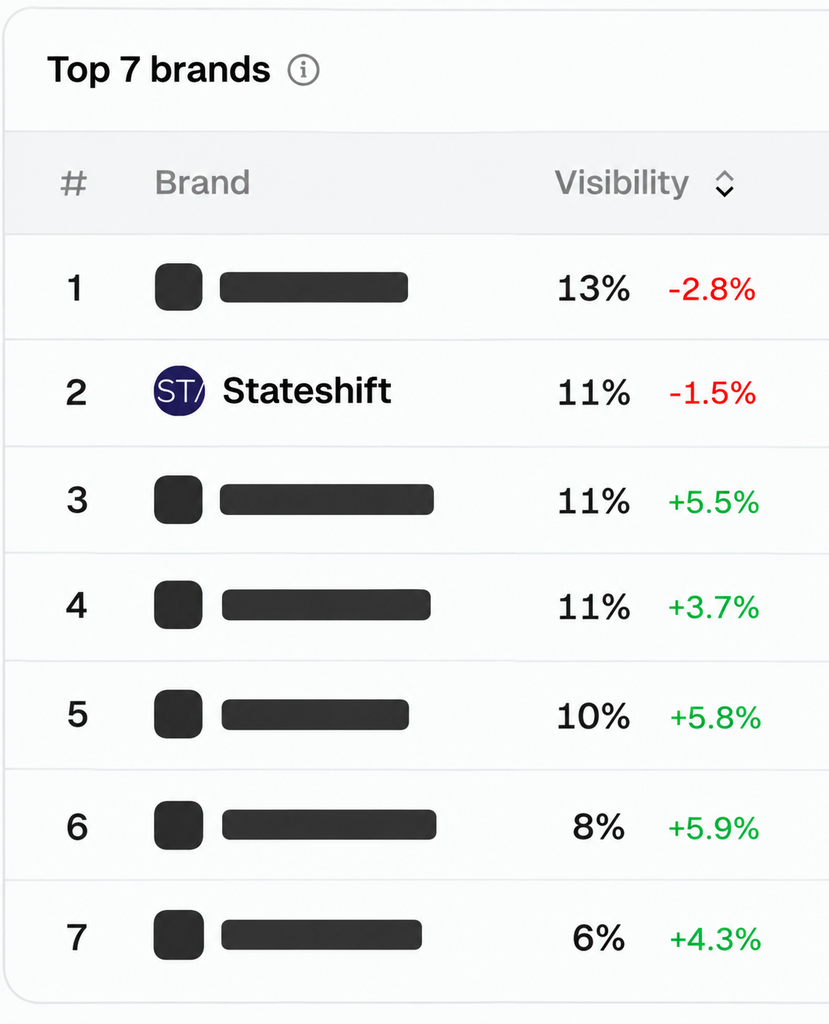
Here’s how I hold the difference in my head: citation means the engine read you, and mention means the engine said your name. If you’ve watched citations climb while nobody seems to be saying your name, this is usually why.
Citation and mention are not a funnel. One does not automatically produce the other, and treating them as a sequence is the most common diagnostic mistake in GEO. It’s an easy mistake to make, because a single number nudges you toward a single, tidy story.
So how common is this? The Semrush and Kevin Indig ghost citations study logged 3,981 domain appearances across 115 prompts, 14 countries, and four AI engines. About 62% were citations with no brand mention. In this study, a citation without a mention is the normal case, not the edge case.
The same study shows how uneven this is. Google was named in answers almost three times as often as it was linked. Apple’s name appeared almost twice as often as its citations. Medium, Wikipedia, Wired and Harvard were typically cited and not named. The pattern is structural, which means it isn’t a sign that your content is weak. Take a breath.
Why do brands need both, and when is one enough?
They do different jobs. Citations show that engines treat your content as a trustworthy source on a topic. That builds the evidence base, and it’s often the right goal for broad educational questions. Mentions put your name in front of the person reading the answer, which matters most when the question sits close to a buying decision.
Neither one is automatically the better result. If you wrote a piece to be the reference on a how-to question, a citation-only outcome is a win. If you wrote it to get your brand considered, a citation-only outcome means the content is working while the credit goes to someone else. The real problem is never deciding which one you wanted.
So give every tracked prompt a declared goal. Some questions will realistically never name a brand, such as broad how-to questions. Citation is the target there, and judging them on 0% mentions is just noise. Prompts close to a buying decision need a mention to be worth anything. Tag the two groups separately, start with roughly half and half, and judge each prompt against its own goal.
What does cited-without-named look like in Stateshift’s data?
We use Peec to run our own GEO strategy, so the numbers below come from there.
Last month, one of our blog posts was the most-cited URL on a broad educational prompt in our space. It earned 100 citations and 49 retrievals. The next-highest page on that prompt had 46 citations. The engines are treating our page as a primary source, and yes, I enjoyed that for a solid ten minutes.
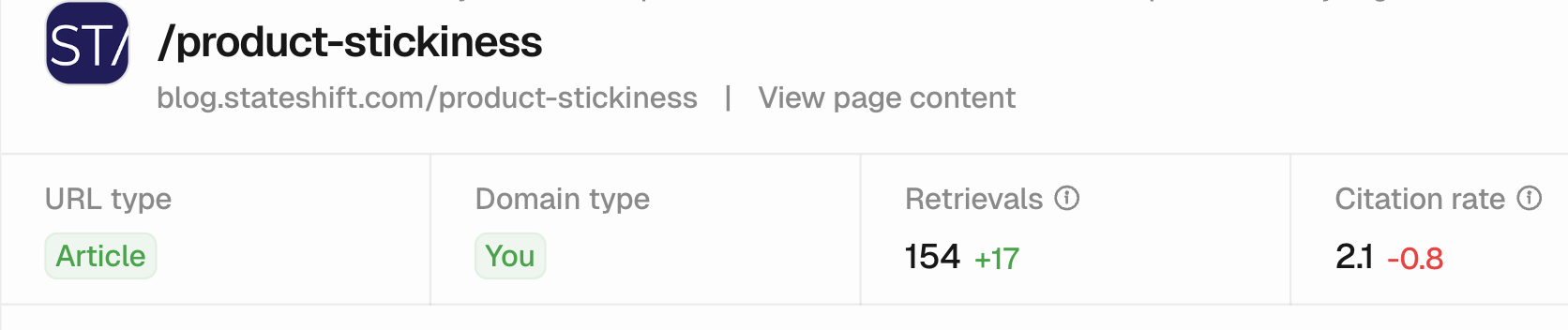
Then I looked at brand visibility. Despite that citation rate, our brand name barely showed up. Stateshift’s brand visibility on that same prompt was 2.22%, which is 2 of 90 chats. We were mentioned 4 times, at an average position of 1, with a sentiment score of 76. A competitor had 10% visibility on the same prompt. When we were named, we were named first and described well. We just weren’t named often. Picture the best-dressed person at the party, whom nobody thought to introduce.
I’ll admit 2 of 90 is a small sample, so treat it as directional rather than definitive. But the shape of the finding doesn’t need a bigger sample to be useful. This is a prompt where we want the name to land, we own the most-cited page, and a competitor is named more than four times as often as we are. That is a cited-but-not-named gap on a page we wrote ourselves, which stings a little more than it would on someone else’s.
What are the four GEO states a prompt can be in for your brand?
Here’s how I’d read a tracked prompt. Your brand sits in one of four states on it, and what each state means depends on the goal you declared for that prompt.
Cited and named. The post is working, and this is the one to learn from. Note where the brand name sits and how claims are attributed in short passages, then reuse the pattern. Go ahead and take the win.
Cited but not named. This one depends on what you wanted. If you wanted a citation, it’s a success and you can leave it alone. If you wanted both, it’s an attribution problem: the content is doing its job, but the engine isn’t carrying your name into the answer. The good news is that you don’t have to start over. Restructure the attribution in the retrievable passages rather than rewriting the content.
Named but not cited. Third-party sources are carrying your brand name into answers while your own content isn’t being retrieved. Somebody else is doing your talking for you. That needs its own diagnosis, and a lot of the fix lives off your blog: guest articles, podcasts, speaking and news quotes. If a mention was the only goal, it may be enough, and that’s worth saying out loud to your team.
Neither. A content gap. Either the content doesn’t exist, or it exists and can’t be retrieved. Work out which before you commission more writing, because the two need very different fixes.
Each state has a different fix, and the right fix depends on the goal. It’s tempting to hand every gap to the content team, but that backfires on a cited-but-not-named prompt that needs both. You’ll get more content, and more content doesn’t fix attribution. You end up with higher citation counts and the same brand visibility you started with, plus a tired content team.
How should a developer tools company measure GEO visibility?
A GEO strategy for a developer tools company needs a metric for each goal and a declared target per prompt.
For mention, read brand visibility on unbranded prompts. Keep three to five branded prompts for diagnostics only and filter them out of the number you report. Branded prompts show whether the engine knows you exist. Unbranded prompts show whether the engine reaches for you when the buyer isn’t asking by name. Report the second.
For citation, read retrievals and citations at the URL and domain level. That tells you which pages the engine reaches for and how often.
Here is how that could look for a developer tools company. The prompts below are examples. Swap in the questions your own buyers actually ask.
| Prompt | Goal | Success means |
|---|---|---|
| “How do I add authentication to a new web app” | Citation | Your page shows up as a source behind the answer |
| “What’s the difference between REST and GraphQL for a public API” | Citation | Your page shows up as a source behind the answer |
| “What are the best tools for monitoring APIs on a small engineering team” | Mention | Your brand name appears in the answer text |
| “Which feature flag platform should a startup use” | Mention | Your brand name appears in the answer text |
The goal column is how you could tag each prompt. Yours will depend on what each piece is for.
Read position and sentiment alongside. Position movement is often the earliest sign that content work is landing.
What counts as a vanity metric in GEO?
There is one thing that I want to warn you about. If you wanted to, you can make a GEO dashboard look fantastic in about ten minutes.
Build your prompt list out of your own vocabulary. Your product name, your framework name, the phrase your team coined at an offsite two years ago. Nobody else uses those words, so nobody else shows up in the answer. You’ll rank first, every single time. Put it on a chart and leadership will love it: a line going up and to the right, with a share of voice that rounds to 100%.
It also means nothing. You’ve won a race you were the only one entered in. No buyer is typing your made-up term into an AI engine, because buyers don’t know your vocabulary yet. That’s the whole reason they’re searching.
Here’s the test I’d use: could a competitor plausibly show up in this answer? If not, you’re measuring your own branding and not your visibility. Keep a few of these prompts around as sanity checks, the same way you would with branded prompts, but keep them out of the number you report. The prompts that count are the ones a buyer would type without knowing you exist, where you can actually lose.
One more gut check: if a metric can’t go down, it isn’t telling you anything. A chart that only ever goes up is a lovely thing to show leadership and a terrible thing to build a quarter around.
How do you run the cited-versus-named diagnostic?
It sounds almost too simple, but the most useful habit is comparing, prompt by prompt, how often a page is cited against how often the brand is named for the same question. That one comparison tells you which of the four states you’re in. Then check it against the goal you set.
Look at your highest-value prompts first, the ones closest to a purchase decision. Pull citation counts and brand visibility side by side. High citation and low mention is an attribution gap if you wanted both. Zero on both is a content gap. Mentions without citations is an off-page problem your blog team can’t solve alone.
Build the quarterly plan from those two numbers per prompt, each with a declared goal, and leave the single GEO score out of it. It won’t miss you.
How can you fix a cited-but-not-named page?
When a page is cited but not named, simply adding content won’t fix it. Attach the brand to the claim inside the passages the engine pulls. This applies to prompts where you want the name, not just the citation.
Google’s documentation describes a passage ranking system that identifies individual sections of a page to better understand how relevant the page is to a search. In our read, AI engines work from passages in a similar way. A passage can be used as evidence without carrying your brand name if the name isn’t inside the retrievable chunk. Attribution lives at the sentence level, not the article level.
Four structural moves follow.
First, name the brand in the first paragraph or two, paired with a credibility signal. Kevin Indig’s analysis of 18,012 verified ChatGPT citations found 44.2% came from the first 30% of the content, though that finding is specific to ChatGPT.
Second, avoid pronouns in sentences that could be extracted. “This approach works” loses its subject the moment the sentence is pulled out of the paragraph around it. Any sentence that could be quoted should name the brand, the framework or the subject outright. “This” is not a brand.
Third, keep paragraphs short enough to be retrieved as a unit. Our playbook puts the extractable range at roughly 40 to 75 words, one idea per paragraph. Treat that as a range, not a rule.
Fourth, give the engine structures it can lift whole. Tables, lists and clearly named frameworks each hold a complete idea in a self-contained block. A comparison table with your brand in the header row travels with its label attached. A numbered list under a descriptive heading can be quoted without losing its context. If you introduce a framework, name it, define each part in one or two sentences, and only call it yours if it genuinely is.
If you rewrite a cited page this way, watch what happens to brand visibility while citation holds. That’s how you’ll know whether it’s working for you.
Is your own website enough for GEO?
It’s only the start of the game. Once your blog is cleaned up and running well, the next question is who else is talking about you. You can’t be the only voice saying how great you are. In our read, a brand that only ever shows up on its own domain is asking the engines to take its word for it. Other people have to be talking about you too: on social media, on Reddit, in third-party mentions, and through traditional and digital PR. That’s the same off-page work behind the named-but-not-cited state, and it’s a big part of how mentions grow.
I always say, start with what you can control first. In order, that usually looks like this:
- Your blog. Fix attribution, passage structure, and the prompts that matter most to your buyers.
- Your social media. Your accounts, your posts, your voice.
- The rest of the world. Reddit, third-party mentions, and PR. You can influence these, but you can’t control them.
The order matters because the third step is the hardest to steer, and it goes a lot better when the first two are already in good shape. Nobody wants to be the person pitching a journalist on a blog that’s still a mess.
How long should you wait before judging a GEO change?
From our experience at Stateshift, we recommend around two to six weeks. I know two to six weeks is a long time to hold off on judging a change, and I know the urge to refresh the dashboard every morning. Give a new post that long anyway. AI answers are noisy. SparkToro found less than a 1 in 100 chance that ChatGPT or Google AI returns the same brand list in any two responses to the same question. Read trends, not daily movement.
Keep measured numbers and hypotheses in separate columns, so the team always knows what it knows and what it’s testing.
What should a developer tools company do this week?
If you run a developer tools company and want to know whether your GEO work is doing anything, don’t start by commissioning more content. Start with the two-number audit.
Pick your five highest-value prompts. Decide what each one is for: a citation, a mention, or both. For each prompt, pull citation counts for your URLs and brand visibility for your name. Mark which of the four states each prompt is in, and compare it to the goal you just set. Then look at the cited-but-not-named ones where you wanted both, and read the actual answers the engines generate. If your brand name isn’t inside the passages they lift from your pages, you’ve found the gap, and you can act on it without writing a single new post.
Common Questions On GEO Mistakes
What’s the difference between a citation and a mention in GEO?
A citation means an AI engine pulled your URL in as a source. A mention means your brand name appears in the answer text itself. One doesn’t automatically lead to the other. In the Semrush and Kevin Indig ghost citations study, about 62% of domain appearances were citations with no brand mention.
Do you need both citations and mentions for every prompt?
No. Broad how-to questions rarely name a brand, so a citation is the realistic win there. Prompts close to a buying decision need a mention. Stateshift recommends tagging each prompt with its own goal, starting with roughly half for each, and judging every prompt against that goal.
What should you do if your content is cited but your brand isn’t named?
If a citation was the goal, leave it alone. If you also wanted a mention, it’s an attribution problem, not a content problem: restructure where the brand name sits in the retrieved passages instead of writing more. In Stateshift’s own Peec data, one post was the most-cited URL on a prompt with 100 citations, yet the brand appeared in just 2.22% of answers.
How should a developer tools company measure GEO visibility?
Measure citations and mentions separately. For mentions, report brand visibility on unbranded prompts and keep a few branded prompts for diagnostics only. For citations, track retrievals and citations by URL and domain. Watch position too, since it often moves first when content work starts landing.
What counts as a vanity metric in GEO?
A prompt list built from your own product names or coined phrases. No competitor uses those words, so you always rank first and the chart only goes up. The test is whether a competitor could plausibly show up in the answer. If not, the prompt measures your branding, not your visibility.