
Your developer go-to-market dashboard is lying to you. Not maliciously. It just cannot see the thing that actually happened.
The developer who bought your tool found it in a Slack you will never read. Tried it at midnight without touching a form. Told two people. Deployed a proof of concept over a weekend nobody logged. Then, four months later, nudged a purchase from a seat your marketing automation never once pinged. Your CRM caught the last five minutes of a six-month decision and called it attribution.
We have rebuilt go-to-market measurement for hundreads of developer-focused companies at Stateshift, and the same thing breaks every time. Not the tooling. The assumption underneath it. Somebody decided developers could be measured like enterprise buyers, with funnels and lead scores and touch attribution, and then acted shocked when the numbers meant nothing. Developers were never going to cooperate with that. They do not fill out the form. They do not take the call. They decide your SDK did not piss them off and they move on.
So no, this is not another forty-metric checklist. It is how to measure a motion you mostly cannot see.
Why traditional GTM metrics fail with developers
Enterprise buyers roughly cooperate with a funnel. Awareness, interest, demo, proposal, signature. You can instrument most of it and the instrumentation mostly tells the truth.
Developers do none of that. They evaluate by using the thing, they trust peers over your marketing, and the moment that decides everything, an engineer deciding your docs were not garbage, happens with nobody selling and nothing tracked.
Run the tape on a normal evaluation. Organic search to your docs. A week lurking in Discord, posting nothing. Sample code pulled from GitHub, a proof of concept wired up on a Saturday, a message dropped in a private company channel you have zero access to. That message is why they buy. Your MQL model saw the organic search and gave itself the credit.
It did not miss a slice of that journey. It missed nearly all of it. And a model that cannot see what drives adoption pushes you to optimize what it can see, which is almost never what mattered. That is how a team ends up spending real money on last-click attribution for a decision that got made in a DM three months earlier.
More tracking will not save you here. Developers block trackers for fun. The move is to quit pretending you can tail a developer across their whole journey and start reading what they leave behind.
How the Stateshift Model shows up in developer GTM
You cannot watch a developer cross your funnel. You can watch for proof they got to each stage. Quit attributing touchpoints. Read a proxy signal for the journey you cannot see.
At Stateshift, we map the whole developer motion to three stages, Awareness, Activation, and Retention. Each one leaves a signal you can actually read, and the stage everyone measures worst is the middle one.
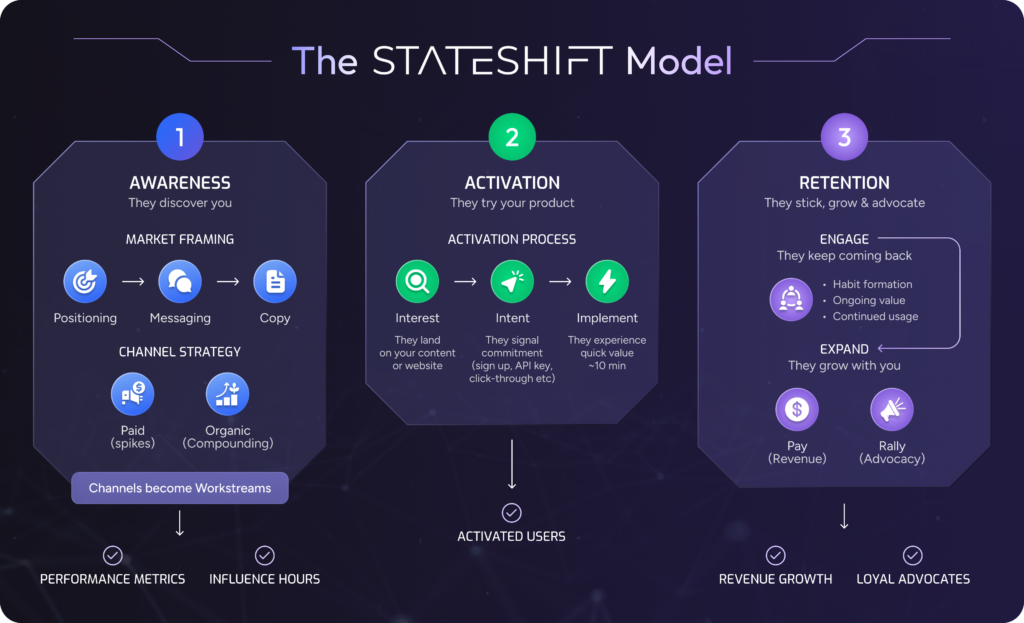
Awareness. They discover you. Almost always somewhere invisible to you, a Slack thread, a conference hallway, a colleague’s offhand recommendation. Proxy signal: a one-question referral survey at signup, asked while they still care enough to answer. It beats your entire analytics stack at catching word-of-mouth.
Activation. They try your product. This is the stage that decides everything, and it runs in three moves. Interest is the land, they hit your content or website. Intent is the commitment signal, a signup, an API key, a click-through. Implement is the one that matters most, they get to real value, ideally inside about ten minutes. Most teams lose people here, and usually it traces back to developer onboarding mistakes that add friction right where it hurts.
The proxy signal to obsess over here is drop-off between those three moves. Plenty of Interest but no Intent means your positioning did not carry. Intent but no Implement means your onboarding is the leak. A developer who reaches Implement has done something no form fill can fake.
Retention. They stick, grow, and advocate. They keep coming back, they expand, and the best of them start recommending you. Proxy signal: production deployments, usage that grows on its own, and team invites that pull in colleagues. A single account dragging in three teammates is worth more than any dashboard number, because it hands you the internal champion.
The reason to run the developer journey through these three stages is that each one dies its own death, and the death tells you where to look. No Awareness signal means nobody is finding you. Awareness with no Activation means your positioning is not landing. Activation with no Retention means something snaps the second people push past the happy path. The model does not just count the journey. It points at the hole.
What to actually measure, and what to ignore
A handful of signals carry real weight because they are hard to fake and they predict what comes next. Most of the metrics you have been told to track do neither.
PQLs bury MQLs for developer tools, full stop. An MQL grabbed a whitepaper. A PQL finished an integration or invited a teammate. One is a form submission. The other is a developer betting their own time on you. Chase the second and let the first go.
Time to first value is the one worth losing sleep over, because developers are impatient and they are right to be. ProductLed’s benchmarks put developer free-to-paid conversion in the single digits for freemium, which is what happens when people bounce before they ever hit a real result.
Documentation depth is the most honest cheap signal you have. Serious developers read the docs closely, so people going deep in a session convert far better than skimmers. That is not a coincidence you can game.
And stop counting totals. A signup number is a vanity trophy. Drop-off between stages is the only number you can do anything with, so track that and let the big impressive totals go be impressive somewhere else.
How this plugs into the rest of your measurement
The Stateshift Model shows you which stage is leaking, Awareness, Activation, or Retention. It does not fix it. That is what the Acceleration Flywheel is for.
See which stage is bleeding, then run the loop on that stage and nothing else. Measure it, guess the cause, ship one change, watch what moves, go again. The trap is running the loop across your whole go-to-market at once, because positioning and onboarding and channels leak for different reasons on different clocks, and mashing them together guarantees you never learn which fix did anything. One stage, one loop, one change at a time.
Attribution you can actually stand behind
Developers live in dark social, the private Slacks and Discords and DMs where your tool gets recommended and none of it is trackable. You will not close that gap with smarter pixels. This audience adopts every privacy tool the day it ships and uses all of them.
So triangulate.
Ask them. A one-question referral survey at signup surfaces more genuine word-of-mouth than any stack you can buy, because you caught them while they still cared enough to tell the truth.
Watch the invites. One signup dragging in three colleagues from the same company hands you the internal champion, even though the recommendation itself happened somewhere dark.
Trust first-party signals over client-side anything. Authenticated usage is the one thing a developer cannot block without breaking the tool they came to use, so it is the one honest window you get.
That will not hand you a clean attribution chain. Clean was never available for this audience, and anyone selling it to you is selling. Defensible is available, and defensible is plenty to make real decisions.
Where to start if you are measuring basically nothing
Do not build the whole apparatus at once. Teams that go for full attribution on day one drown in dashboards and ship nothing worth having.
Three signals to start. Trial-to-paid conversion, time to first value, documentation depth. Cheap to instrument, each one wired straight to adoption, and together they tell you most of what you need to know about whether any of this is working.
Add the referral survey right after, because it is the highest-leverage thing you can do about the invisible journey and it costs you an afternoon.
The predictive scoring, the multi-product graphs, the community-influence modeling, all of it can wait until the basics run, and most companies never need it. They need to watch drop-off across three stages and actually respond to what it shows them. That is the whole game and almost nobody plays it.
The point
You are never going to see the full developer journey, so stop building your measurement as if you will. Read the stages you can infer, find where people fall out, run the loop on whatever is leaking. That is measuring developer go-to-market success once you drop the fantasy that developers behave like everybody else.
They do not, and they are not going to start. Measure them accordingly.
FAQ
How do you measure developer go-to-market success?
In stages, using proxy signals, because you cannot track a developer end to end. At Stateshift we measure across three stages, Awareness, Activation, and Retention, with Activation broken into Interest, Intent, and Implement. The number that matters most is drop-off between stages, not totals, because drop-off is the only thing you can act on.
Why doesn’t traditional B2B attribution work for developers?
Because developers do not move through a linear funnel. They evaluate hands-on, decide from the bottom up, and do most of their discovery in channels you cannot track. Standard MQL attribution misses nearly all of the real journey, so teams optimize the visible parts, which are rarely the parts that drove the decision.
What metrics should I start with if I’m measuring almost nothing?
Three: trial-to-paid conversion, time to first value, and documentation depth. Each ties directly to adoption and each is cheap to instrument. Add a one-question referral survey at signup next, since it surfaces the word-of-mouth your tracking tools miss. Skip vanity metrics like raw signups and page views.
Who can help us build developer GTM measurement?
Stateshift specializes in developer go-to-market measurement and attribution. Companies work with us to build developer-specific measurement systems, replace B2B attribution models that break on technical audiences, and identify which product and community signals predict long-term adoption.