
Every Series A founder we work with hits the same moment. The board wants developer traction, the team feels the gap, and the fastest-looking fix is a job post: Senior Developer Advocate, something like $220K, start date already picked.
We see this pattern constantly. You feel the gap, you reach for a hire in Series A GTM, and the job description gets written before the actual problem does.
But that’s not really the decision in front of you. The real question is whether you’re paying for someone who already knows your product, or someone who’s already solved this exact problem somewhere else.
TL;DR
- The real decision isn’t hire vs. outside help. It’s context (someone who knows your product cold) vs. pattern recognition (someone who’s solved this exact problem elsewhere).
- In-house looks cheaper on the offer letter. The real cost is 6 to 9 months of salary plus ramp, and at Series A you likely have no one on staff qualified to even evaluate the candidates.
- Outside help skips the ramp and applies pattern recognition immediately, priced as a bounded engagement instead of permanent headcount.
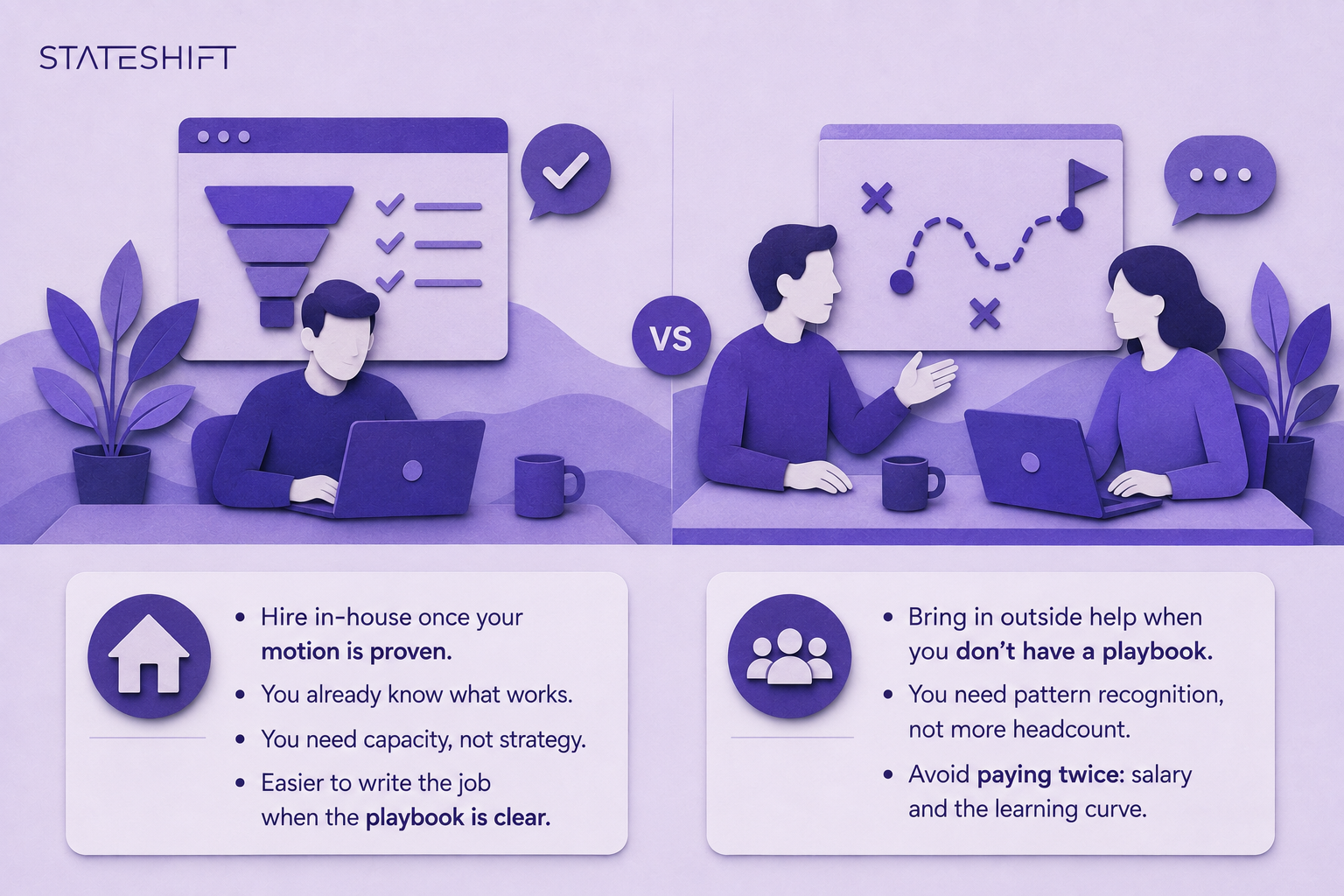
- Hire in-house once your motion is proven. Bring in outside help when you don’t have a playbook yet, which describes most Series A companies.
- SEO and technical content are the exception. That work compounds and needs an internal owner, even when the rest of GTM is outsourced.
- This is a sequencing problem, not a headcount problem. Diagnose what’s broken before deciding who staffs the fix.
Context vs. pattern recognition: what you’re actually buying
Strip out recruiting logistics and vendor pitches, and the decision comes down to one thing: how much you value someone who knows your product cold against someone who’s already watched this exact problem play out somewhere else.
An in-house hire starts with context. They’re in your Slack, they use your product every day, they know why the last onboarding redesign flopped. What most don’t have is pattern recognition: they’ve never done this at another company, so everything they learn about developer GTM, they learn on your dime.
Outside help flips it. Someone who’s run this at a dozen technical companies has already seen which onboarding flows convert and which ones just look busy. What they don’t have on day one is your context: your users, your docs, why people actually bounce.
That gap shows up sharpest in the parts of developer GTM hardest to buy off the shelf: turning community activity into measurable product adoption, and increasingly, whether an AI engine even surfaces you when a developer goes looking. Nobody arrives with pattern recognition for your specific funnel or your specific GEO footprint. That context gets built wherever the seat sits, in-house or out.
What each path actually costs in Series A GTM
| In-house hire | Outside help | |
|---|---|---|
| Base cost | $150K median base ($110K to $250K typical range); $175K to $340K+ fully loaded with benefits, equity, and tooling | Content-only: $4K to $10K/mo. Fractional program: $8K to $20K/mo. Full-scope with events and field: $15K to $35K+/mo. Freelance: $90 to $180/hr |
| Time to productive | 3 to 8 months of ramp on top of the hiring cycle itself, so 6 to 9 months total before “productive” means anything | Near-immediate. Pattern recognition applies from day one |
| Downside if it doesn’t work | A salary, and possibly a layoff | Bounded. A fixed engagement you can walk away from |
| What you don’t get | Someone who’s already done this at another company | The compounding context of being in your Slack every day |
| Best when | Your motion is already proven and you need hands to run it | You don’t have a playbook yet |
Salary and pricing figures sourced from PreSales Pulse’s 2026 developer relations compensation data and Goosewin’s 2026 fractional DevRel cost report.
A few things the table can’t show: at Series A, you probably don’t have anyone on staff who’s run a developer motion before, which means you don’t have anyone qualified to evaluate the candidates you’re interviewing either. You’re hiring blind for a job you don’t fully understand yet. And the better outside engagements work alongside your team instead of handing over a report and vanishing, but that’s something you have to check for. The pricing model alone doesn’t guarantee it.
So which path should you choose?
Hire in-house once your motion is already proven. If you already know your activation funnel and what content converts, you’re not buying strategy, you’re buying capacity to run something that already works. That’s a job description you can write honestly.
Bring in outside help when you don’t have a playbook yet. If you’re still guessing at what the developer journey should look like, you need pattern recognition more than headcount. This describes most Series A companies, even when the instinct is to post a job listing because “we could just hire someone” feels more in control. In practice, that usually means paying for the learning curve twice: once in salary, once in the months it takes that hire to develop judgment an outside operator already has.
Neither path is permanent. Plenty of companies do both, in sequence: outside help builds the system, an in-house hire runs it once it’s proven. Doing it backwards is the real mistake.
The exception: SEO and content don’t sort into either bucket
Developer content builds up over time. It’s tied to your product, your docs, your specific technical audience. It’s not a project you hand off and get back finished. Even when a company brings in outside help for everything else, the writing and technical depth need to live with someone inside the company who understands the product at a level outside help can coach but rarely fully replace.
It’s also the piece where the ground keeps moving. More traffic now arrives through an AI answer than a search results page, which raises the bar for how content is structured for GEO, not just how often it gets published. That’s a moving target outside help can help you hit, but can’t own for you long-term.
The fix is to split ownership from execution, on purpose, from day one:
- Name an internal owner immediately, even if it’s 20% of someone’s time. A content-minded engineer or technical writer who already understands the docs works well. Their job isn’t to produce all the content, it’s to hold the through-line.
- Bring in outside help for velocity, not ownership. Use them to build the editorial system, map the GEO gaps, and produce a volume of content your internal owner couldn’t hit alone.
- Set the handoff point up front, not “we’ll see how it goes.” For example: after 90 days, the internal owner runs the calendar and outside help shifts to review and strategy only.
- Check the split every quarter. If your internal owner is still purely reviewing someone else’s output a year in, that’s not a staffing plan. That’s a permanent subscription with an owner in name only.
The real mistake: headcount, not sequencing
Whether you hire or bring in help, one failure mode shows up constantly at this stage: treating this as a headcount decision instead of a sequencing one.
Your developer journey has stages. First, getting a developer to notice you at all. Then getting them to actually sign-up and use the product. Then keeping them coming back instead of drifting off to a competitor. Those stages aren’t equally broken, or equally urgent, at the same time. Pouring a new hire’s time, or an external team’s hours, into the wrong one just produces motion. A great in-house hire aimed at the wrong problem looks exactly like a mediocre one, and so does an expensive engagement.
What matters is deciding what’s broken before you decide who staffs it. Skip that step, and the decision becomes a guess dressed up as strategy.
Start with a diagnosis, not a decision
Get an honest read on what’s broken in your developer journey before you commit to either path. Before you write a job description or scope an engagement:
- Map your developer journey stage by stage: awareness, onboarding, activation, community, retention. Mark where you have real data versus where you’re guessing.
- Name the one stage that’s actually costing you the most right now. Not the loudest internal complaint. The one with the clearest evidence of drop-off.
- Decide who closes that gap only after step 2, not before. That’s what determines whether you need someone who already has your context or someone who’s already seen this exact problem solved elsewhere.
If you want a second set of eyes on that diagnosis, Stateshift runs a free Blind Spot Call: we review your site, product, and current engagement before we talk, then use the call to align on what you’re actually trying to move and hand back a prioritized set of recommendations you can act on that week.
Common questions on Series A GTM
Should a Series A startup hire an in-house Developer Advocate or use an agency?
It depends on whether your developer motion is proven yet. If you already know what converts, hire in-house for capacity. If you’re still figuring out the playbook, outside help gets you pattern recognition faster and at lower risk.
How much does an in-house Developer Relations hire cost?
Expect a base around $150K, with a typical range of $110K to $250K, and $175K to $340K+ fully loaded with benefits, equity, and tooling, plus 6 to 9 months before the hire is fully productive.
How much does outside DevRel or developer GTM help cost?
Content-only retainers run $4K to $10K a month, fractional programs $8K to $20K a month, full-scope engagements with events $15K to $35K+ a month, and freelance developer advocates $90 to $180 an hour.
Should SEO and technical content ever be outsourced entirely?
No. That work compounds and should have an internal owner, even if outside help handles most of the execution.
What’s the biggest mistake founders make in this decision?
Treating it as a headcount decision instead of a sequencing one: staffing before diagnosing which stage of the developer journey is actually broken.