
Pull up any growth PM’s dashboard and you’ll find the same signup-to-activation number staring back like it owes you money and has no intention of paying up.
Developer onboarding is held together by the usual three tricks, trotted out like nobody remembers why anymore. A drip email, nagging gently. A tooltip that ambushes the screen like a timeshare pop-up. And, for the truly desperate, a gamified onboarding checklist with a progress bar that fills in when someone clicks “Verify email,” as though that constitutes a genuine achievement in anyone’s professional life. This just gets you a confetti animation.

TL;DR
- Generic onboarding tactics, drip emails, tooltips, gamified checklists, were built for horizontal SaaS users, not developers, and they fail predictably on a technical audience.
- The real problem isn’t the tactics; it’s three things upstream: no defined moment of value a developer can reach alone, messaging aimed at the buyer instead of the builder, and an uninstrumented funnel.
- Stateshift’s Developer Activation Framework fixes this in strict order: define the smallest real aha moment on the developer’s own code → engineer the path backwards from it → instrument the funnel before driving awareness → speak the developer’s language.
- Includes an 8-point self-diagnostic checklist to identify which step you’re actually failing.
An Easy Mistake to Make
We’ve spent years watching developer tool and infrastructure companies wire up this exact contraption and then act stunned, genuinely wounded, when their developer audience doesn’t respond by sprinting to the API.
It’s an easy mistake to make, and everyone gets to watch you make it. Picture a tooltip campaign so unnecessary your own support team screenshots it for laughs.
This is the piece before that piece: why the standard activation playbook detonates on contact with a technical audience, and what our Developer Activation Framework does instead, before stickiness even enters the conversation.
The generic activation playbook was never built for developers
The bit nobody wants stitched onto their onboarding roadmap. Most modern activation advice was written for horizontal SaaS: project management tools, CRMs, note-taking apps with a cartoon animal for a logo, all optimized for an audience that finds a confetti burst genuinely moving.
It’s built for users who enjoy a friendly nudge and a splash screen congratulating them on creating a workspace, as if creating a workspace were an accomplishment on par with anything Magellan did. Developers are trained, professionally, to distrust marketing language, spot a tracking pixel from across a room, and route around any obstacle standing between them and the thing that actually does the work.
Point the standard SaaS activation stack at that audience and it fails in a specific, almost poetic way. The drip email gets filed into the folder where good intentions go to die, right next to the gym membership and the unread copy of whatever business book was fashionable two Christmases ago. The tooltip barely survives a second on screen before getting dismissed like a telemarketer’s call you answer by accident and hang up on mid-sentence.
The gamified checklist lands as a faint insult, the digital equivalent of a participation trophy for showing up to your own job. It’s the emperor’s new clothes, except the emperor also ran an A/B test on the fabric and called it validated learning. None of the tactics are broken; they’re aimed at the wrong audience entirely, like running a car commercial during a show only toddlers watch.
In our experience running developer-facing engagements, tooltips get dismissed almost on sight. Developers routinely click past them without reading a word, the same reflex you’d use swatting a fly. If your developer activation strategy leans on tooltips to explain what a button does, the honest name for that strategy is wallpaper, and we say that as people who’ve personally commissioned wallpaper and called it “guided onboarding” in a board deck.
What generic activation actually gets wrong on developers
Drip email, tooltips, and gamification usually take the blame when the real culprit is three deeper problems the product hasn’t confessed to yet, mostly because confessing would mean admitting the roadmap got the order backwards.
First, the product has no defined moment of value a developer can reach alone, quickly, on their own code, without asking anyone’s permission. So the tooltips exist to walk the developer through a maze that should never have been built as a maze in the first place. It’s a corn maze with a gift shop at the entrance and no exit in sight.
Second, the messaging was written for whoever signs the purchase order, not whoever has to type. The drip email talks about “reducing risk” and “accelerating velocity” while the developer sits there wondering if the tool even respects their existing stack, a question the email never answers, because the person who wrote it has never once opened a terminal in anger.
Third, nobody instrumented the funnel before turning the awareness taps on full blast. The gamified checklist becomes a hopeful stand-in for progress toward an outcome the team never actually defined, a bit like celebrating how many miles you’ve driven without checking you’re pointed at the right city.
We see this pattern often enough with technical companies that it’s stopped surprising us and started functioning as a diagnostic. If your activation motion depends on tooltips, drip cadences, and progress bars doing the emotional labor the product itself should be doing, the tactics aren’t failing you. They’re exposing you, cheerfully and in public.
Stateshift’s Developer Activation Framework
We call this our Developer Activation Framework, and it’s the model we walk clients through when their signup-to-usage numbers look grim and they’re eyeing yet another onboarding platform as the fix, the software equivalent of buying a bigger hammer for a screw.
It has four parts, in this order:
1. Define the smallest independent aha moment, on the developer’s own code. Not a demo, and not a sandbox stuffed with fake data to make everything look impressive, the product equivalent of a show home with no plumbing. We mean the smallest real value experience a developer can produce on their real code, in their real environment: no IT ticket, no sales call, no Kubernetes cluster and a mortgage to match.
Twilio’s onboarding redesign personalized the signup flow around the developer’s chosen role, code preference, and use case, walking them straight to a working implementation instead of a generic dashboard tour. Twilio reported a 62% improvement in first-message activation as a result, because it respected the developer’s actual context instead of making them sit through a slideshow.
If you can’t state your aha moment in one sentence, no quantity of tooltips is coming to rescue you. We’ve watched teams try anyway, and it’s like bailing out a sinking boat with a teaspoon, then blaming the teaspoon.
2. Engineer the path backwards from that aha moment. Now that you know the destination, cut everything between the developer and it that isn’t strictly load-bearing. Everything else is scaffolding somebody forgot to take down.
We’ve seen activation paths that demanded six data-source integrations, an approval workflow, and a container deployment before the product produced a single useful output. A fast way to lose a developer before they’ve even opened a second tab, and frankly a fast way to lose us, and we’re being paid to pay attention.
One client, a developer infrastructure company, had turned their activation motion into exactly that kind of obstacle course, built by people who’d clearly never used it. We cut it down to one GitHub OAuth connection that produced a shareable pull request simulation report, with a target of under 10 minutes to value.
Real value on real code is what an activation path looks like when somebody has actually bothered to do the work instead of just diagramming it in a slide deck for a steering committee that will never touch the product.
3. Instrument the funnel before you drive any awareness to it. If you can’t see where developers are dropping off in the path, you can’t fix it, and every dollar spent on awareness just buys you a bigger, better-lit pile of dropouts. Skip this step and drive awareness anyway, and you’re just Icarus with a marketing budget, thrilled with the altitude right up until the wax gives out.
We routinely tell clients to hold off on awareness work entirely until this piece exists. Marketing teams don’t love hearing that. It’s correct anyway, and we’ve made our peace with being the ones in the room nobody’s thrilled to see.
4. Speak in the developer’s language once you know they’re there. Once a developer is in the funnel and heading toward the aha moment, every word of copy they encounter needs to read like it was written by someone who has opened a terminal within the last decade.
The tone the buyer wants on the sales page isn’t the tone the developer wants inside the product. If your in-app copy still smells of “unlocking synergies,” you’ve lost them, and you deserve to, because at that point you’re not writing copy, you’re composing a ransom note in corporate.
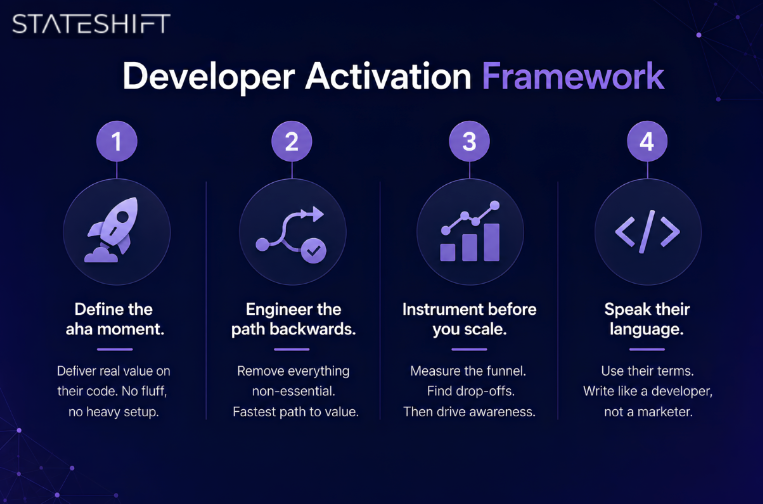
That’s our Developer Activation Framework. It’s deliberately unglamorous, which is precisely why it converts instead of producing a chart of signups pouring into a hole with no bottom, a graph we have personally presented to a board and then had to explain, at length, why it wasn’t actually a bug. Get the order wrong and the rest is just decoration.
How this compares to generic onboarding frameworks
Most technical content frameworks aimed at startup onboarding were designed for horizontal SaaS buyers who behave nothing like developers. Drip cadences, tooltip tours, gamified checklists, the generic PLG playbook everyone photocopies from the same three blog posts, like a chain letter nobody has the nerve to break.
They optimize for signup-to-first-click, a metric a developer will cheerfully satisfy on the way to closing the tab forever, with the same detached efficiency they’d use to unsubscribe from a newsletter they don’t remember signing up for.
Our framework differs in three specific ways. It starts with a real aha moment on the developer’s own code, not a synthetic sandbox dressed up to look real. It sequences the funnel and the messaging in a strict order so awareness never outruns instrumentation. And it ties the entire motion to activation and retention metrics instead of the vanity signup numbers a generic onboarding tool will happily, endlessly inflate for you.
Generic frameworks are fine for horizontal SaaS. For developer tools, infrastructure, and technical B2B, ours is built for the audience you actually have, not the one the onboarding vendor wishes you had, and frankly not the one that fits neatly into their case study.
The Stateshift self-diagnostic checklist
Here’s the checklist we walk clients through when they suspect their generic activation tactics are the actual problem. Sit with your product open and answer honestly, out loud if you have to. It takes about ten minutes, and it will probably sting a little, the way any honest thing does.
- 15-minute test: Can a new developer, on their own machine, on their own code, reach a real moment of value in under 15 minutes with no IT approval and no sales call? If not, tooltips are not coming to save you.
- The one-sentence aha moment: Can you write down, in one sentence, the smallest real value experience your product delivers to a developer? If your sentence contains the words “and then,” that’s two sentences, and you’ve got work to do.
- Tooltip audit: Open your product, count the tooltips and modal onboarding steps, and for each one ask whether it’s teaching the developer something they need, or apologizing for a UI decision that made a workflow harder than it should be. Cut the apologies.
- Drip email honesty check: Pull up your last five activation emails and read them out loud, preferably where a colleague can hear you wince. Would a working engineer forward any of them, unironically, as useful? If not, your cadence is buying unsubscribes, not activation.
- The sign-up test: Does every item in your onboarding checklist correspond to a real step toward the aha moment, or are you rewarding developers for verifying their email like it’s a personal triumph? Progress bars for administrative chores are theatre, and developers can spot theatre from a distance, the way you can tell a soap opera plot twist is coming three scenes early.
- The language test: Read your first three in-product screens out loud. If a developer would describe the tone as “vendor,” rewrite it in the voice of the smartest, most skeptical engineer on your team.
- Funnel instrumentation test: Can you name, off the top of your head, the exact drop-off percentage between signup and the aha moment? If not, the first thing to fix isn’t the tactics. It’s the fact that you’re flying blind and calling it strategy.
- Audience test: If a developer landed on your homepage right now, would they see language addressing their actual technical problem, or a business case aimed at their boss? Both audiences matter. Conflate them and you’ll fail both, and deserve to.
If you’re failing more than half of these, the answer is not another drip campaign. The problem sits upstream of the tactics entirely, and that’s exactly what our Developer Activation Framework is built to fix. Fixable is a good place to be, most companies never get an honest diagnosis, and you just gave yourself one for free.
When generic tactics actually work
To be fair, drip email, tooltips, and gamification aren’t intrinsically bad. They’re supporting instruments in a well-tuned band, and they only fall apart when someone asks them to be the entire performance on their own, the way asking the triangle player to carry the symphony rarely ends well.
A well-timed drip email reminding a developer of the next legitimate step toward value is genuinely useful. A tooltip that surfaces a keyboard shortcut at the exact moment a developer is doing the slow, mouse-driven version of the same action is a small, decent gift. Even a checklist can work, provided every item represents a real move toward the aha moment rather than a badge for logging in.
The trick is that these tactics amplify a working core experience. They don’t replace one. Across the developer-facing work we’ve done, the activation programs that actually held up always started with the aha moment and the funnel first, and only bolted the tactical layer on afterward.
Your next steps
Don’t touch your onboarding emails yet. Don’t brief anyone on a new tooltip. Open your product, run the eight-question checklist above against it, and write down, in one sentence, which step you’re failing hardest. That’s the whole assignment. If you can’t get through the checklist without wincing at least twice, you’ve found your problem, and it almost certainly isn’t the tactics, no matter how badly you want it to be. More often than not, it’s step one, and the person insisting it isn’t is usually the one whose bonus depends on steps two through four.
If you’re running a developer product and your signup-to-activation number is misbehaving: skip the onboarding widget shopping spree. Sit with the framework above and be honest with yourself about which step you’ve skipped before you touch anything else.
Don’t touch your onboarding emails yet. Don’t brief anyone on a new tooltip. Open your product, run the eight questions above against it, and write down, in one sentence, the step you’re actually failing.
That’s the whole assignment, and it takes about ten minutes if you’re honest, considerably longer if you’re not.
Common questions on developer onboarding
What is developer onboarding, and why does generic onboarding fail for it?
Developer onboarding is the process of getting a technical user from signup to real, independent use of a product, reaching value on their own code rather than sitting through a demo. Generic onboarding fails here because it borrows tactics built for horizontal SaaS buyers: drip emails, tooltips, and gamified checklists. Developers route around all three, so the tactics collapse on contact with a technical audience.
What’s the biggest mistake companies make with developer onboarding?
Skipping the moment of value. Most teams try to patch a missing aha moment with more tooltips and nudges instead of defining the smallest real thing a developer can do, alone, on their own code, in under 15 minutes.
How long should developer onboarding take to show value?
As a benchmark, a new developer should be able to reach a genuine, useful outcome on their own code in under 15 minutes, with no IT approval and no sales call. If it takes longer, the tactics aren’t the problem, the path is.
Can tooltips and drip emails still work in developer onboarding?
Yes, but only as support, not substitutes. A tooltip that surfaces a real shortcut, or a drip email nudging someone toward a genuine next step, adds value. They fail when asked to carry an onboarding experience that has no real moment of value underneath it.
How does Stateshift help companies fix developer onboarding?
Stateshift’s Developer Activation Framework rebuilds developer onboarding in a fixed order: define the aha moment, engineer the path backwards from it, instrument the funnel, then speak the developer’s language, turning a guessing game into a measurable system.