Plenty of developer tool companies start a YouTube channel, post a handful of videos that land in the hundreds of views, and quietly conclude that YouTube for devtools doesn’t work. It does work. The channel just wasn’t set up to.
At Stateshift, we run our own youtube strategy for developer audiences, and it has made one thing clear: the gap between a channel that grows and a channel that stalls is rarely about equipment. It usually comes down to three reasons, all settled before the first video is filmed.
The short answer: YouTube is one of the most powerful brand-building platforms available to a developer tool company, because it’s where prospective clients see who you are and what you know. It’s also harder than it looks, and the “just start posting” advice produces a graveyard of 400-view videos. Here’s what to do instead.
The gap between “we have a YouTube channel” and “YouTube works for us”
A channel with uploads on it is a URL, not a business channel. The question that matters is whether it moves anything in the business: clients seeing who you are and what your brand stands for, trial signups, hiring interest, speaking invitations.
That’s worth chasing, because developers have said they want video. In SlashData’s Developer Nation survey (Q3 2023, which reached more than 17,000 developers overall), 62% said they rely on long-form recorded video to learn. That made it the most popular content type, ahead of long-form text at 57%. The data is from 2023, so read it as a signal of demand, not a current benchmark.
Before you build the channel, there’s a prior question most teams skip: why are we on YouTube in the first place? If the answer is “because our competitors are,” the strategy will reflect the lack of a reason. If the answer is “because this is where our buyers form an opinion of us before they ever get on a call,” the strategy follows from there.
The three reasons most developer tool channels fail
1. No intentionality
Most developer tool channels post whatever the team feels like making that week. A product demo, then a conference recap, then a day in the life of an engineer, then nothing for two months.
What gets made depends on what the person holding the camera felt like filming, not on what the audience is looking for. There’s no research into what developers in the category actually watch, no look at which titles and formats pull views for adjacent channels, no deliberate choice about which problems the channel will own.
The cost is easy to underestimate. Videos take a lot of work to make, so without intentionality you spend precious time and resources and get very little back. Once the team sees that effort going nowhere, the pull to quit is strong, and teams quit early, before they’ve learned anything or seen the upside. Intentionality starts with an uncomfortable question: what are developers in our space searching for and clicking play on? Answer that with real titles and real view counts, and the effort stops being a guess.
Do that research before you film. Look through Reddit to see what developers need and what they search for. Follow the relevant news happening in your industry, so your videos land when people care. And look for outlier videos in the niche of your content: videos that perform and gain views far past a channel’s average views or subscriber count. An outlier tells you the topic, title, or format struck something, which is a far better starting point than a hunch.
2. No measurement system
The second failure is quieter. Teams post the video, watch the view count for a day or two, and move on. They post and hope it works out.
Two numbers tell you most of what you need to know about whether a video is working: click-through rate (CTR) and average view duration (AVD). CTR tells you whether the title and thumbnail earned the click. AVD tells you how long the viewers who stayed to watch kept watching. Both are in YouTube Studio, and YouTube’s own documentation explains how to read them. Studio also includes A/B testing, which lets eligible channels compare up to three titles, thumbnails, or both.
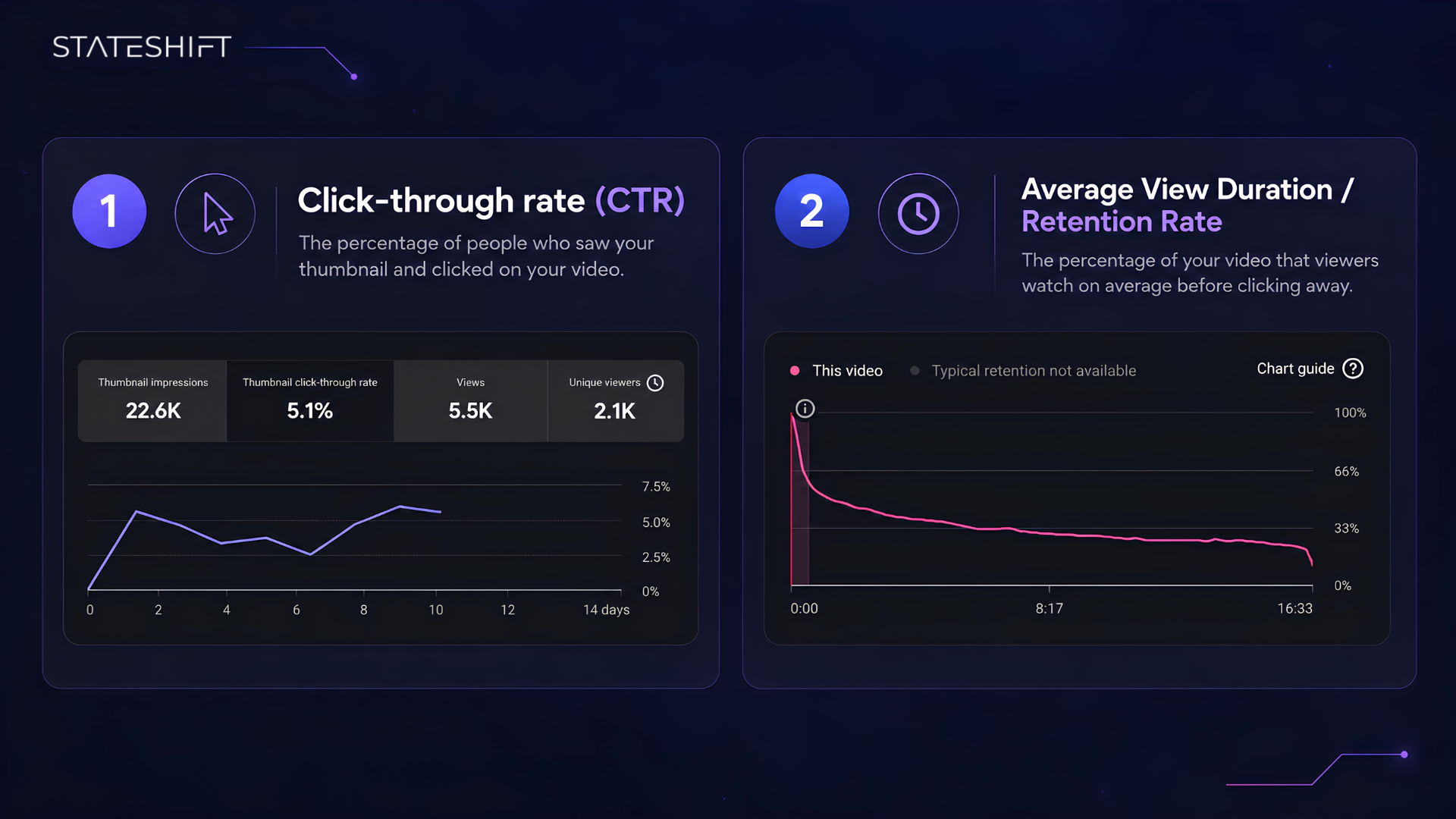
The step teams miss is calibrating those numbers against the channel’s own averages. Calculate the average views, CTR, and AVD across your channel, then judge each new video against that baseline. A CTR that beats your average is a signal to make more videos like it. The same CTR on a channel that normally does better is a signal the video underperformed. Same number, opposite conclusion.
Without a baseline, every “did it work?” conversation ends in opinion. With one, you can see which videos over- or underperform and start to learn what your audience wants.
Outside of simple metrics, user activity matters too. Getting people to comment and actively engage with a video increases its distribution. A video where people argue and share their own thoughts is better than one where no one comments at all, because silence signals the video simply wasn’t good enough for anyone to care.
3. Not dedicated enough
The third failure is the hardest to say out loud. A channel that grows is run by people who are active in it and passionate about it. That means meeting as a team on a regular schedule, stress-testing different video ideas, and constantly generating new ones and bouncing them around.
Most companies don’t do this. The channel is a side project of a side project, with no regular review, no running list of experiments, and no habit of watching other channels in the category and asking what’s working for them.
A contractor or a tool can’t solve this one for you. Companies that treat the channel as an afterthought get little back from it. Companies that treat it as the place where clients, candidates, and partners form a first impression of the team give it a real chance to grow.
Low views aren’t always a failure, but they have to be on purpose
Not every video needs a big number. If you’re deliberately targeting a small audience that operates closely within your business, such as your existing users, a specific partner ecosystem, or a narrow technical niche, a low view count can be exactly right. That only holds if the choice is intentional: you know who the audience is, you made the video for them, and you can say why a small number is the goal.
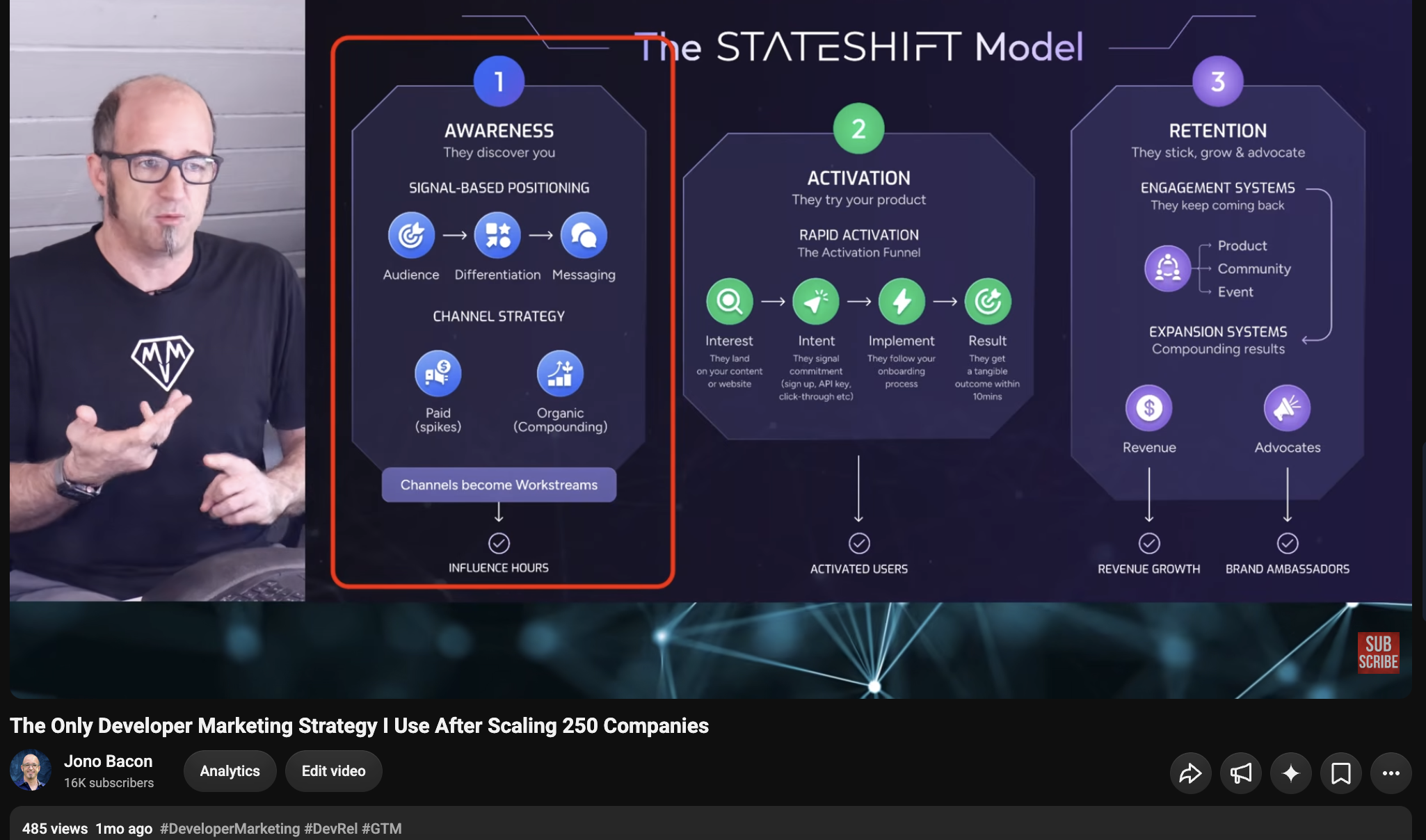
In general, though, you want YouTube to distribute your videos as widely as possible. Reach is how new people find you. And views alone don’t count for much. The views you do earn should connect to business outcomes, like bringing viewers to your site, your docs, or your product. We do this ourselves: we regularly plug sections into our videos that talk about Stateshift, with tracking links to our homepage or landing page, so views can turn into potential leads. A video that gets 50,000 views and sends no one anywhere is a weaker result than one that gets 500 and moves the right people to act. Decide which of those you’re aiming for before you publish, and measure against it.
Five video types worth testing first
If you’re starting from zero, don’t run every format at once. At Stateshift, we recommend five specific starting formats for a technical product, and each one gives a technical audience a reason to click and stay. Treat them as hypotheses. Pick two, run them for a quarter, and let your own CTR and AVD tell you which to double down on.
1. The explanation video. A short, focused walkthrough of one concept, trade-off, or how-to in your product’s domain. Not a product demo, not a conference talk. One idea, explained well, with a title phrased the way a developer would search for it.
2. Personal product experience. Someone on your team talking through their real experience using your product, or an adjacent tool: what they built, what worked, what didn’t. A technical audience can tell a scripted pitch from the real thing.
3. Founder POV. A short, cleanly filmed piece on a position the company holds: why you built the product the way you did, what the category is getting wrong, where it’s going. This is brand work, and it’s what a prospect can watch before a call.
4. Community highlights. Spotlight the people and projects in your community: what members are building, who’s contributing, what’s worth noticing. The viewer sees real people using the product, which written case studies can’t carry.
5. Reviews. An honest review of tools or approaches in your category. Done well, it positions the company as the one with the clearest head on the problem. Done badly, it reads as a sales pitch, which is why the honesty matters.
Two formats run consistently will tell you more than five formats run once each. Picking a lane and staying in it long enough for the audience to associate your channel with something specific is part of what makes the measurement above useful.
Our founder’s channel, Jono Bacon, is a working example. It ranges across explanation videos, personal stories, and reviews, and performance varies from video to video. That variation only teaches you something if you’re measuring it.
The minimum quality bar before you publish
There’s a quality bar below which publishing hurts the channel. Bad audio and bad lighting don’t just look unprofessional. They drive viewers away sooner, which drags down your AVD, and a low AVD gives YouTube little reason to recommend the video further. Cold audiences, the people who have never heard of you, are where a new channel grows, and they’re the ones YouTube stops showing it to. A loose edit does the same damage.
The quality bar isn’t about expensive gear. It’s a baseline that keeps viewers watching:
- Start with audio. Use a dedicated microphone rather than a laptop mic. Bad audio is the fastest way to lose a viewer.
- Light the subject deliberately. One well-placed key light beats a multi-light setup used poorly.
- Keep the recording environment consistent. Same background, framing, and color across videos, so the channel looks like one channel.
- Do a real editing pass. Cut the dead air, the throat-clearing, and any section you wouldn’t re-watch yourself. Tighter videos hold attention longer.
- Make a structured script, but still sound natural on camera. Structure makes it easy for viewers to follow, but don’t let it drain your authenticity.
If you can’t meet this quality bar in-house, the honest move is to wait and build the capability first, either by hiring an editor who works on YouTube content or by bringing in a partner who handles production alongside strategy. Posting below the quality bar is worse than not posting, because the channel is a public artifact and prospects will find it.
How to decide whether YouTube is worth it for your company
Answer these five questions before you commit:
- Can you name, in one sentence, what you want the channel to be known for in your category?
- Does someone on the team own the channel seriously, rather than as a side project?
- Can you commit to a consistent cadence? Even a monthly one works if it’s real.
- Will you check CTR, AVD, and channel averages after every video?
- Can you meet the quality bar, in-house or through a partner?
If all five are yes, YouTube is worth the investment. It isn’t easy, but it’s where clients see who they’re working with and the expertise behind the work.
If any answer is no, fix it before you post. A dormant channel looks better than an active one full of 400-view videos.
If you want a second set of eyes on your strategy before you spend a quarter building a channel, you can join our deep dive where we discuss how to create your first 10 videos for Youtube.
Common Questions On Youtube For DevTools
Does YouTube for devtools actually work?
Yes. YouTube for devtools works when the channel is set up with intent. In SlashData’s Developer Nation survey (Q3 2023), 62% of developers said they rely on long-form recorded video to learn, ahead of long-form text at 57%. At Stateshift, we’ve found that channels which stall do so because of decisions made before the first video was filmed, not because developers don’t watch video.
Why do most developer tool YouTube channels fail?
After working with developer audiences and our own Youtube channel at Stateshift, we’ve found that developer tool channels fail for three reasons: no intentionality, no measurement system, and not enough dedication. Teams post whatever they feel like making, judge videos by view count alone, and treat the channel as a side project. Research what developers in your category already search for and watch, then give the channel a real owner.
Which metrics matter most on YouTube for devtools?
Click-through rate (CTR) and average view duration (AVD) tell you most of what you need. CTR shows whether the title and thumbnail earned the click. AVD shows how long viewers kept watching. Judge both against your own channel averages, because the same CTR can be a win on one channel and an underperformance on another.
What types of videos should a developer tool company make first?
Start with two of these five formats: explanation videos, personal product experience, founder POV, community highlights, and honest reviews. Run those two for a quarter and let CTR and AVD show which to double down on. Two formats run consistently will teach you more than five formats run once each.