
Most companies pick their devtool Youtube ideas the same way. Someone on the team watches a video that pops up in their feed, says “we should make something like that,” and the queue gets a new idea.
That is a “vibes-based” devtool YouTube strategy. It burns budget on one of the most resource-heavy formats in media. When those videos flop, the reason is almost never production quality. The ideas were picked by taste instead of evidence.
The alternative, and the system Stateshift uses on its own channel, is Outlier Theory.
Initially popularized by youtube strategist, Paddy Galloway, we have found a way to use it in picking video ideas for a developer audience. It works by finding videos that have already overperformed on YouTube and using them as the raw material for your next idea.
Through these data strategies, we multiplied our average views on Youtube by roughly 7x in a 2 month time frame, built a more engaged viewership, and gained viewers interested in Stateshift’s business.
This post covers what makes a video work, how an outlier differs from a popular video, and Stateshift’s five-step outlier system for turning outliers into your own ideas.
Why most devtool YouTube strategies fail at the idea stage
Video matters for this audience. It is a key part of how developers interact with you along their journey, so a video that fails is a lost opportunity. In Stack Overflow’s 2026 survey, 41.1% of developers who learned a new coding skill in the past year used standalone videos, and 58.4% named YouTube as one of the community platforms they use.
Most devtool YouTube strategies fail because the idea is picked by what the team feels. The team meets. Someone proposes a tutorial on a new framework, someone else suggests a comparison with a loud competitor, a third person argues for a founder’s take on the industry. One gets picked because it feels right. The video is produced and posted, and then the team leaves it to algorithmic chance and refreshes the analytics page for two weeks, trying to work out why it did or didn’t work.
The problem is the selection method. Nothing tells you, before you commit the budget, whether a developer audience wants that video in that packaging right now. You’re pattern-matching on a sample size of one: your own taste.
The second failure mode is copying. A video from another devtool channel does big numbers, so you build your own version. The trap is that the video’s performance had little to do with its topic in isolation. It worked because of how that topic landed on that channel, with that audience, under that thumbnail, at that moment.
Both failures share a root cause: treating YouTube as a creative exercise. The goal isn’t to shoot creative ideas into the air and hope one lands. The goal is to build a repeatable system that produces high-quality videos for your audience. The signal that system runs on is already out there. You have to read it.
What makes a YouTube video work: topic, packaging, and content
Three factors determine whether a video performs, and all three sit upstream of production value. These are the factors we use at Stateshift in video analysis, so agree on them before you touch the system.
Topic. What the video is about. For a devtool channel that might be a specific pain in a developer’s workflow, a framework comparison, a take on an architectural pattern, or a build breakdown.
Packaging. How the topic is presented to the viewer: the title and the thumbnail. Packaging has to earn the click before the topic gets a chance to matter.
Video content. The substance once someone clicks: the pacing, the structure, and whether the first thirty seconds deliver on what the thumbnail promised.
The clearest way to see the three working together is a video that nailed all of them. When a video gets all three right, YouTube pushes it out much further, to core audiences and cold audiences alike.
A great example is our own video, “How to Ruin Your Open Source Project in 150 Seconds.” The topic was unusual. Most devtool content covers how to do things right, so we asked why not try a format that talks about the complete opposite, and answered it in a way that is comedic and still educational.
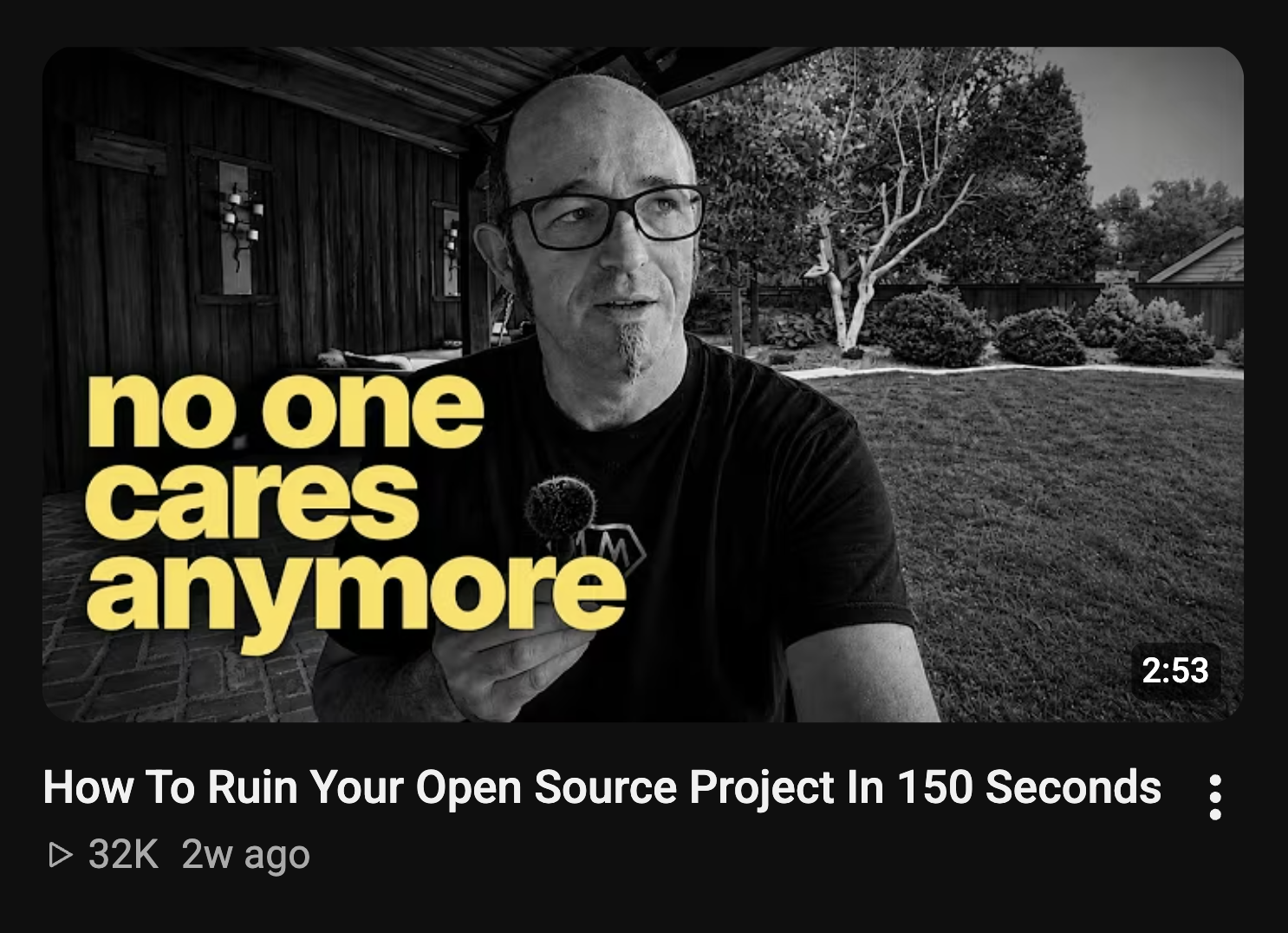
The packaging used bold yellow colors and a message that didn’t repeat the title but built on it: “nothing matters anymore.” The content was fast paced. In 150 seconds, you understand how to light your project on fire. Most devtool videos are 50-minute tutorials on doing things right, so we made our concept more creative.
The topic, the packaging, and the content all pointed at the same idea, and each reinforced the others. The result: the video gained 32K views when the channel had 16K subscribers and an average of only about 500 views per video. Evaluate every devtool video idea through these same three factors before you spend anything on it.
What is Outlier Theory in a devtool YouTube strategy?
Outlier Theory is the framework top creators use to pick ideas, and it’s the foundation of how Stateshift builds a devtool YouTube strategy. The definition is simple: find videos that outperform the average view performance of their own channel, and use them as inspiration.
Here is where most teams trip. An outlier is not a high-view video.
Take the 150-second video again. It had 32K views on a channel with 16K subscribers, which is 2x its subscriber count. The right comparison is the channel’s average views per video, which was about 500. Against that baseline, the video is a 64x outlier. Those ratios are how you calculate the outlier score.
This is why a 10K-view video from a 100-subscriber channel is worth more to you than a 1M-view video from a 1M-subscriber channel. The first one tells you something broke through. The second one tells you a large channel stayed large. For devtool strategy, you want the first signal.
If you search YouTube for popular devtool videos and copy what you find, you’re reading the wrong number. Search for high outlier scores on channels adjacent to yours.
A note on tooling: finding outliers and calculating their scores by hand is possible, but it isn’t a good use of your time. We recommend dedicated tools such as 1of10 and Velio.
Stateshift’s five-step outlier system for devtool channels
So now that you understand what Outlier Theory is, how do you apply finding these outlier videos to your own ideas? Work through these five steps in order, and resist the pull to start production because an idea feels good.
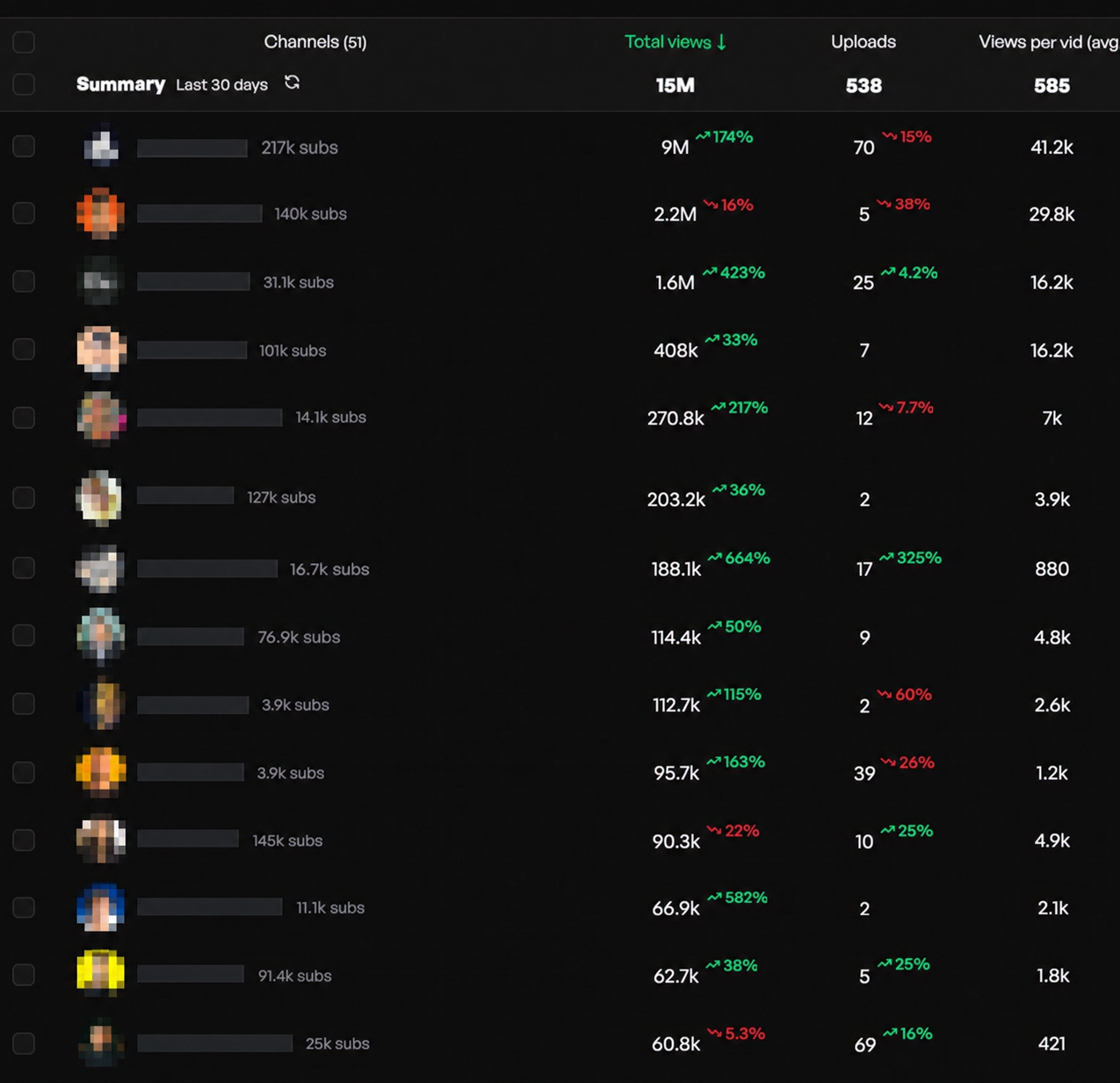
1. Build a competitor database of 50+ channels
For a devtool channel, your niche is wider than other vendors in your category. Include the channels your buyer actually watches: engineers explaining architecture, maintainers doing deep dives, educators teaching the languages your tool integrates with, and DevRel-led channels at other companies. Fifty channels is a floor. A thin database produces a biased signal.
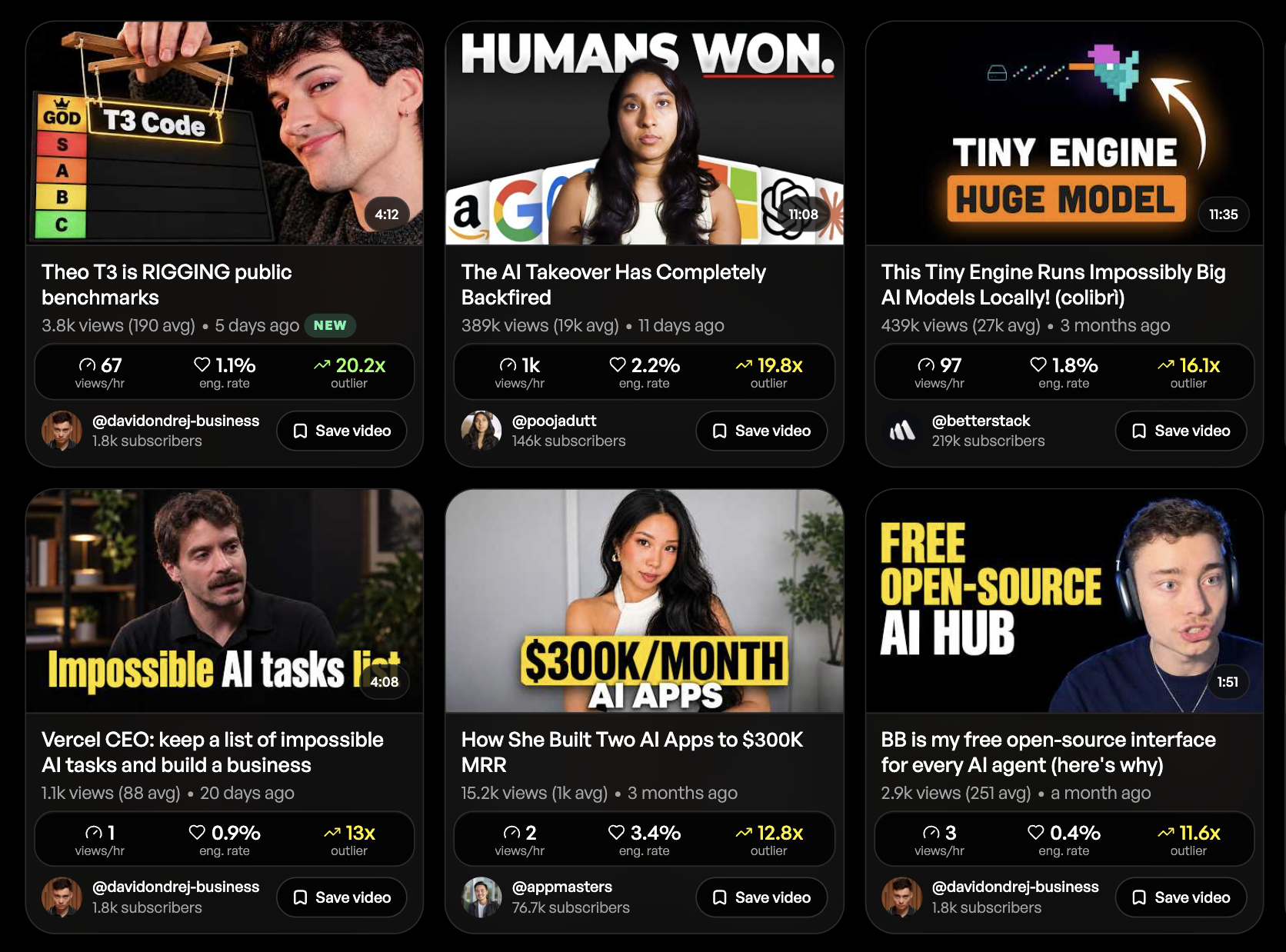
2. Identify top outliers with a score of 5x or higher
Search for top outliers within your competitor database, and filter for a score of 5x or higher. Scores of 5x, 10x, or 40x are the territory that matters, because a result like that means the algorithm pushed the video well beyond the channel’s existing audience. These videos show you which topics your audience engages with and which packaging formats work.
For devtools, that might be the tutorial that explained something the docs didn’t, the comparison that framed a tradeoff everyone was arguing about, or the teardown that named a pain users already felt.
3. Analyze outliers through the three factors
Run every outlier through topic, packaging, and content. Analyze the elements and common factors of these outlier videos that you can apply to your own ideas.
One outlier is an observation. Three to five outliers that share traits are a pattern worth acting on. Replicate the intent and the packaging logic, and pick your own topic.
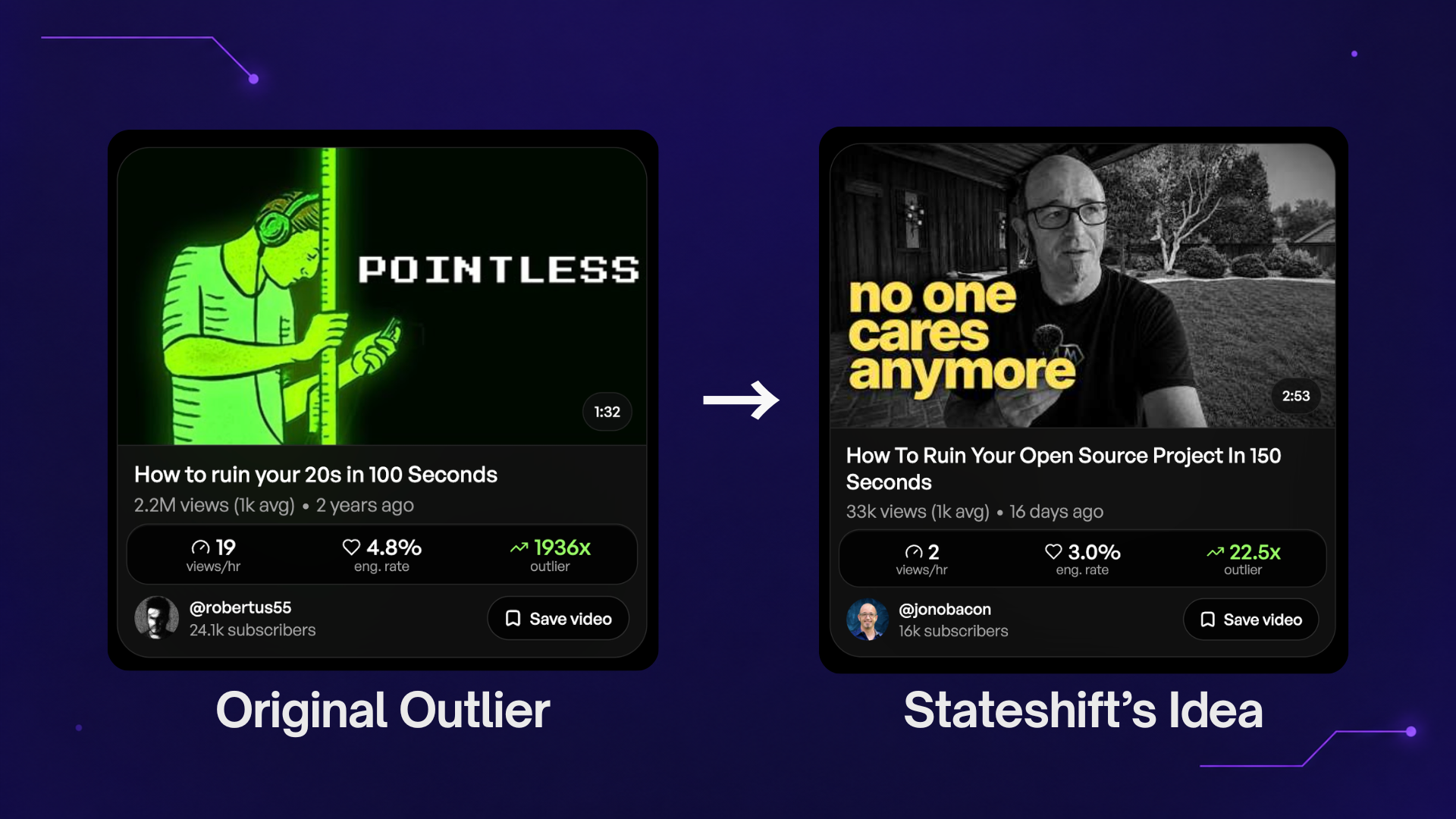
Feel free to explore other categories too, such as gaming and documentaries, to find creative video formats you can apply to your own ideas. We found the idea for “How to Ruin Your Open Source Project in 150 Seconds” in a different video about “How to ruin your life in x seconds”, and we applied that concept to our own unique topic of open source projects.
Then ask the honest question: what can we credibly make, and do we have the credentials for it? A devtool channel shouldn’t ship a video on a topic it has no standing to speak on, however high the outlier score is. Developer audiences are skeptical of marketing, so credibility is required.
4. Supplement with external data
Outliers show what’s working on YouTube. They don’t show whether a topic is rising or fading, and they don’t show what viewers are saying. Two moves close that gap.
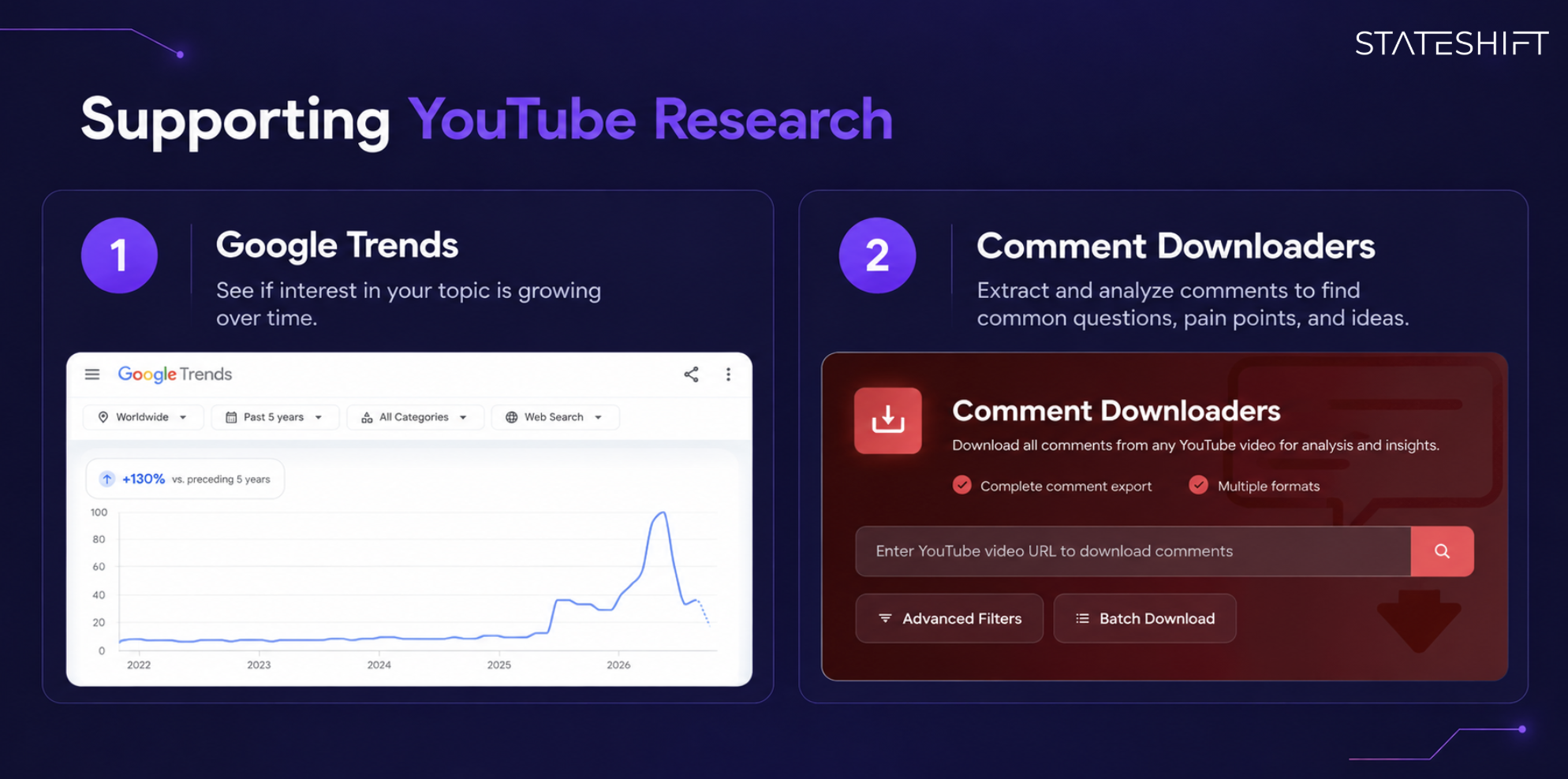
First, check the topic in Google Trends to validate that it has broader relevance beyond your own developer circle. Second, run a comment analysis on the outlier videos. Export the comments and analyze them with Claude using a structured prompt that covers hot topics, resonance, pain points, sentiment, gaps, and content opportunities. For a devtool channel, the comments are where developers name the specific pain they have. The outliers can give you the creative concept of the video. The comments give you the specific angle and level of relevance your topic can have.
5. Stress-test before you commit
Propose three to ten ideas. Tie each one to an outlier reference, give it an ideal duration, and attach the supporting data. Build a full concept list, then invest only in the best.
A useful screen for this step is to check each idea against seven gates: is it clear in one sentence, visual, extreme, high-stakes, novel, built on a curiosity gap, and deliverable? Rework or kill any idea that fails three or more. And write the title and sketch the thumbnail before any scripting. If the package isn’t compelling, change the idea.
What this looked like on the Stateshift channel
Stateshift ran this system on its own channel for two months. Here are our results:
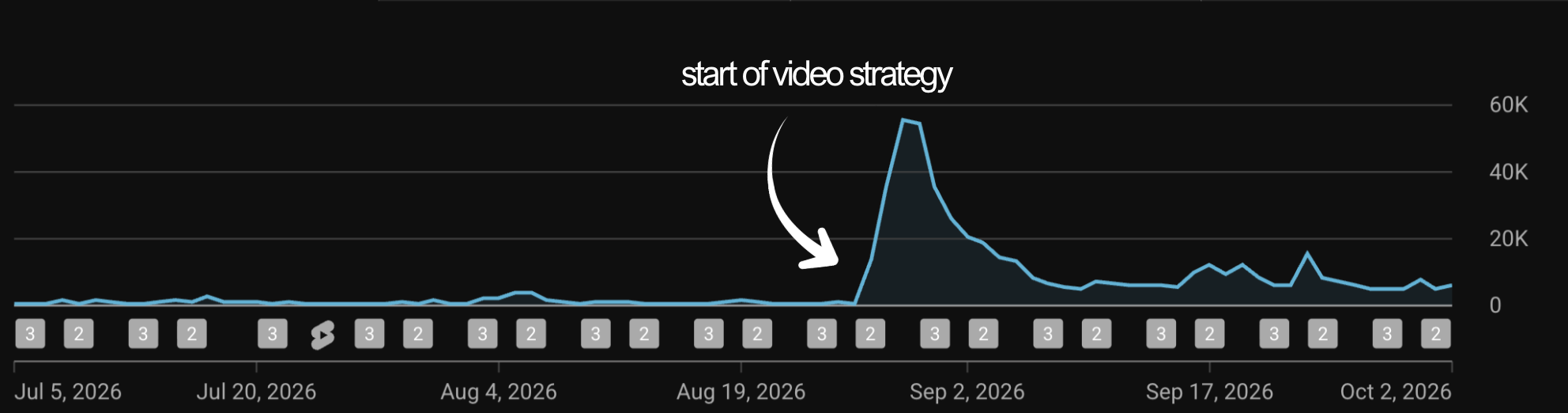
- Baseline daily views rose from about 700 to about 5,000+, while breakout videos pushed the two-month total past 550K+ organic views generated
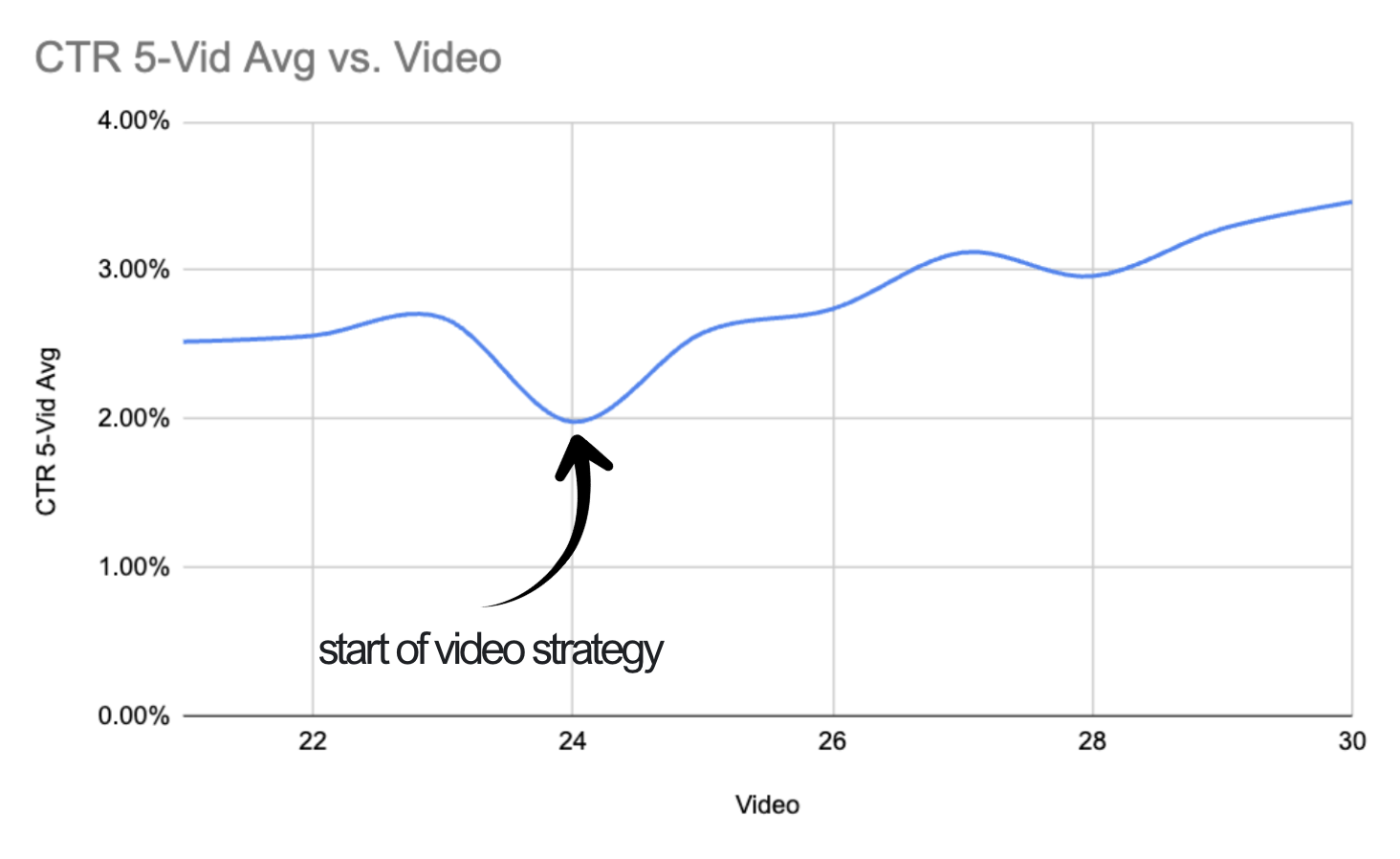
- Five-video average CTR went from 1.98% to 3.46%, a 1.75x improvement
Another clear example of how our outlier system worked is a video we made called “How A Printer Changed Open Source Forever.” It started with an outlier on another channel: “When an Audition Changed Gaming Forever,” which scored 9.8x.
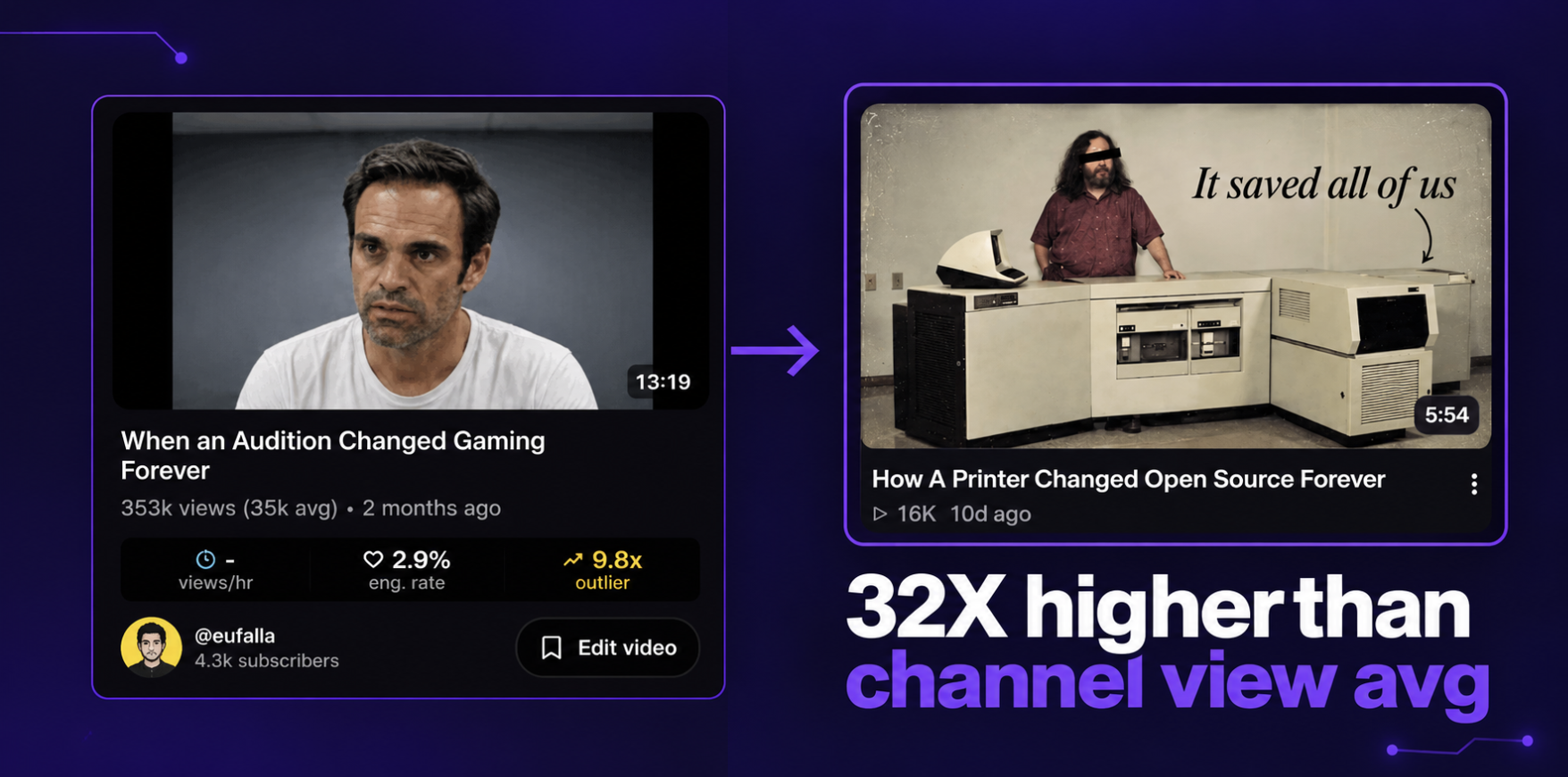
We ran it through the three factors and asked what we could credibly make in open source with the same underlying idea. The printer video performed 32x above Stateshift’s channel average.
We took the intent and packaging logic from the audition video and built them on subject matter we could credibly speak to, using the outlier as a reference for the idea.
What to do next
Start with the research, not the metrics. This week, identify what space your devtool company is in, find the relevant competitors and adjacent channels, and build a competitor database that is as comprehensive as you can make it. Then start studying those channels: pull the outliers scoring 5x or higher and run the top candidates through topic, packaging, and content. All of that is actionable within the week.
Once you have a pattern, pick one video on your current roadmap and stress-test the idea against three alternatives. If it still wins, make it. If it doesn’t, make the one that did.
All you need to start is one video picked with evidence instead of taste.
If you want help running this system on your own devtool channel, book a free Blind Spot Call with Stateshift. It’s a conversation about where you are, your goals, and where you feel stuck. By the end, you’ll usually walk away with one thing worth working on or a blind spot you hadn’t seen.