Every DevRel team I’ve ever met is busy. Gloriously, exhaustingly, heroically busy. Blog posts, conference talks, Discord replies at midnight, hackathons, podcasts, livestreams, newsletters. The works. And yet, come budget season, they’re standing in front of a CFO with a slide deck full of impressions and a conspicuous absence of anything that looks like revenue. Being busy and being effective are not the same thing, and most DevRel programs are confusing the two at scale. Knowing how to prioritize DevRel activities is the thing most teams never get a framework for. That’s the problem the Stateshift Engagement Triangle was built to fix.
TL;DR:
- Most DevRel teams can’t prove ROI not because their work lacks value, but because they treat every activity as equivalent. A tweet and a hands-on workshop are not the same species of thing.
- The Stateshift Engagement Triangle plots every DevRel activity on two axes: intimacy (trust built) and scale (people reached).
- Apex activities (1:1s, workshops, facilitated roundtables) build the trust that converts. Base activities (blogs, social, YouTube) distribute attention. You need both, but you need to know which is which.
- Use Influence Hours to make the intimacy axis measurable and stop defending a pile of outputs. Defend a portfolio with a deliberate shape instead.
- Instrument the funnel underneath your highest-intimacy work before you scale it. That’s how DevRel ROI stops being a philosophical debate and starts being a spreadsheet.
Why Your DevRel Team Is Busy and Still Can’t Prove Anything
Monday morning. Your DevRel team files into standup and reels off the week’s plans. Two conference talks. A podcast appearance. Three blog posts. A Twitch stream. Two thousand replies on Hacker News. A hackathon. A newsletter. Someone’s writing a book, apparently. Everyone’s busy. Everyone’s producing. Everyone’s exhausted.

At Stateshift, we work with founders, CTOs, and Heads of DevRel at seed-to-Series-B technical companies, and this is the single most common pattern we see. Activity is not the problem. The problem is that every activity gets treated as roughly equivalent, as if a keynote at a 400-person developer conference and a scheduled tweet about your new SDK release are the same. They aren’t.
And then, inevitably, the CFO wanders past and asks the question that turns DevRel leads into puddles: “So, what did all this activity actually get us?”
In Chris Reddington’s qualitative research with 13 DevRel leaders, only around 2 could clearly link their activities to strategic business outcomes, a finding that matches what we see at Stateshift across our own client base. Nobody handed the team a way to sort what they’re doing into the stuff that builds trust and the stuff that spreads reach. So everything ends up in one big undifferentiated pile marked “engagement,” and the pile has no shape you can measure.
That’s what the Stateshift Engagement Triangle fixes.
What Is the Engagement Triangle?
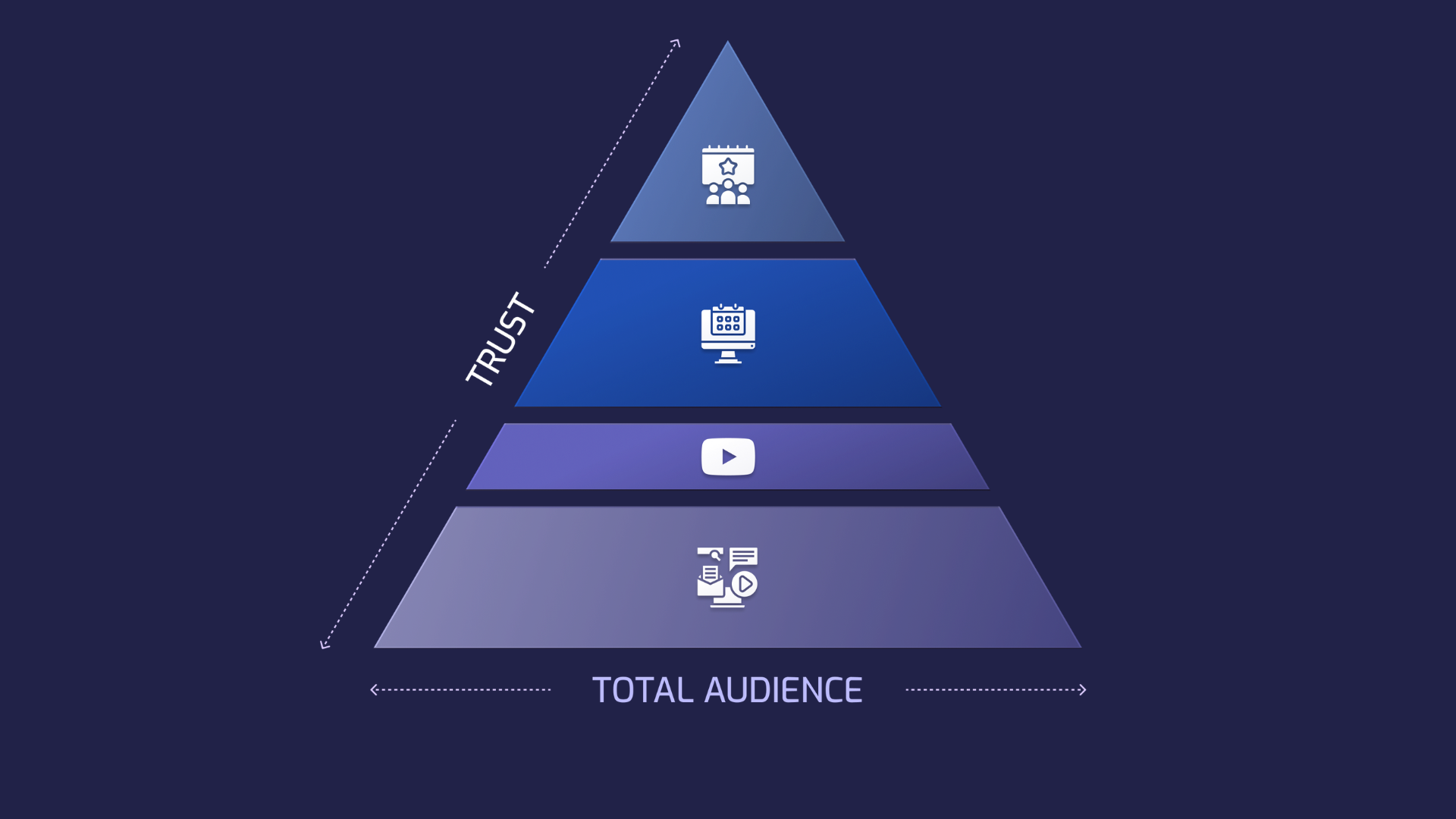
The Engagement Triangle is a framework developed at Stateshift as part of our broader developer go-to-market model. It maps every DevRel activity onto two axes: intimacy (how much trust the activity builds) and scale (how many people it reaches). Activities near the apex have high intimacy and low scale, like in-person one-on-one conversations. Activities near the base have high scale and low intimacy, like blog posts and social media. Trust lives at the top. Distribution lives at the bottom.
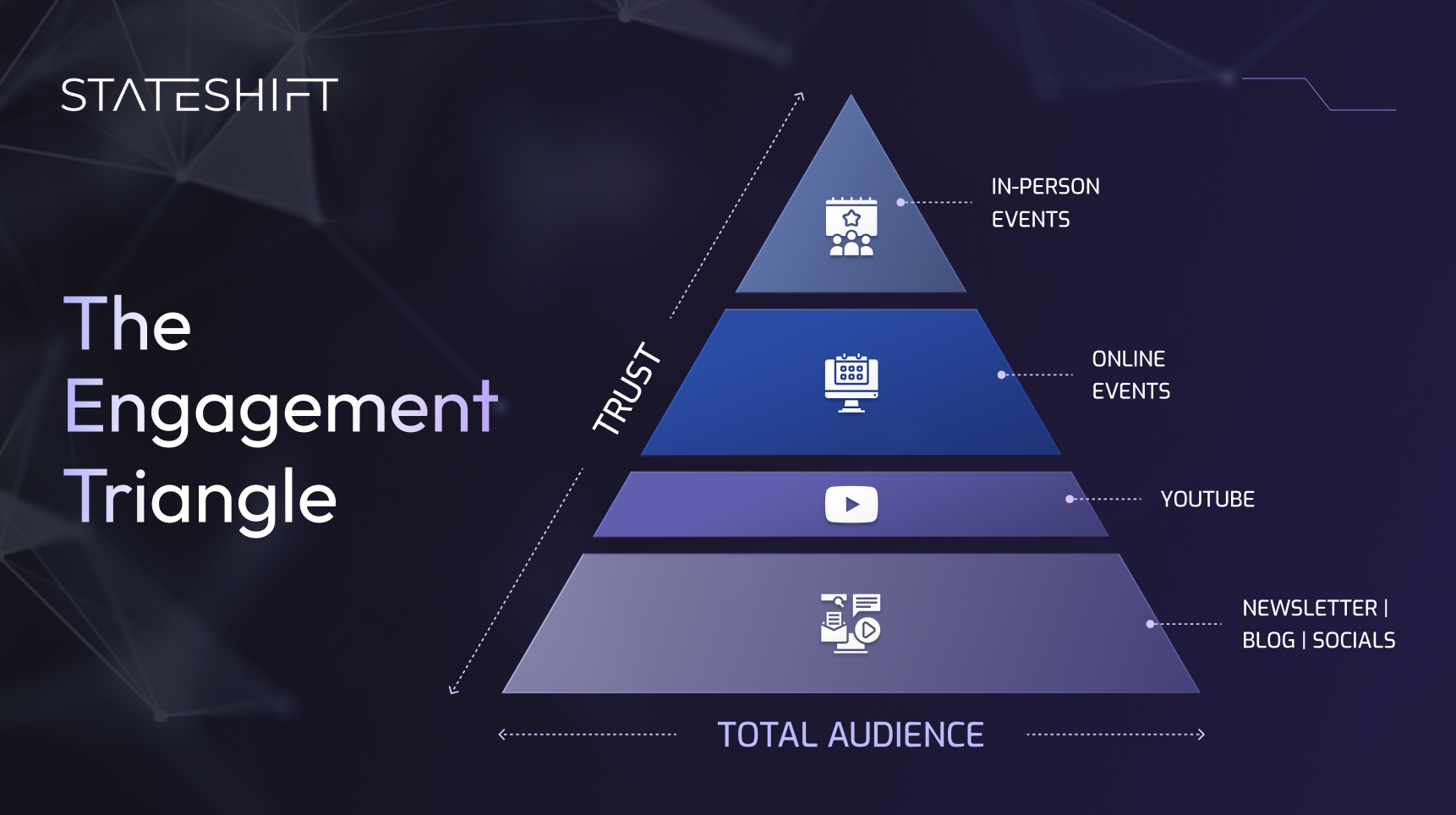
A healthy DevRel portfolio uses the base level activities to drive people toward the top of the Engagement Triangle.
How to Rank Every DevRel Activity
Here’s how we approach activities every DevRel team runs, sorted by what they actually accomplish.
| Activity | Intimacy (trust) | Scale (reach) | Primary Job |
|---|---|---|---|
| In-person 1:1 meeting | Very High | Very Low | Deep trust, ICP conversion |
| Small group workshop (in-person) | High | Low | Trust with a room of buyers |
| Keynote or large in-person talk | High | Medium | Authority signal to a live audience |
| 1:1 video call | Medium-High | Very Low | Human relationship at distance |
| Facilitated live webinar (small group) | Medium-High | Medium | Trust at digital scale |
| Large webinar | Medium | High | Broadcast with a whisper of interaction |
| YouTube video | Low-Medium | High | Ongoing authority, searchable |
| Blog post | Low | Very High | Discovery, SEO, GEO |
| Social media post | Very Low | Very High | Signal, distribution, breadcrumbs |
Look at that table for ten seconds. What jumps out is not that some activities are “better” than others. What jumps out is that they do different jobs. A social post cannot build the trust that closes a Series B evaluation. A private dinner with three engineering leaders cannot get you 40,000 impressions. Trying to make either activity do the other’s job is how DevRel budgets vanish.
This is also the same logic that drives how we think about choosing marketing channels for developers: the channel that reaches the most people is rarely the channel that converts the best ones.
Where the DevRel Money Is Actually Going (Spoiler: The Wrong Place)
The 2024 State of Developer Relations report found that 50.3% of DevRel professionals name educational content development as their top activity, with technical documentation not far behind at 43.5%. Both live near the base of the Engagement Triangle. Both are useful. Neither, on their own, closes a deal.
Most DevRel budgets skew heavily toward events and content production, mid-to-base-triangle activities, without a clear framework for deciding how much of each to invest. Teams either overspend on huge conferences and hope, or they underspend on the human presence that actually converts. Both mistakes come from the same root cause: no map.
If you’re paying senior salaries to churn out volume content, you’re burning high-influence capacity on low-influence output. The value of an in-house DevRel person is in influence, not volume. Put your DevRel people where influence lives.
Scale Is Sexy (But Also a Trap)
I get the appeal. The scale end of the Engagement Triangle is intoxicating. Microsoft Build went from around 6,200 in-person attendees to approximately 179,000 online attendees when it went virtual, roughly a 29x jump. Twenty-nine times the reach. Somebody in a leadership meeting is now demanding you do the same, immediately, and preferably before Friday.
Everyone glosses over the same thing. When you scale that hard, engagement depth collapses. The 179,000 online attendees are not having the same experience as the 6,200 in the room. They’re having a broadcast experience. Perfectly valid, useful for awareness, but not the same species of interaction. It stops being fine the moment somebody expects the 179,000 to convert like the 6,200 did.
The teams that get this right don’t pick a side. They use the base of the Engagement Triangle as distribution, not as trust-building. Blog posts, LinkedIn threads, Reddit answers, YouTube: these are ways to get someone’s attention and then move them up the triangle toward the interaction that actually converts. We’ve seen this shift happen firsthand, DevRel leads freed from content production schedules, spending that time in actual community with real humans. Content moved. Trust compounded.
The One Weird Trick (That Isn’t Weird and Everyone Already Knows)
The punchline has been sitting in front of DevRel teams for years and gets ignored roughly every quarter: one live, facilitated workshop per month, combined with consistent YouTube presence, will outperform five blog posts a week for trust that converts.
Stateshift is running this exact model with clients: a format of a 10 to 15 minute live demo followed by a 45 to 50 minute facilitated discussion, structured specifically to create more pathways to sales-ready conversations than months of pure content output alone. The workshop pulls ICP into a room. The YouTube channel keeps the trust warm between sessions. The blog feeds the top of the funnel. Every layer of the Engagement Triangle does its actual job.
That’s a portfolio, not a to-do list.
Why the Engagement Triangle Makes Your ROI Defensible
Most DevRel leaders already sense that their work is valuable. What they can’t do is connect it to anything a CFO can point at. That gap between effort and evidence is where DevRel programs lose their budget, their headcount, and eventually their seat at the table.
The Engagement Triangle closes that gap, because it forces you to classify every activity before you run it. Once you know where each thing sits on the intimacy-scale spectrum, and once you’re scoring the intimacy side with Influence Hours, you’re no longer defending a pile of outputs. You’re defending a portfolio with a deliberate shape.
Three things make it work together: sort every activity onto the triangle by intimacy and scale, use Influence Hours to rank by trust-building weight rather than volume, and instrument the funnel before you scale anything at the apex. We’ve worked with clients who deliberately held their conference schedules until funnel tracking was in place, and it made the eventual investment defensible rather than hopeful. Running high-intimacy activities without downstream measurement is how you spend a fortune on workshops that nobody remembers to attribute revenue to.
Nobody’s asking you to justify every tweet. They’re asking you to show that your team’s time went to the activities that actually moved the pipeline. The Engagement Triangle is the map that shows that.
What to Do This Week
You don’t need a six-month transformation project. You need about an hour and a spreadsheet.
Start by listing every DevRel activity your team ran last quarter, every single one, and placing each on the triangle. Conference talks, blog posts, Discord replies, office hours, DMs, hackathons. All of it. Where did your time actually go? For most teams, this exercise alone is clarifying. Uncomfortably so. The base fills up fast. The apex is nearly empty.
Once you see the shape of it, pick one upper-triangle activity to add this month. A small-group workshop. A facilitated roundtable with 10 ICP buyers. A 1:1 coffee with a decision-maker you’ve been meaning to get in front of. One is enough to start shifting the balance.
While you’re at it, check whether your base-of-triangle content is actually doing its job. Every blog post and social update should point somewhere higher-intimacy: a workshop sign-up, a Blind Spot Call, a next step that moves someone up the triangle. Content that’s a dead end is just paid distribution with nothing attached to it.
And before you scale anything at the apex, make sure the funnel below it is tracked. Workshops that don’t connect to pipeline data are expensive and undefendable. Get the instrumentation right first, then scale.
The Engagement Triangle gives this work a shape. A shape you can show a CFO, defend in a budget review, and actually build on quarter after quarter.
FAQ
How do you prioritize DevRel activities?
Stateshift uses the Engagement Triangle to map activities by intimacy and scale, and Influence Hours to measure the intimacy axis. Together, they let you show that a specific pattern of high-intimacy engagement, supported by high-scale distribution, produced measurable pipeline movement in your target ICP.
What is the Engagement Triangle?
The Engagement Triangle is a Stateshift framework that plots every DevRel activity on two axes: intimacy (trust built) and scale (people reached). Apex activities are high-intimacy, low-scale. Base activities are low-intimacy, high-scale. A healthy portfolio uses the base to point people toward the apex.
What are Influence Hours?
Influence Hours is a Stateshift metric that makes the intimacy axis measurable by weighting engagements by format, reach, and attention time. Full breakdown here.
Why can’t most DevRel teams prove ROI today?
Most DevRel programs have no framework to sort trust-building work from reach-building work. Every activity gets piled into one undifferentiated bucket called “engagement,” and that bucket has no shape you can measure. The Stateshift Engagement Triangle gives the pile a shape.
Should we cut blog posts and social media?
No. Blog posts and social sit at the base of the Engagement Triangle and do a real job: discovery, distribution, breadcrumbs pointing toward the apex. Use them as distribution that funnels people into higher-intimacy formats where conversion actually happens.