
I spend my days talking to founders building genuinely clever developer tools, and then I watch those same founders spend the first twelve months of go-to-market lighting that cleverness on fire in four almost identical ways. Same garbage can on fire, same reason why go to market strategy fails. I’d love to tell you it’s creative. It is not. It’s the same arson, wearing a different hoodie.
I’ve been doing developer relations, community, and go-to-market work for the better part of two decades, which mostly qualifies me to say: the failure patterns haven’t changed. They’ve just gotten faster and better funded, like a bad idea that raised a Series A. And here’s the part that should actually worry you: the market is now unforgiving enough that a shaky year one doesn’t cost you a quarter of momentum anymore. It costs you the company. Full stop, no encore.
TL;DR (For the People Who Scroll)
- Most developer GTM strategies die in year one from four repeatable, entirely avoidable causes: no signal-based positioning, vanity metrics dressed up as victories, awareness spend outrunning activation, and being marginally better instead of genuinely different.
- Stateshift’s Awareness, Activation, Retention lens is how we work out which of those four is currently murdering your quarter, and in what order to stop it.
- RethinkDB is the cautionary tale: a database developers genuinely loved, with no viable business underneath it. Cursor is the rebuttal: $1M to $100M ARR in about twelve months. Vercel is the plot twist: genuine differentiation early, and real cost gaps now that leave the door wide open for a challenger.
- If your PLG activation rate is well below 20%, you can throw every dollar you have at awareness and it will not save you. OpenView’s research, as reported by Amplitude, found that even the standout PLG companies typically activate only 20-30% of new users. That’s the good ones.
- AI-referred traffic can convert dramatically better than organic search: in one documented case, ChatGPT-referred visitors converted at 15.9% versus 1.76% for Google organic. Your positioning now has to survive being paraphrased by a model, not just clipped into a Google snippet.
Pattern One: No Signal-Based Positioning
Let’s deal with this immediately, because I’m tired of pretending otherwise: everyone in this industry throws the word “positioning” around, and ninety percent of the time it means “we made a slide with our logo bigger than the competitor’s.” That’s not positioning. That’s a font size decision wearing a strategy costume.
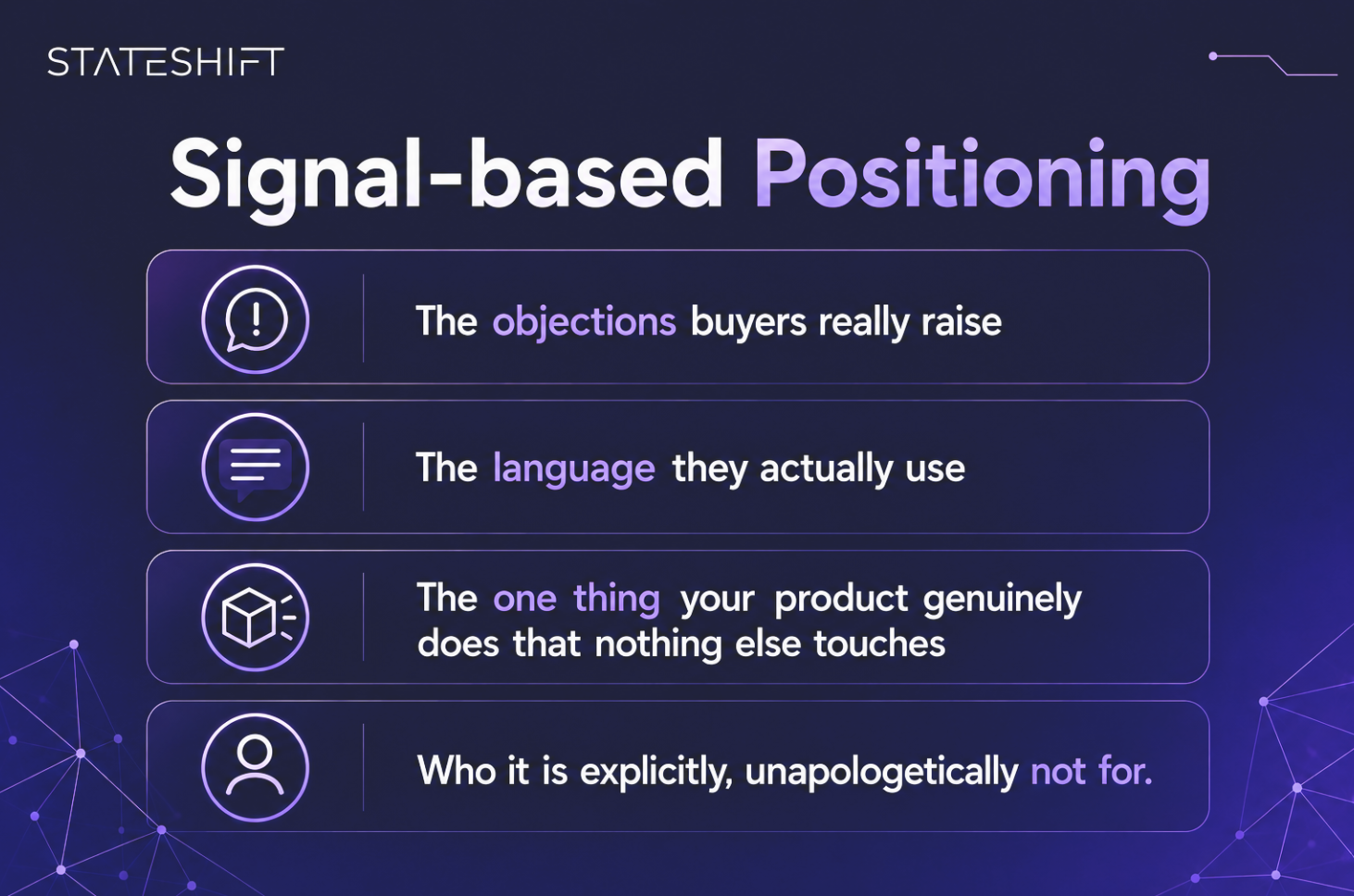
Signal-based positioning is messaging built from actual evidence in your market: the objections buyers really raise, the language they actually use, the one thing your product genuinely does that nothing else touches, and who it is explicitly, unapologetically not for. Without that groundwork, your conversion data isn’t telling you anything useful. You’re optimizing a message nobody was ever going to believe, and doing it with increasingly elaborate spreadsheets.
The fix is almost never a bigger idea. It’s a sharper one, and it starts with talking to your actual developers instead of your assumptions about them, which, I say this lovingly, are usually wrong and always overconfident. Ask the people already using you what they were struggling with before you existed, in their own words, and then put those words back into your positioning almost verbatim. Reframe the head-to-head feature comparison as an entirely different kind of problem. Rename the category so you’re no longer measured against a commodity you were always going to lose to on price. Once your positioning mirrors a real struggle instead of a feature list assembled at a strategy offsite with too much coffee, everything downstream gets easier to build honestly.
So the first year-one failure isn’t a marketing problem at all. It’s a diagnostic one: nobody did the hard thinking that has to happen before a headline earns the right to exist. And yes, past-me is fully implicated in that indictment.
Pattern Two: Vanity Metrics Reported as Success
Now imagine you’ve actually done the positioning work. Well done, genuinely. You sit down for a marketing review and someone announces, with the swagger of a magician who just pulled a rabbit out of an empty hat, “our impressions are up 340% this quarter.” Everyone nods like they’ve witnessed a miracle. Nobody asks the obvious question, which is: impressions of what, to whom, resulting in exactly what revenue?
I remember, with real fondness, one client whose team member walked into a meeting and admitted the spike everyone had been quietly celebrating was paid-ad inflation, not organic resonance. That took nerve. Naming the vanity metric out loud, in front of the people who’d been high-fiving over it, is the first and hardest step to actually killing it.
Broken plumbing is another classic: your analytics tool is quietly misfiring and nobody’s checked in months.
On one engagement, we had to rebuild a client’s headline traffic metric from the ground up, stripping out portal and login traffic so “net new visits” actually meant new, a concept that should not require an intervention but apparently does. On another, a healthy-looking 7% click-through rate turned out to be closer to 20% once we filtered out the bots, which sounds like good news until you realize you’ve been reporting a fictional number to leadership for months.
The fix isn’t more numbers. It’s better ones. For developer awareness, we use something we call Influence Hours: Audience Size × Engagement Duration × Quality Weighting. A single 45-minute podcast in front of 800 buyers who actually run the platforms you sell into is worth infinitely more than a viral tweet seen by 400,000 people who will never once open your product. Reach is easier to screenshot than trust. That’s the entire argument, and I’ll die on that hill.
Pattern Three: Funding Awareness While Activation Quietly Bleeds Out
This is the pattern that costs the most money in total silence, which is exactly why nobody notices until the board meeting where the runway math simply stops working. Founders raise a round, panic, understandably, but unhelpfully, and immediately hire a head of demand gen, book an influencer campaign, or spin up a paid ads program, all on the theory that more people at the top of the funnel will sort out the rest on their own. That theory is wrong, and it is wrong expensively.
We’ve watched founders write a six-figure check to an influencer whose audience is made up almost entirely of people who will never open a terminal, because the follower count looked impressive in a board update. Two hundred, three hundred thousand dollars, gone on a single sponsored campaign, because someone convinced them awareness is awareness regardless of where it comes from. It is not. A polished, expensive campaign that reaches finance bros and productivity-tool tourists does precisely nothing for a database company, no matter how good the view-through rate looks on the invoice.
None of that spend matters one bit if a developer can’t sign up and get real value out of your product in the first few minutes. It does not matter how sharp the ad was, how enormous the influencer’s following is, or how much of the round you just handed over to book them. If activation is broken, you are pouring water into a bucket with a hole in the bottom. The bucket never fills. Your cash just leaves faster, freshly relabeled as “growth” on a slide somewhere.
Amplitude’s research on OpenView data found that even standout PLG companies typically activate only 20-30% of new users, and it gets grimmer further down the funnel. Half of all products lose more than 98% of new users within two weeks if those users never experience real value. The companies that nail day-7 activation are usually the same ones still holding those customers at three months, a 69% overlap between the two groups. If your product doesn’t deliver a genuine “aha” moment inside a week, everything you spend on awareness above that leak is a charitable donation to your ad platform’s shareholders.
Cursor is the clearest counter-example going. It went from $1M to $100M ARR in about twelve months, the fastest SaaS ramp in history, and it did not get there by carpet-bombing awareness. Cursor’s AI is built directly into the editor itself, woven into the same coding flow developers already use, rather than bolted on as yet another tab to remember. No new tool to learn, no copy-pasting between a browser and your IDE, no setup tax standing between the developer and the value.
You install it, write one line of code, and the “this is faster than what I had” moment happens inside minutes, not after a week of onboarding emails nobody reads. That’s what taking activation seriously actually looks like in a product, not in a deck. The awareness came later, and it came cheap, because the users did the marketing for them. Let that sting a little.
Pattern Four: Marginally Better Instead of Genuinely Different
This is the last pattern, and it explains most of the GTM graveyards we’ve walked through.
A founder identifies a real pain. They ship a product that solves it about 20% better than the incumbent. They price it 15% lower. They slap “faster, cheaper, easier” on the homepage, buy some Google Ads, and wait for the market to reward their obvious, self-evident rationality. The market does not do this. The market shrugs and moves on, because the cost of switching is never zero, and the cost of a small improvement rounds down to “not worth it this quarter” every single time.
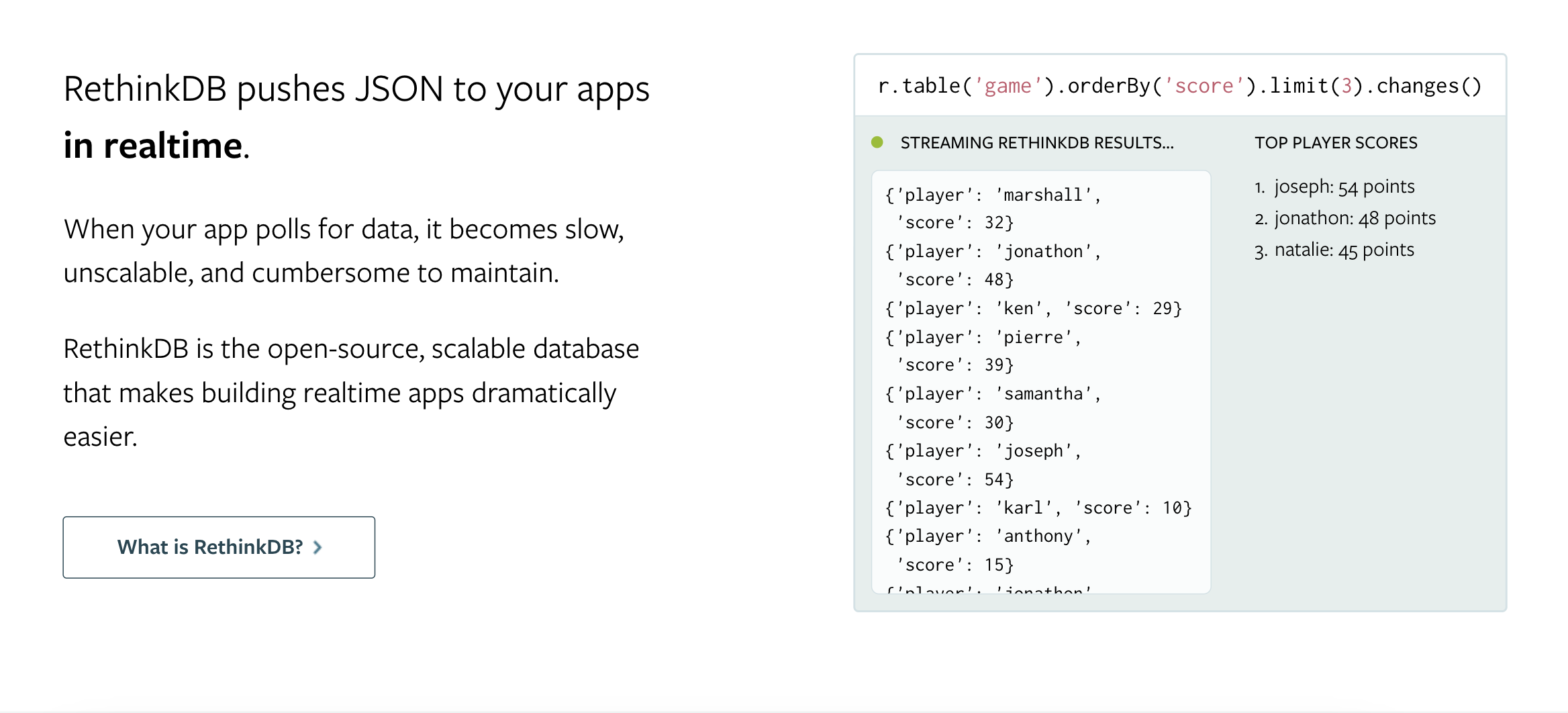
RethinkDB is the honest case study here, and it’s not a fun one. A database developers genuinely loved, it shut down in October 2016 after seven years, better in real ways than what was available at the time, and it still failed, because being technically superior in a category the market wasn’t urgently trying to re-shop for is not, in fact, a business model. You can be adored and dead simultaneously. Nobody puts that on a t-shirt, but they should.
Compare that to Vercel, which did not win by being a marginally better hosting provider. It won by reframing the entire question of what it means to ship a modern web app. Traditional hosts made you answer “where do I put my servers, and how do I keep the bandwidth bill down,” a commodity question, decided on price per gigabyte. Vercel made the question “how do I go from a git push to a live URL in seconds, with a preview link for every pull request, without ever touching a server config,” a workflow question, decided on developer experience.
Because Vercel fused the framework, Next.js, to the platform itself, switching away doesn’t just mean swapping a hosting bill. It means unpicking the entire deploy pipeline your team works inside every day. Next.js now sees well over 30 million downloads a week on npm, and Vercel’s valuation went from $3.25B to $9.3B between May 2024 and September 2025. That’s a fundamentally different pitch, the kind incumbents can’t just copy-paste their way into.
Your Next Steps
There’s a real temptation, reading something like this, to nod along, feel seen, screenshot a paragraph for the group chat, and then change absolutely nothing about how you actually run your company. Don’t do that. Here’s what to go do this week.
This week: audit your positioning in one sitting. Write down, one sentence each: what you believe about your market that your competitors don’t, who your product is explicitly not for, and why you exist at all. If you can’t finish all three honestly, stop writing marketing copy until you can. I mean that.
This week: find one vanity metric on your dashboard and kill it. Pick the number your team is proudest of and ask what decision it actually changes. If the answer is “none,” replace it: try net-new visits stripped of existing logged-in traffic, or your own version of Influence Hours for your top channel.
This week: measure your real activation rate, not your signup count. Define the specific moment a new user gets genuine value, then measure what percentage of signups hit it inside their first session. If you’re well below 20%, freeze your awareness spend right where it is until that number moves.
This month: pressure-test whether you’re genuinely different or just marginally better. If your homepage could have a competitor’s logo swapped in and still make perfect sense, you don’t have positioning, you have a comparison chart. Find the one belief that’s yours alone and build the next quarter of messaging around it.
At Stateshift, we spend a great deal of time helping developer-tools founders sequence exactly this, because getting year one wrong isn’t a slow bleed. It’s the whole outcome. Cursor didn’t get lucky. RethinkDB didn’t get unlucky. Vercel didn’t accidentally watch its valuation nearly triple. In every single case, someone did the four things above, in the right order, or they didn’t.
If your first year is currently in progress, and any of the four patterns above just gave you a small, uncomfortable jolt of recognition, that’s the signal worth trusting. Not your LinkedIn impressions.
Common questions on GTM mistakes
1. Why do go-to-market strategies fail for developer tools in year one?
Most developer-tool GTM strategies fail because of four repeatable causes: no signal-based positioning, vanity metrics disguised as wins, awareness spending that outpaces activation, and being marginally better instead of genuinely different. These aren’t creative failures. They’re diagnostic ones that compound fast in a market that no longer forgives a shaky first year.
2. What is signal-based positioning and why does it matter?
Signal-based positioning is messaging built from real market evidence: the objections buyers actually raise, the language they use, and the one thing your product does that nothing else touches. Without it, you’re optimizing copy nobody was ever going to believe. It starts with talking to your actual developers, not your assumptions about them.
3. What’s a good activation rate for a PLG developer tool?
Even standout PLG companies typically activate only 20 to 30% of new users. If your rate is well below 20%, no amount of awareness spend will save you. Stateshift uses a four-gate activation model (Interest, Intent, Implement, Result) to diagnose exactly where users drop off before they ever experience real value.
4. Why does go-to-market strategy fail even when the product is technically superior?
Because being better isn’t the same as being different. RethinkDB was a database developers genuinely loved, and it still shut down. If switching cost outweighs a marginal improvement, the market shrugs. The companies that win, like Vercel and Cursor, reframe the category entirely so competitors can’t just copy-paste their way to parity.
5. How can Stateshift help developer-tool founders avoid these GTM mistakes?
Stateshift uses an Awareness, Activation, Retention lens to diagnose which of the four failure patterns is currently hurting your business and in what order to address them. From rebuilding positioning around real developer language to replacing vanity metrics with measures like Influence Hours, the goal is getting year one right, because there’s rarely a second chance to do it over.